


Esophageal Cancer
Compliance rules
1Summary
Esophageal carcinomas account for approximately 1% of all malignancies and approximately 2% of all cancer-related deaths in Germany. The distinction between squamous cell carcinomas and adenocarcinomas is clinically relevant.
Approximately 30-40% of patients are in a resectable stage at the time of initial diagnosis. Particularly in patients with squamous cell carcinoma, comorbidities often need to be taken into account, resulting in limited functional operability. The 5-year survival rate with resection alone is around 20%. Multimodal approaches improve the prognosis for locally advanced tumors and can also enable organ preservation. For locally advanced gastric and gastroesophageal tumors, D-FLOT (FLOT plus durvalumab) is now the perioperative standard therapy, irrespective of PD-L1 expression. The addition of durvalumab is currently off-label and an application for reimbursement must be submitted to the insurance company. After preoperative chemoradiotherapy and complete resection, patients with histological tumor residuum (non-pCR) of squamous cell carcinoma are candidates for adjuvant immunotherapy with nivolumab (regardless of PD-L1 status).
For metastatic squamous cell carcinoma, platinum-based chemotherapy remains the treatment of choice despite limited evidence. Checkpoint inhibitors are approved for first-line treatment either in combination with chemotherapy (pembrolizumab, PD-L1 CPS ≥ 10, nivolumab PD-L1 TPS ≥ 1%, tislelizumab TAP ≥ 5%) or as a so-called double checkpoint blockade (nivolumab + ipilimumab, PD-L1 TPS ≥ 1%). In addition, the PD-1 antibody toripalimab is approved in combination with cisplatin and paclitaxel regardless of PD-L1 expression. In the second line, nivolumab and tislelizumab are approved regardless of PD-L1 status.
For metastatic adenocarcinomas of the esophagus and esophagogastric junction, personalized therapy approaches (HER-2 positive carcinomas; Claudin 18.2-positive carcinomas) and immunotherapy in combination with chemotherapy (PD-L1 CPS ≥ 1; PD-L1 TAP ≥ 5) are available (see chapter 6.1.4.1.2).
2Basics
2.1Definition and basic information
In addition to the histological distinction between squamous cell carcinomas and adenocarcinomas, the location of the tumor is an essential factor for planning diagnosis and therapy. Depending on the position within the chest, esophageal cancer is divided into cervical, intrathoracic, and esophagogastric junction (GEJ) tumors.
The guideline presented here refers to esophageal carcinomas according to the currently valid 8th edition of the TNM/UICC classification and also includes adenocarcinomas of the esophagogastric junction type I and type II according to Siewert.
2.2Epidemiology
Cancer of the esophagus accounts for approximately 3.7% of all cancer deaths in men and 1.3% in women. Age-standardized incidence and mortality rates have changed only slightly since 1999 for both women and men. For both sexes, rates are declining for age groups under 60, while they are still rising in age groups 70 years and older. Men in Germany are three times more likely to develop esophageal cancer than women, on average 68 years old, and are first diagnosed three years earlier than women.
Squamous cell carcinomas currently account for about 42% of all esophageal cancers. The proportion of adenocarcinomas has risen to 48% in recent years. Among men, this proportion is significantly higher than that of squamous cell carcinomas, at 51%. With relative 5-year survival rates of 25% for women and 27% for men, esophageal cancer is one of the cancers with poor survival prospects. Only about one in three tumors with sufficient stage information is diagnosed at an early stage (UICC I/II).
Squamous cell carcinomas are significantly more common worldwide, especially within the so-called "Asian esophageal cancer belt." Here, the incidence can rise to 100/100,000 inhabitants [1]. In Germany, approximately 5,700 new cases are diagnosed in men and approximately 1,850 new cases in women each year. Esophageal carcinoma ranks 13th among malignant cancers in men (2.2% of all cancers) and 8th (3.4%) among cancer-related causes of death; in women, it ranks 22nd (0.8%) and 18th (1.3%), respectively. The average age of onset is 67 years for men, which is lower than for cancer overall (70), and 71 years for women, which is higher than for cancer overall (69). The average age of death is 70 years for men and 74 years for women (cancer overall: 75 and 76, respectively). Approximately 16,000 patients with esophageal cancer live in Germany who were diagnosed no more than five years ago, and just under 20,000 patients who were diagnosed in the last 10 years [2]. These epidemiological data are largely consistent with those from Switzerland [3] and Austria [4].
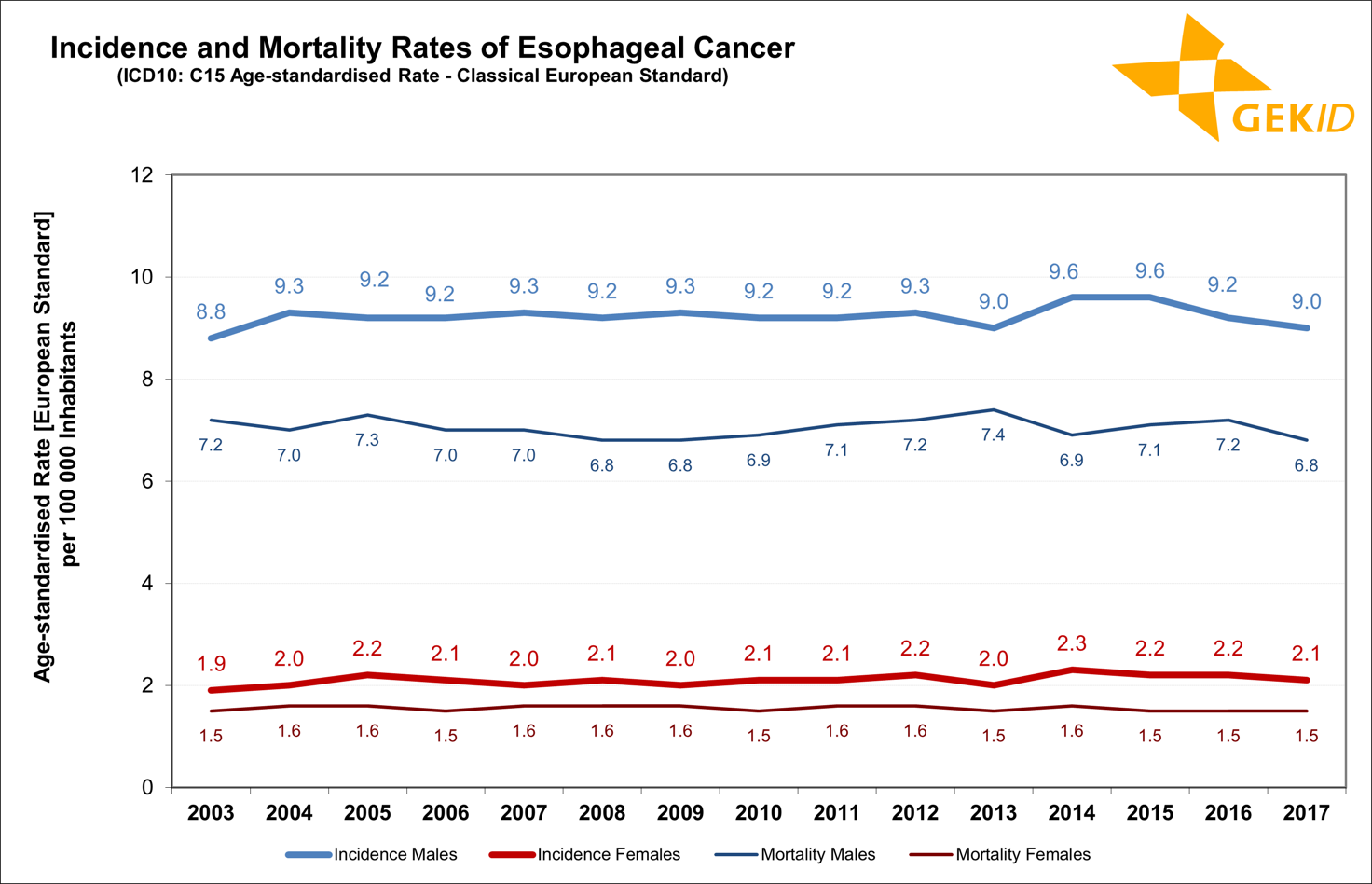
The age-standardized incidence rates and mortality rates for both sexes have remained virtually constant over the last 15 years. It should be noted that the rates for men are significantly higher (factor 3.5) than those for women, see Figure 1.
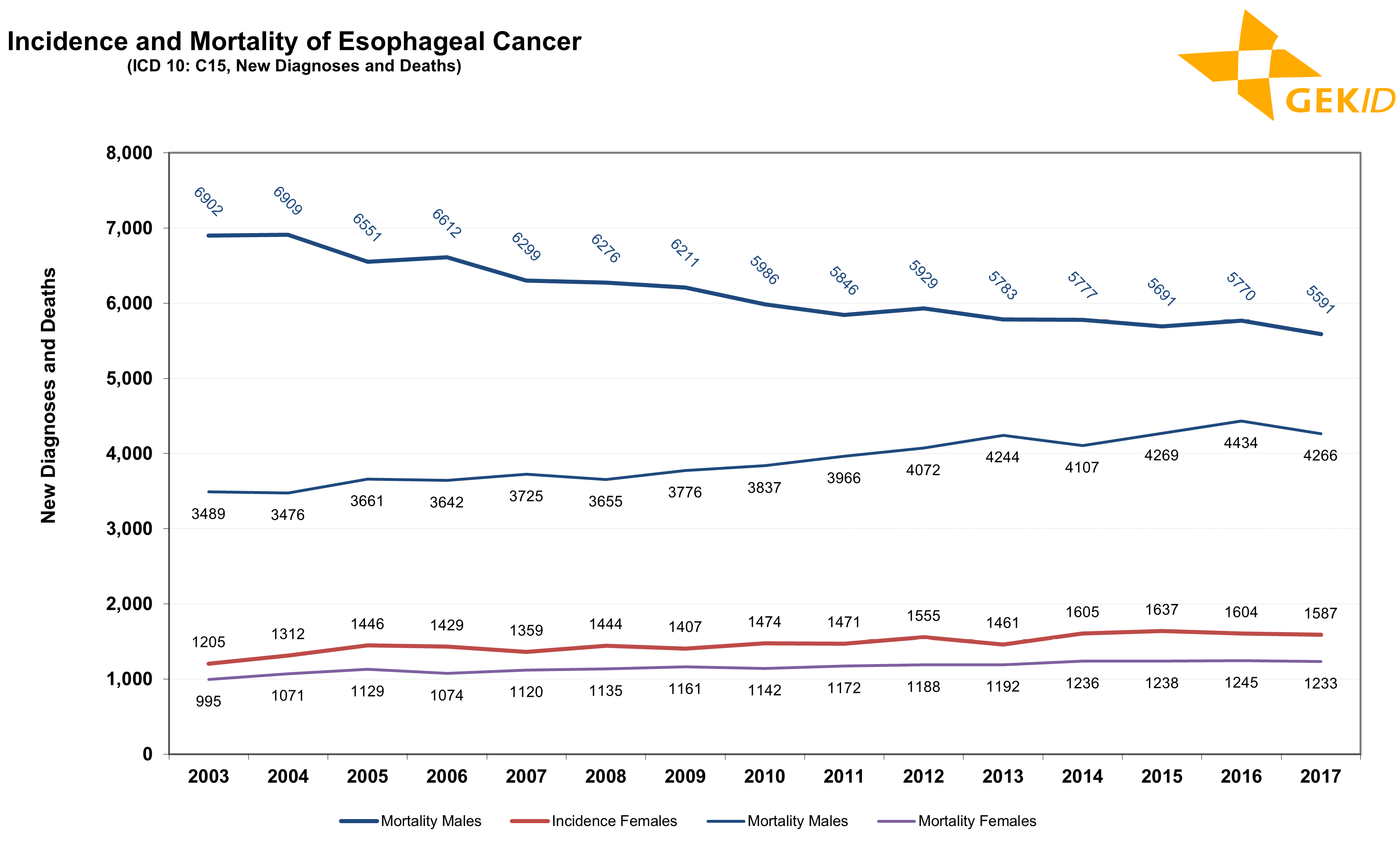
Due to the shift in the age structure towards an older society and because the baby boomers have reached the age of highest probability of disease, the trends in new cases and deaths differ from the trends in rates. This shift has a greater absolute impact on men due to their higher probability of disease, but in relative terms the increase is the same for both sexes. Despite constant age-standardized incidence rates, the number of cases has risen by an average of 1.7% per year over the last 15 years. The situation is similar for the number of deaths. Here, the number rose by an average of 1.7% per year for men and 1.3% per year for women, see Figure 2.
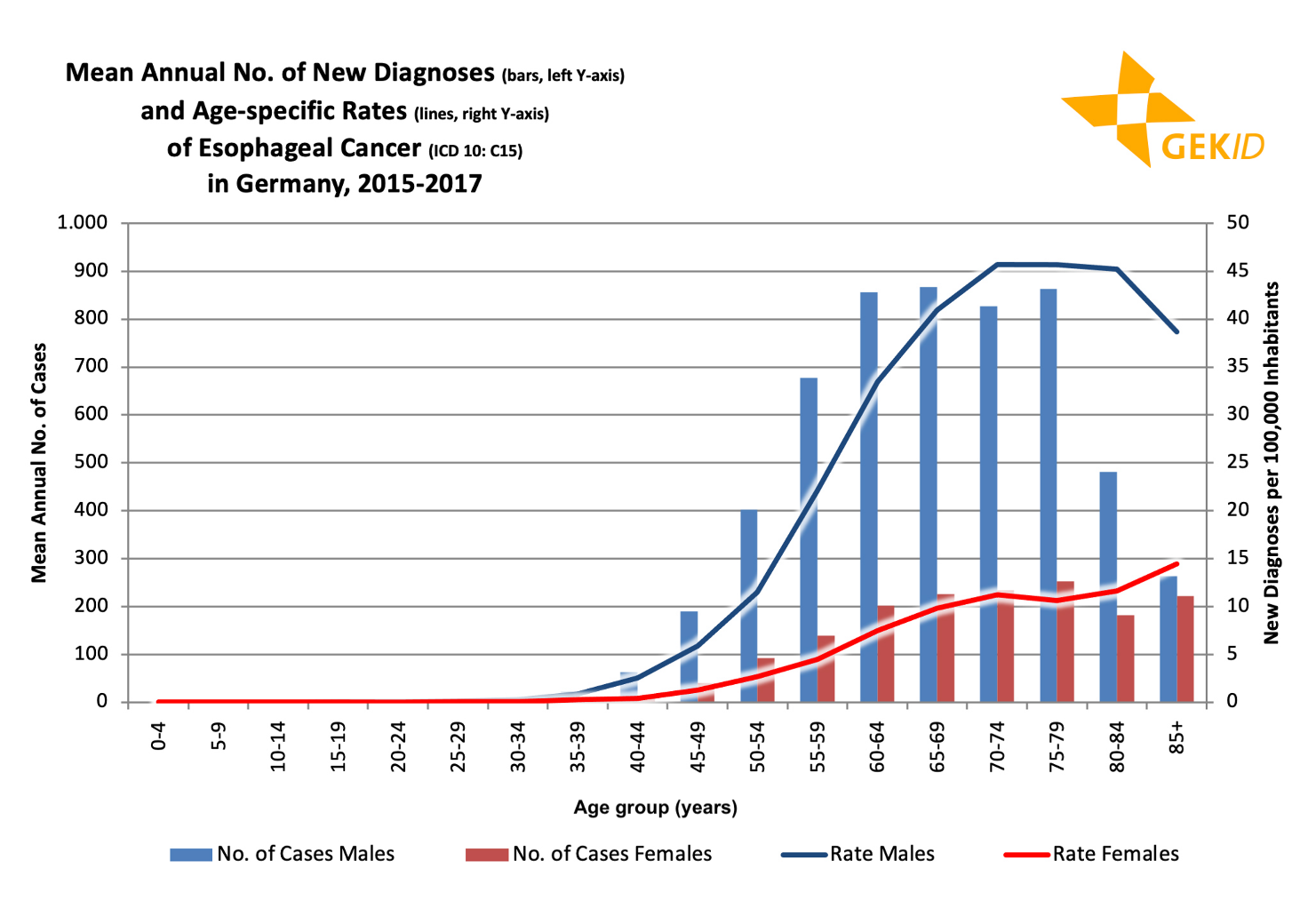
Most cases occur in men between the ages of 70 and 79 years, see Figure 3 (bars). From the age of 50, the number of new cases rises steadily. The number of cases among 65- to 79-year-olds is almost the same, but from the age of 80, the number of cases decreases significantly. In women, the number rises continuously – at a significantly lower level – until the age of 85 and then remains almost constant. The highest risk of disease, see Figure 3 (lines), is found in men between the ages of 75 and 79 and in women, rising steadily to the highest age group. Case numbers and incidence rates for men are significantly higher than those for women in all age groups.
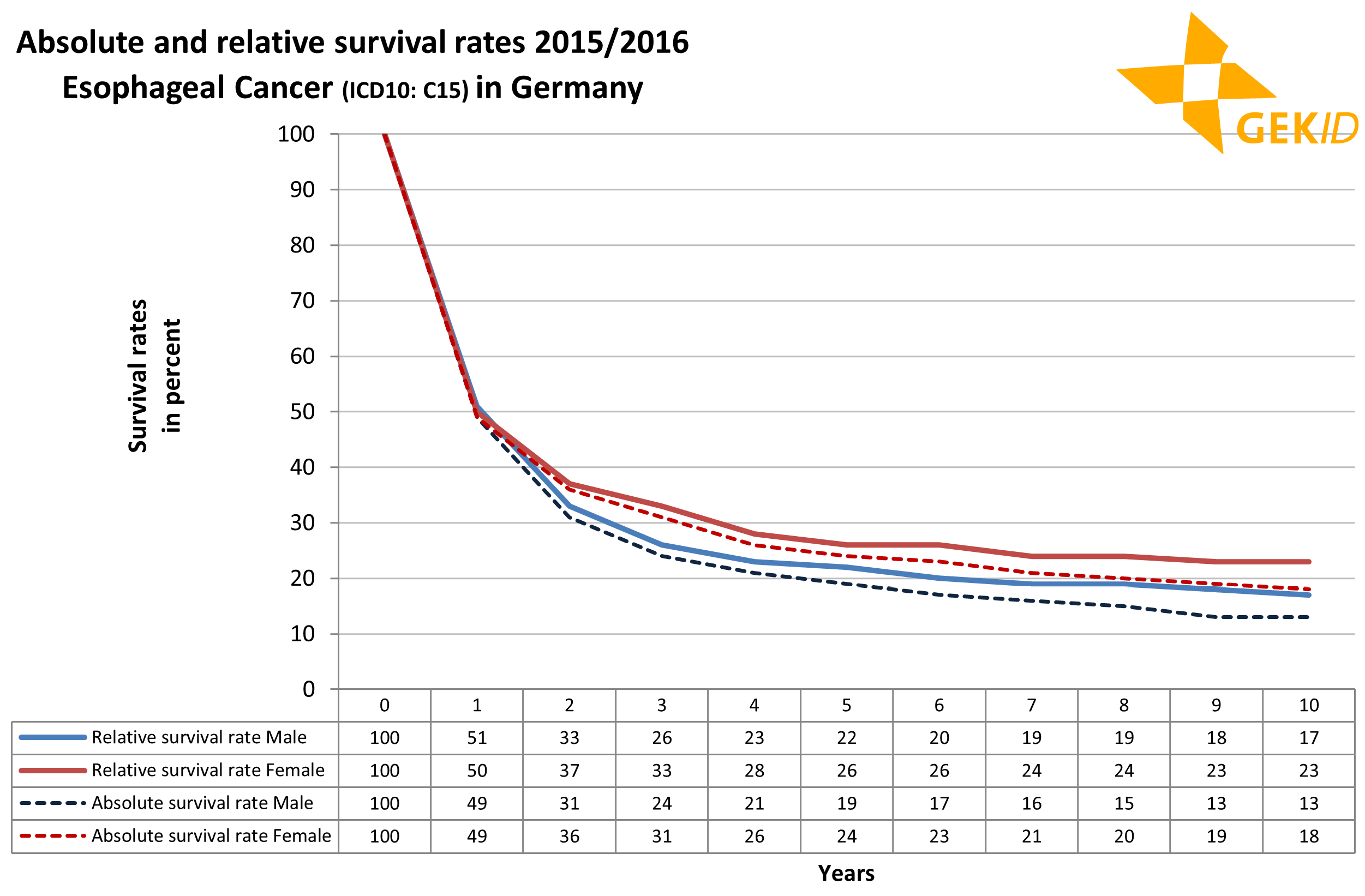
The prognosis for esophageal cancer is relatively poor, especially in the first year after diagnosis. Approximately 50% of patients die within the first year after diagnosis. The small difference between the absolute survival rate (percentage of patients who survive for a certain period of time) and the relative survival rate (ratio of absolute survival to expected survival in the general population) shows the excess mortality caused by cancer. From the fifth year after diagnosis, the gap between absolute and relative survival rates widens, and relative survival rates decline only slightly, meaning that after about five years, there are significantly fewer cancer-related deaths. However, the relative survival rates never reach a completely parallel course to the x-axis, indicating that cancer-related deaths still occur even after 8-10 years. Figure 4 shows the absolute and relative survival rates for the first 10 years after diagnosis, with only minor differences in survival between the sexes.
Based on the current incidence of the disease and the 14th coordinated population projection by the Federal Statistical Office (G2L2W2, moderate development), the number of cases can be expected to increase by around 21% to around 8,500 new cases (2050) over the next 30 years due to the shift in the age structure of the population alone. Due to the relatively low age of onset, especially in men, the expected demographic increase in the number of cases is lower than for most other cancers.
2.3Pathogenesis
Squamous cell carcinomas typically develop as a result of initial mechanical damage, e.g., in achalasia, after radiation therapy or after chemical burns with acids or alkalis, and in combination with toxic carcinogenic substances such as alcohol and nicotine. These carcinogens also lead to secondary squamous cell carcinomas in the head and neck area or in the lungs [5, 6].
The link between carcinoma in the distal esophagus and chronic acid reflux has been thoroughly investigated and is considered a recognized risk factor. The metaplasia of the orthotopic squamous epithelium to a columnar epithelium leads to pre-neoplastic Barrett's mucosa. The risk of developing carcinoma has long been overestimated. The progression rate from Barrett's metaplasia to carcinoma is approximately 0.3% (3 out of 1000 patients) per year [7]. Case-control studies also show an increased risk of developing adenocarcinoma in smokers. The use of non-steroidal anti-inflammatory drugs (NSAIDs), proton pump inhibitors (PPIs), and statins appears to reduce the risk of Barrett's carcinoma progressing to invasive adenocarcinoma [8]. However, due to inconsistent data, pharmacologic prophylaxis cannot be recommended [9].
Pathogenetically, the transformation of the columnar epithelium to columnar epithelial dysplasia occurs via inactivation of p53, which occurs in up to 50% of all squamous cell carcinomas of the esophagus. Other frequently occurring mutations include allele loss in p16 and amplification/overexpression of cyclin D1. Allele losses in the fragile histidine triad (Fhit) gene inactivate this tumor suppressor gene, which is particularly sensitive to the effects of chemical carcinogens [10].
The carcinogenesis of adenocarcinomas that do not originate from Barrett's mucosa occurs in analogy to carcinomas of the rest of the digestive tract, i.e., sequentially in multi-stage processes via precancerous intermediate stages. Low-grade dysplasia develops into high-grade dysplasia and invasive carcinoma. Infection with Helicobacter (H.) pylori might be considered protective against the development of adenocarcinoma of the esophagogastric junction. Conversely, the increased use of H. pylori eradication therapies has been associated with an increase in these carcinomas, although this could also be explained by increased surveillance [11].
2.4Risk factors
The risk factors vary depending on the histology and location. Squamous cell carcinomas are often associated with alcohol and nicotine abuse. In contrast, carcinomas of the esophagogastric junction are more commonly associated with obesity and gastroesophageal acid reflux. Nicotine abuse is a common risk factor for cancer development.
The risk of developing esophageal carcinoma is increased by the following factors [6]:
Squamous cell carcinomas:
Smoking and alcohol, dose-dependent
Male gender
Tylosis (autosomal dominant dys-/hyperkeratosis of the feet and hands): up to 90% develop squamous cell carcinoma of the esophagus
Achalasia
Stenosis resulting from chemical burns with alkalis or acids
Prior radiation therapy in the neck/thorax area (dose-dependent)
Previous diagnosis of squamous cell carcinoma in the head/neck area or lungs
Adenocarcinomas:
Gastroesophageal reflux disease (GERD): Barrett's esophagus
Smoking
Obesity
Achalasia
Stenosis resulting from chemical burns with acids or alkalis
3Prevention and early detection
3.1Prevention
The recommendations for preventing esophageal cancer refer to the acquired risk factors identified to date [9]:
Avoid excessive alcohol consumption
Avoiding tobacco consumption
Nutrition rich in fruits and vegetables
Treatment of gastroesophageal reflux disease
No recommendation can currently be made for pharmacologic prophylaxis (aspirin, antioxidants), although case-control studies suggest that aspirin reduces the risk [12]. However, even at low doses, the risk of gastrointestinal bleeding is significantly increased by 14% [13].
3.2Early detection
No early detection measures have been established for the general population in Germany, and their impact on the development of esophageal cancer or the prognosis would be difficult to prove due to the low incidence. In some Asian countries, general screening is being discussed due to the higher prevalence.
For patients with Barrett's esophagus, regular check-ups using endoscopy and a 4-quadrant biopsy every 2 cm are common practice. However, there is no data available on effective risk reduction with a decrease in cancer-specific mortality [14].
4Clinical characteristics
4.1Symptoms
Early-stage carcinomas are usually asymptomatic. The following symptoms often only occur in locally advanced tumors with obstruction of approximately two-thirds of the esophageal lumen or in metastatic carcinomas:
Dysphagia, odynophagia
Recurrent vomiting, nausea
Loss of appetite
Early satiety
Weight loss, asthenia
Thoracic pain
Gastrointestinal bleeding, anemia
5Diagnosis
5.1[chapter not relevant]
5.2Diagnostics
5.2.1Initial diagnosis/local findings
Endoscopy is the most important and usually primary method for diagnosing esophageal cancer. The aim is to determine the location and extent of the tumor and to detect metaplastic changes in the epithelium of the lower esophagus (Barrett's esophagus). High-resolution video endoscopy makes it possible to detect even subtle changes in the color, relief, and architecture of the mucosa. The endoscopic detection of dysplasia and early carcinomas can be improved by chromoendoscopy (e.g., Lugol's solution) or by computer-assisted digital procedures (e.g., narrow-band imaging) in the endoscope [15, 16].
Since the prognosis for patients with esophageal carcinoma is closely correlated with local tumor spread and lymph node involvement, the most accurate pre-therapeutic staging possible is required for therapy management. The goals of diagnostics are to determine the stage of the disease and to assess the patient's ability to tolerate cancer treatment. The depth of tumor invasion (T category) and its location in relation to adjacent structures play a particularly important role here, and endosonography can improve the accuracy of predictions in this regard (see Table 1). Due to its high local resolution, endosonography has the highest accuracy of all procedures. Data (evidence level 1b) from Russell et al. [17] suggest that consistent EUS tumor staging in esophageal carcinomas leads to improved survival rates in patients examined by EUS (approximately 3 months compared to the control group). Limitations are the dependence on examiner’s skills and, in case of highly stenosing tumors, the limited technical feasibility.
5.2.2Staging
5.2.2.1Sonography
B-mode sonography is the initial imaging procedure used in staging diagnostics to rule out liver metastases. The additional use of contrast-enhanced sonography results in increased sensitivity and specificity. In addition, B-mode sonography of the neck can be used to rule out cervical lymph node metastases, which are present in 10-28% of patients, especially if the primary tumor is located on the cervical or upper intrathoracic level.
5.2.2.2X-ray Barium swallow
Barium swallow X-ray should not be used to diagnose esophageal cancer.
5.2.2.3Computed tomography (CT)/multidetector computed tomography (MDCT)
In patients with newly diagnosed esophageal carcinoma, a CT scan of the neck/thorax and abdomen with multiplanar reconstructions and additional wall distension using neutral contrast medium and intravenous contrast medium should be performed for primary staging. It is recommended that the neck be imaged using current fast scanner technologies, which then eliminates the need for a supplementary ultrasound of the neck.
5.2.2.4Magnetic resonance imaging (MRI)
MRI can be performed as a substitute procedure if CT cannot be performed (contrast agent contraindications) or as a supplementary procedure to CT/EUS. MRI is particularly useful in assessing tumors in the esophagogastric junction and in the assessment of liver metastases (with the use of liver-specific contrast agent). It is less accurate than CT for pulmonary lesions.
5.2.2.5Positron emission tomography (PET/CT)
In cases of locally advanced tumors (cT2-4 and cN+), PET/CT can also be used for M staging if curative treatment is intended or if the result has clinical consequences. The evaluation of PET/CT in esophageal cancer varies considerably in the international literature. Several meta-analyses have assessed PET/CT in the context of primary staging [18, 19, 146] and confirmed its high diagnostic specificity, but low sensitivity, particularly with regard to locoregional lymph node metastases. Although the false-negative rate is not insignificant, the detection of locoregional lymph node metastases in PET/CT has the clinical consequence of expanding the radiation volume or extending lymph node dissection.
Note on reimbursement: in the context of the German outpatient specialist care (ASV) for patients with severe disease progression, PET or PET/CT is included for the detection of distant metastases in gastrointestinal tumors and tumors of the abdominal cavity.
The usefulness of PET/CT in assessing the response to (radio)chemotherapy is highly controversial. Although most studies show a strong correlation between metabolic response in PET/CT and clinical/histopathological response, there are no studies to verify the cut-off values in order to derive decisions for surgical resection. Based on this situation, PET/CT cannot be routinely recommended for this setting.
5.2.2.6Assessment of operability
In the case of potentially resectable tumors, an extended anesthesiological assessment should be carried out to clarify functional operability in patients who often have comorbidities. This assessment should include age, nutritional status, comorbidities, cardiopulmonary and hepatic pre-existing conditions (alcohol history, cirrhosis?), and functional "reserve". A geriatric assessment is also recommended for patients aged 70 years and over.
In various studies, systematic recording of risk factors showed a good correlation with postoperative morbidity and mortality. For esophageal surgery, for example, the "Cologne Risk Score" and "O-Possum for Esophagectomy" are available [20, 21].
Histopathological reports on resected tissues (endoscopic resection; ER) should include the following information:
Size of the neoplastic lesion in 3 dimensions
If applicable, grading of dysplasia or intraepithelial neoplasia according to WHO
Histological type according to WHO (in particular, discrimination between squamous cell carcinoma and adenocarcinoma, other rare types)
Immunohistochemical information on the biomarkers PD-L1 (as a combined score CPS and as a proportion of positive tumor cells TPS), HER-2, and microsatellite status (both in adenocarcinomas)
For invasive carcinomas:
Degree of differentiation (grading) according to current WHO classification
Maximum depth of invasion: pT1a (mucosa m1, m2, m3, m4), pT1b (submucosa sm1, sm2, sm3) plus depth of invasion in µm (or higher pT category)
Lymphatic and/or venous invasion
Summary assessment of the risk of lymph node metastasis:
Low risk vs. high risk
Resection margins with regard to the neoplasia: in the case of ER in toto, circular and basal resection margin; in the case of "piece-meal" ER, basal resection margin, since the circular resection margin must generally be assessed histopathologically as “RX” here.
After neoadjuvant therapy, restaging should be performed to rule out metastases. If there is clinical evidence of tumor progression during neoadjuvant therapy, symptom-oriented diagnostic procedures are recommended for further treatment planning [9].
5.3Classification
5.3.1Classification according to tumor location
Depending on the location (distance from tooth row, TR) and the positional relationships within the chest, the current TNM classification, 8th edition [22], distinguishes between carcinomas
of the cervical esophagus (C15.0): from the lower edge of the cricoid cartilage to the entry of the esophagus into the thorax (suprasternal notch), approximately 18 cm from TR
of the intrathoracic esophagus
upper thoracic section (C15.3): from the entry of the esophagus into the thorax to the level of the tracheal bifurcation, 18 to 24 cm from TR
Middle thoracic section (C15.4): upper half of the esophagus between the tracheal bifurcation and the esophagogastric junction, 24 to 32 cm from TR
Lower thoracic section (C15.5): distal half of the esophagus between the tracheal bifurcation and the esophagogastric junction. The lower boundary is the Z-line approximately 40 cm from the TR
of the esophagogastric junction (C16.0): Tumors that involve the esophagogastric junction and whose center lies within 2 cm above or below the Z-line and crosses it (Siewert types I and II), synonym GEJ (adenocarcinoma of the gastroesophageal junction)
Type I: primary tumor in the distal esophagus
Type II: primary tumor in the cardia of the stomach
Type III: adenocarcinoma of the subcardial stomach (belongs to gastric carcinomas)
5.3.2Stages and staging/TNM
The classification of the extent of the primary tumor and metastasis is based on the UICC/AJCC TNM criteria. Since 2017, the 8th edition has been used in Europe [22]. The TNM criteria are summarized in Table 2, the staging for squamous cell carcinomas in Table 3, and for adenocarcinomas in Table 4.
Regional lymph nodes (LNs) are those located in the lymphatic drainage area of the esophagus. This includes the celiac LNs and the paraesophageal lymph nodes of the neck, but not the supraclavicular lymph nodes.
5.3.3Histological subtypes
Carcinoma in situ (CIS): macroscopically raised or flat epithelial thickening or sunken thinning of the mucosal epithelium, appearing whitish (leukoplakia), reddish (erythroplasia), or unchanged in color (occult type). Solitary in 10-20% of cases and multiple in 80-90% of cases.
Polypoid carcinoma: most common, accounting for approx. 60% of cases.
Diffuse infiltrating carcinoma: approx. 15% of cases.
Ulcerative carcinoma: in about 25% of cases, the tumor appears as an irregularly defined hemorrhagic ulcer with raised wall-like edges.
Varicose carcinoma: tumors resembling esophageal varices in their endoscopic and radiological appearance.
5.3.4The Cancer Genome Atlas (TCGA) classification
Current studies divide esophageal carcinoma into three molecular subtypes [23]:
BRCA and BRCA-like mutations (BRCAness) and alteration of DNA repair genes by homologous recombination (HRD)
Mutation patterns with predominant T>G base exchange and an association with a high mutation burden and the emergence of neoantigens
Mutation patterns with predominant exchange of the bases C>A and an association with accelerated cell aging.
These subtypes have no impact on everyday clinical practice and therapeutic decisions to date.
6Therapy
6.1Treatment structure
Due to the complex treatment options, recommendations should always be discussed and decided on a multidisciplinary basis (multidisciplinary tumor board).
In addition to tumor-specific factors, patient-specific factors play a particularly important role, as comorbidities with potential cardiovascular, pulmonary, or hepatic limitations, which can significantly complicate therapy and lead to so-called functional inoperability in resectable tumors [11] are often present in these patients,
Many patients are in poor general condition at the time of diagnosis, and severe malnutrition is particularly common in squamous cell carcinoma. Due to the high metabolic risk, patients should be fed before surgery, even if this means postponing the operation. After surgery, (parenteral) nutrition should be started early (within 24 hours).
More than 50% of patients with esophageal cancer are over 65 years of age at first diagnosis. Nevertheless, there is still little data available on the treatment of patients over 70 years of age. Older British reports suggest that the advantage of preoperative chemoradiotherapy over surgery alone decreases with age and is no longer significant for patients over 65 years of age. A randomized British study (GO2 study) in metastatic disease shows, at least for older patients with adenocarcinoma, that a primary dose-reduced vs. standard chemotherapy does not worsen the prognosis, but improves the quality of life during therapy [136] (see chapter 6.1.4.1.2).
The treatment decision is primarily based on the T category and the presence of distant metastasis. Lymph node involvement is only a secondary factor in the treatment algorithms.
A treatment algorithm is shown in Figure 5 for resectable squamous cell carcinomas, in Figure 6 for resectable adenocarcinomas, and in Figures 7 to 10 for metastatic tumors.
1 More than 16 cm distal from tooth row
2 m=mucosal, sm=submucosal
3 Risk factors: ulceration, L1, V1, G3, R1 basal, deep submucosal invasion
4 R0 resection if ypT ≥1 or ypN ≥1
1 GEJ: Adenocarcinoma of the gastroesophageal junction
2 Risk factors: ulceration, L1, V1, G3, R1 basal deep submucosal invasion, multifocal/non-resectable Barrett's lesions
3 Particularly critical indication for postoperative chemotherapy in MSI-high adenocarcinomas
*Currently (October 2025) off-label, but significant advantage in event-free survival and overall survival demonstrated in the randomized placebo-controlled phase III Matterhorn study [122, 150].
6.1.1T1a N0 M0 (early-stage carcinomas)
Since the likelihood of lymph node metastasis in mucosal esophageal carcinoma (T1a) is very low at 1-2%, mucosectomy by endoscopic resection (ER) is considered the standard of care for early adenocarcinoma in category pT1 m1-sm1, and for early squamous cell carcinoma in category pT1 m1-m2. The aim should be en-bloc resection, which allows complete histological assessment of the lateral and basal margins. The goal of the procedure must be R0 resection. Endoscopic mucosal resection (EMR/ER) and endoscopic submucosal dissection (ESD) [24] are available techniques. EMR is well established in Europe. However, it can only be used to completely resect lesions up to a maximum of 15 mm en-bloc. Larger tumors must be resected using the "piecemeal" technique, which increases the risk of incomplete resection. In Barrett's neoplasia, up to 30% of cases experience a relapse or secondary manifestations after EMR [25]. Data for ESD are currently available mainly from Asian countries for squamous cell carcinoma. Here, ESD has been shown to be superior in terms of en-bloc resection rate, curative resection rate, and local recurrence rate. Data from Japan show that ESD is also possible in principle for Barrett's carcinoma and that R0 resection can be achieved in 85% of cases. However, the benefit of ESD in adenocarcinoma/Barrett's carcinoma has not been conclusively clarified [25, 26].
In patients with superficial mucosal infiltration of squamous cell carcinoma without risk factors (T1m3, L0, V0, G1/2, < 20 mm, no ulceration), endoscopic resection may be a sufficient alternative to surgery after multidisciplinary discussion.
In the presence of the following risk factors, surgical resection of the tumor should be performed instead of endoscopic resection [9]:
Tumor residue at the basal resection margin (R1 basal)
Multifocal or non-resectable Barrett's lesions
After endoscopic resection and histopathological diagnosis of a tumor of category T1sm1-3 (squamous cell carcinoma) or T1sm2-3 (adenocarcinoma), surgical resection with systematic lymphadenectomy should be performed. Surgical resection should always be considered if lymphatic or venous invasion (L1, V1), a differentiation grade of G3, or deep submucosal invasion (>500 µm) is present after ER [9]. In squamous cell carcinomas, definitive chemoradiotherapy is an alternative to surgical resection. The rate of grade III esophageal stenosis after ER and radiochemotherapy is around 6%. Some patients require repeated dilatations.
Since local recurrence limited to the mucosa after ER or early secondary carcinoma can be treated endoscopically with curative intent, regular endoscopic follow-up examinations are indicated. The recommended follow-up intervals are 3 months in the first year and 6 months in the second year. Thereafter, follow-up examinations should take place annually.
In Barrett's esophagus, the non-neoplastic Barrett's mucosa should be thermoablated after successful endoscopic resection, as this can reduce the rate of secondary neoplasms.
6.1.2T1b-T2 M0 (localized tumors)
In esophageal carcinomas of category pT1b (invasion of the submucosa), the risk of lymph node metastases is between 7% and 35%, with squamous cell carcinomas having a higher risk than adenocarcinomas.
The treatment of choice for thoracic carcinomas and carcinomas of the esophagogastric junction is primary surgical resection with complete removal of the tumor orally, aborally, and circumferentially, as well as the regional lymph nodes. The type and extent of the surgery and the associated lymph node dissection depend on the location of the tumor and any affected lymph nodes; see chapter 6.2.1. Treatment modalities – Resection. The value of perioperative or adjuvant chemotherapy for patients with T1b carcinomas is not proven, regardless of lymph node involvement. Regardless of the tumor location in the esophagus and the histology (adenocarcinoma or squamous cell carcinoma), definitive chemoradiotherapy is an alternative for patients who are not suitable for surgery due to comorbidities, with the aim of achieving long-term locoregional tumor control [147]. For patients with adenocarcinoma, endoscopic resection may be the treatment of choice for tumors in category T1b despite the increased risk of recurrence [9].
In the case of a T2 tumor, especially in cases of high-grade suspected or evidence of lymph node metastases, the use of multimodal therapy concepts, as described below for T3/T4 tumors (see chapter 6.1.3), may be appropriate. The recommendation for such an approach should be discussed on a multidisciplinary basis, and the advantages and disadvantages should be discussed with the patient [27]. In any case, patients with T2 tumors were also included in the published randomized studies on perioperative chemotherapy [28] and preoperative chemoradiotherapy [29]. A significant survival benefit has not yet been demonstrated in this subgroup [30, 31].
If preoperative therapy is applied, care must be taken to ensure that the goal of secondary tumor resection is not jeopardized. Any deterioration in the patient's general condition must be recognized at an early stage and its cause assessed (toxicity, non-response with persistent or increasing symptoms due to the tumor). In these cases, preoperative chemotherapy should be shortened, if necessary, malnutrition should be treated preoperatively, and - provided that distant metastases have been ruled out - surgery should be brought forward.
6.1.3T3-T4 M0 (locally advanced tumors)
Both squamous cell carcinomas and adenocarcinomas of the esophagus and GEJ carcinomas should be treated with multimodal therapy concepts from category cT3 onwards. For squamous cell carcinomas, preoperative chemoradiotherapy should be performed in addition to curative resection. Patients with adenocarcinoma of the esophagus or esophagogastric junction (GEJ) should receive perioperative chemotherapy with or without immunotherapy (FLOT/D-FLOT regimen) [111, 122, 150].
In the CROSS study, preoperative chemoradiotherapy showed a survival benefit for both histological subgroups (median OS 49 versus 24 months, HR 0.66, p=0.003), which, however, was only significant for the squamous cell carcinoma group after long-term observation [30]. In this randomized study, 368 patients (75% of whom had adenocarcinoma) were treated with preoperative chemoradiotherapy up to 41.4 Gy in combination with weekly administration of carboplatin and paclitaxel plus subsequent surgery or underwent primary surgery. The positive effect of chemoradiotherapy was more pronounced in patients with squamous cell carcinoma (10-year survival rate 46% vs. 23%, HR 0.48, p=0.007), but also existed in patients with adenocarcinoma (10-year survival rate 36% vs. 26%, HR 0.73; p=0.061). Postoperative complications were comparable in both groups [28]. The high patient selection must be taken into account when evaluating this study. Almost exclusively patients with tumors of the distal esophagus/GEJ in excellent general condition (84% AZ grade 0 according to WHO) were included, as were patients with early tumors (17% category T1 or T2). Further studies have shown that even in patients with locally advanced carcinomas, 5-year survival rates of over 40% are possible after optimized radiotherapy in combination with platinum/taxane-based chemotherapy and surgery.
After preoperative CRT and surgery, adjuvant immunotherapy with nivolumab for 12 months is recommended for squamous cell carcinomas that were R0-resected and for which no pathological complete remission has been achieved. This recommendation is based on data from the international phase III CheckMate 577 study. In this study, 794 patients were randomized to receive placebo or nivolumab for 1 year after completing preoperative chemoradiotherapy and recovering from the subsequent surgery [33]. The results show that immunotherapy is well tolerated and does not impair the quality of life of patients compared to placebo. The primary endpoint was achieved with a significant prolongation of disease-free survival (median from 11.0 to 22.4 months, p=0.0003, HR 0.69 (CI 0.56-0.86)). Nivolumab particularly reduced the rate of distant recurrence (29% vs. 39%). Patients with carcinomas of both histologies benefited significantly (HR 0.61 for squamous cell carcinomas, HR 0.75 for adenocarcinomas). The result did not differ between PD-L1-positive (72% of patients) or negative tumors, whereby only tumor cells prior to chemoradiotherapy were considered for the assessment (PD-L1 TPS ≥ 1% or <1%). The DFS in the control arm appears short, with a median of 11 months. Based on these data, the European Commission granted approval in September 2021 for adjuvant immunotherapy with nivolumab for both histological types, regardless of PD-L1 status, in Europe. Data on the secondary endpoint of OS were reported for the first time at ASCO 2025 [140]. With a median follow-up of 78.3 months, nivolumab showed a trend toward improvement in median OS of 16.4 months and higher 5-year OS rates compared to placebo (HR 0.85 [95.87% CI 0.70–1.04]). The improvement in OS was only evident in patients with PD-L1 CPS ≥ 1 (HR 0.79 [95% CI 0.64–0.99]), while PD-L1-negative patients even appeared to be disadvantaged by adjuvant nivolumab therapy (HR 1.40). Notably, in the subgroup analysis, patients with adenocarcinoma (HR 0.92) and tumors at the gastroesophageal junction (HR 1.12) showed no benefit from adjuvant immunotherapy.
If patients with adenocarcinoma have been treated with chemoradiotherapy preoperatively according to the CROSS protocol rather than perioperatively with D-FLOT, the recommendation for adjuvant therapy with nivolumab still applies.
6.1.3.1Locally advanced squamous cell carcinoma*
*see Figure 5
For cervical (almost always squamous cell) carcinomas of the esophagus, definitive chemoradiotherapy is considered the standard therapy [41]. Only a few centers in Europe perform surgical resection (usually with laryngectomy) for tumors in this location. It should be noted that resections up to the upper esophageal sphincter are associated with a high complication rate and high postoperative morbidity, such as dysphagia, aspiration tendency, and recurrent laryngeal nerve palsy, so that surgery should not be performed for cervical esophageal carcinomas.
Definitive radiotherapy alone without chemotherapy, preoperative radiotherapy without chemotherapy, or preoperative chemotherapy are not currently recommended for squamous cell carcinoma of the esophagus [35]. Initial data from a Japanese multicenter study (NEXT study) suggest that preoperative chemotherapy improves the prognosis [73]. In this 3-arm study, 2 courses of standard chemotherapy (cisplatin/5-FU) were compared with 3 courses of intensified chemotherapy (docetaxel/cisplatin/5-FU) or combined chemoradiotherapy (41.4 Gy + 2 courses of cisplatin/5-FU). Of the 200 patients in each treatment group, more than 98% had squamous cell carcinoma, with approximately one-third in categories cT1 and cT2. Compared to cisplatin/5-FU, only the intensified chemotherapy regimen significantly improved OS (3-year survival rate 72% vs. 63%, HR 0.68 (0.50-0.92)), but not by combined CRT (3-year survival rate 68% vs. 63%, HR 0.84 (0.63-1.12)). CRT was only superior in terms of histological tumor response (pathological complete remission 37% with CRT vs. 19% with DCF vs. 2% with CF). The rate of postoperative complications did not differ between the treatment groups. The results of the NEXT study also show that increased pCR rates, as can be achieved with combined CRT, do not necessarily translate into prolonged survival. In Europe, preoperative chemotherapy alone is not standard treatment for squamous cell carcinoma of the esophagus.
Evidence that adjuvant radiotherapy may improve local tumor control and possibly OS from Asian studies and meta-analyses [36, 37] should be verified in phase III studies with "Western" patients. Adjuvant radiotherapy (or chemoradiotherapy) is not a standard of care.
6.1.3.2Locally advanced adenocarcinoma of the esophagus/GEJ*
*see Figure 6
6.1.3.2.1Perioperative therapy
In patients with adenocarcinoma of the esophagus or esophagogastric junction (GEJ) of category ≥T3 or N+, perioperative chemotherapy is an evidence-based and well-established treatment option and the standard of care. Based on data from the FLOT-4 study, perioperative chemotherapy consisting of taxane, platinum derivative, and fluoropyrimidine (5-fluorouracil/folinic acid/oxaliplatin/docetaxel, FLOT) has been considered the standard therapy for patients with locally advanced GEJ tumors (≥cT2 and/or cN+). FLOT led to a significant prolongation of progression-free survival (PFS) (hazard ratio [HR] 0.75) and overall survival (OS) (HR 0.77 (0.63-0.94), p=0.012). This effect was consistent across all relevant subgroups, such as age, histological type, or location. The rate of perioperative complications was comparable in both arms [28]. Perioperative therapy with FLOT has also been effective for patients with signet ring cell carcinoma or MSI-H/dMMR [32].
For locally advanced gastroesophageal junction tumors (≥T2 and/or ≥N1), neoadjuvant chemoradiotherapy (CRT) with carboplatin/paclitaxel according to the CROSS protocol has also been a treatment option according to guideline recommendations. Until recently, comparative data between preoperative chemoradiotherapy and perioperative chemotherapy in locally advanced GEJ did not show a statistically significant survival benefit from additional radiotherapy. Data from the phase III Neo-AEGIS study show no difference in OS (3-year survival rate 55% vs. 57%, HR 1.03 (0.77-1.38) between (now outdated) perioperative chemotherapy (90% of patients received epirubicin/platinum/fluoropyrimidine) and preoperative chemoradiotherapy analogous to the CROSS study [74]. Approximately 80% of patients had cT3 GEJ.
The ESOPEC study has been the first head-to-head study to compare both treatment concepts for esophageal adenocarcinoma: perioperative chemotherapy with FLOT versus neoadjuvant CRT according to CROSS [111]. The primary endpoint of the study was OS. Patients with cT1N+ or cT2-4a, cN0/+, cM0 were included. With a median follow-up of 55 months, the study showed a significant advantage in median OS of 66 months with FLOT versus 37 months with CROSS (HR 0.70) and a 3-year survival rate of 57.4% versus 50.7% in the ITT population, respectively. Thus, patients treated with FLOT had a 30% lower risk of death after 3 years than those who received chemoradiotherapy according to the CROSS protocol. This benefit was present in all subgroups, but with a particular effect in T3-4 (HR 0.70) and N+ tumors (HR 0.68). The 3-year PFS was also significantly improved for the FLOT arm in the ITT population (51.6% vs. 35%; HR 0.66, p=0.001). The rate of complete pathological remissions, defined as ypT0, ypN0, was also improved in favor of neoadjuvant chemotherapy, at 16.8% with FLOT compared to 10.1% with CROSS. Critics note that in the CROSS group, neoadjuvant therapy was only fully administered in 67.7% of cases (even though 98% had received the planned 41.4 Gy), compared to 87.3% complete administration of neoadjuvant therapy in the FLOT group. In the meantime, data on the cumulative incidence of relapse from the resected patient population with regard to distant and local relapse have also been presented. These show a 16% reduction in the distant recurrence rate in the FLOT arm compared to the CROSS arm (HR 0.59; p=0.002) with comparable incidences of local recurrence (HR 1.0; p=0.99) [129]. Due to the superiority of perioperative chemotherapy versus chemoradiotherapy demonstrated in the ESOPEC study, FLOT has become the standard therapy for locally advanced GEJ tumors. There is no comparison with neoadjuvant chemoradiotherapy according to CROSS, followed by consolidating immunotherapy with nivolumab according to CheckMate 577 in cases of R0 resection without pCR.
The AIO-RACE study is investigating whether a combination of both forms of therapy offers additional benefits. It compares the current standard of perioperative chemotherapy with FLOT with induction chemotherapy with 2 cycles of FLOT followed by chemoradiotherapy (5-FU/oxaliplatin). The primary endpoint is disease-free survival (DFS). Recruitment was recently completed.
There is currently no established indication for pre- or postoperative radiotherapy, regardless of the underlying tumor subtype. Following publication of the ESOPEC and TOPGEAR studies, this applies to subcardial gastric carcinomas and adenocarcinomas of the esophagogastric junction [111, 128, 129].. Only after R1 resection can adjuvant chemoradiotherapy be considered (see 6.1.3.2.5).
6.1.3.2.2Significance of perioperative immuno-oncological therapy in pMMR/MSS GEJ tumors
Additional treatment with a PD-L1- or PD-1-targeted immune checkpoint inhibitor in combination with FLOT chemotherapy resulted in an increased histopathological response rate [119, 122, 123]. Most recently, the phase III MATTERHORN study demonstrated an improvement in event-free survival when the PD-L1 inhibitor durvalumab was added to perioperative FLOT chemotherapy and continued for up to a total duration of one year following combined chemoimmunotherapy. The two-year event-free survival rate (Kaplan-Meier estimate) was 67.4% in participants in the durvalumab group and 58.5% in participants in the placebo group (HR for event or death: 0.71; 95% confidence interval [CI]: 0.58-0.86; p < 0.001). The final OS data were presented at ESMO 2025 [150]. With a follow-up period of 43 months, there was a significant prolongation of OS in favor of D-FLOT therapy (HR 0.78, p=0.021). The benefit was independent of PD-L1 expression. These results confirm the therapeutic benefit of D-FLOT as standard therapy for all patients with locally advanced gastroesophageal adenocarcinoma. The addition of durvalumab to perioperative therapy with FLOT is currently not approved, but should be submitted for reimbursement as off-label use regardless of PD-L1 status.
There is currently no indication outside of clinical trials for perioperative immunotherapy alone without chemotherapy in microsatellite-stable tumors. Adjuvant immunotherapy proved to be insufficiently effective in the EORTC1707 VESTIGE study (nivolumab and ipilimumab) and in the Asian ATTRACTION-5 study (nivolumab and chemotherapy) [126, 127].
6.1.3.2.3Significance of anti-HER2-directed perioperative therapy
The longest established molecular target structure in gastric cancer/GEJ is the HER2 oncogene. Up to 30% of adenocarcinomas of the stomach and esophagus are HER2-positive. Supplementing chemotherapy by HER2-targeted treatment with trastuzumab improves OS in patients with advanced HER2-positive gastric cancer and GEJ [82]. The treatment of locally advanced adenocarcinomas continues to be independent of HER2 status. The role of HER2-targeted therapy in resectable disease in the perioperative setting has not yet been conclusively clarified, but current studies show an increase in efficacy through the additional perioperative use of anti-HER2-targeted therapy.
The phase II PETRARCA study investigated the efficacy of additional HER2-targeted therapy with trastuzumab and pertuzumab to perioperative FLOT [39]. pCR rates were significantly higher in patients who received HER2-targeted therapy perioperatively (35% vs. 12%, p=0.02), while R0 resection rates were comparable in both groups (93% vs. 90%). The improved local response translated into significantly longer disease-free survival and a trend toward better OS with anti-HER2-targeted therapy. However, the study was terminated prematurely and the number of cases was small.
The multinational EORTC1203-INNOVATION study shows promising response rates for the combination of FLOT + trastuzumab with good feasibility of the regimen, while FLOT + trastuzumab + pertuzumab did not prove successful due to increased toxicity. According to current data, neither trastuzumab alone nor trastuzumab + pertuzumab led to improved survival [114]. After discussion in the multidisciplinary tumor board, primary systemic therapy with FLOT plus trastuzumab may be considered in cases of questionable R0 resectability in locally advanced HER2-positive carcinomas of the stomach or GEJ in order to achieve resectability (so-called conversion chemotherapy). However, trastuzumab is not approved for this indication.
6.1.3.2.4Significance of perioperative immuno-oncological therapy in dMMR/MSI-H GEJ tumors
Based on retrospective data analyses, doubts have been raised about the efficacy of perioperative chemotherapy in microsatellite-instable localized GEJ tumors [120]. However, current data from the DANTE study show that complete and subtotal tumor remissions can also be achieved with FLOT chemotherapy in GEJ tumors of the MSI subtype [72, 120]. Thus, according to the current state of knowledge, perioperative chemotherapy with the FLOT regimen remains indicated for MSI-GEJ tumors if tumor reduction is aimed for. However, several studies show that the addition of an immune checkpoint inhibitor to neoadjuvant therapy in cases of deficient DNA mismatch repair/microsatellite instability leads to significantly better remission rates [119, 122]. In addition, exploratory subgroup analyses also show that event-free and overall survival are significantly improved when perioperative chemotherapy is supplemented with an immune checkpoint inhibitor in MSI-high GEJ tumors [123]. The FFCD-NEONIPIGA phase 2 study shows a high histopathological remission rate after 12 weeks of therapy with nivolumab + ipilimumab without chemotherapy in resectable MSI carcinomas [121]. These data were confirmed by the Italian GONO INFINITY study in a small group of patients with locally advanced MSI carcinomas, which showed pathological complete and subtotal tumor remissions of 60% and 80% [125] after 3 months of neoadjuvant immunotherapy with tremelimumab + durvalumab. However, the data need to be validated in larger and independent cohorts. As of today, in cases of confirmed MSI-high/dMMR status, perioperative immunotherapy should be administered - most likely with durvalumab in combination with FLOT chemotherapy, as shown in the randomized Matterhorn study. The extent to which chemotherapy can be dispensed with in these patients in the future needs to be evaluated in larger studies.
6.1.3.2.5Adjuvant therapy after lack of preoperative therapy
Patients with locally advanced GEJ carcinoma who have undergone resection without prior treatment (e.g., due to an incorrectly low tumor stage assessment prior to surgery) may receive adjuvant therapy if there is an increased risk of local recurrence, such as in cases of extensive lymph node involvement (pN2-3). It is currently unclear whether adjuvant chemotherapy or chemoradiotherapy should be preferred. However, according to data from an Asian phase III study, combined chemoradiotherapy (45 Gy + cisplatin/capecitabine) does not lead to a (further) improvement in disease-free survival compared to combination chemotherapy alone (cisplatin/capecitabine) (ARTIST2 study) [40].
After R1 resections, adjuvant chemoradiotherapy is recommended due to the high risk of local recurrence [9, 36, 37]. Alternatively, after R+ resection and neoadjuvant chemoradiotherapy, adjuvant administration of nivolumab is also covered by the label (although not included in CheckMate 577) and may be an alternative to radiotherapy, which is often not favored with respect to the vulnerable area of the anastomosis [116, 117, 118].
6.1.3.2.6Locally inoperable adenocarcinomas of the esophagus/GEJ
In patients with adenocarcinoma of the esophagus who are functionally inoperable or whose tumors are technically unresectable, definitive chemoradiotherapy appears to achieve results comparable to those for squamous cell carcinoma.
A radiation dose of 50.4 Gy should be targeted for definitive chemoradiotherapy. According to mature data from a Dutch phase III study (ARTDECO), higher doses do not improve local tumor control or OS in either squamous cell carcinoma or adenocarcinoma [42]. With regard to chemotherapy within concurrent chemoradiotherapy, the data support a combination of platinum and fluoropyrimidine or carboplatin and paclitaxel [43]. A French phase III study showed comparable efficacy for a combination of oxaliplatin and 5-FU (FOLFOX regimen) compared to the standard combination of cisplatin and 5-FU in combination with definitive radiotherapy [44]. The combination of radiotherapy plus carboplatin and paclitaxel, which has been well documented in preoperative therapy, is apparently also suitable for definitive chemoradiotherapy [43], although no data from comparative studies are available. Feasibility in combination with 50.4 Gy appears to be better than with cisplatin and FU. The addition of cetuximab did not result in increased effectiveness in several studies, or even had negative effects [45, 46, 47].
6.1.4Stage IV (metastatic tumors)
6.1.4.1Systemic tumor therapy
The treatment of metastatic esophageal/GEJ carcinomas is palliative. Systemic therapy is the first line of treatment, supplemented by local therapeutic measures if necessary. An algorithm for metastatic squamous cell carcinoma is shown in Figure 7 and for metastatic adenocarcinoma in Figures 8 to 10.
1 Combined score from tumor cells and immune cell infiltrate
2 Indicates the ratio of PD-L1-positive tumor cells relative to all viable tumor cells (%)
3 Fluoropyrimidine (5-fluorouracil + folinic acid or capecitabine)
4 Progressive disease
5 Best Supportive Care
6 The TAP score is given as a percentage of the total tumor area containing PD-L1-expressing tumor and immune cells
1 Nivolumab is EU-approved for PD-L1 CPS ≥ 5 according to the Checkmate 649 study.
2Pembrolizumab is EU-approved for adenocarcinoma of the esophagus with PD-L1 CPS ≥ 10 according to the KEYNOTE-590 study and for HER2-negative and HER2-positive adenocarcinoma of the stomach and esophagogastric junction with PD-L1 CPS ≥ 1 according to the KEYNOTE-859study and KEYNOTE-811 study.
3 Tislelizumab is EU-approved for adenocarcinoma of the stomach and esophagogastric junction with PD-L1 TAP ≥ 5%.
1 Since many tumors can lose their HER2 overexpression after trastuzumab failure, it is recommended to recheck the current HER2 status using a fresh biopsy before T-DXd therapy in the second line.
2 5-FU/folinic acid-irinotecan is also used in some cases due to higher response rates than with irinotecan monotherapy.
3 Pembrolizumab in the second line of therapy only if no PD-1/PD-L1 inhibitor was administered in the first line of therapy
1According to the Destiny Gastric01 study, re-evaluation of HER2 status is not mandatory for T-DXd therapy in the third line.
6.1.4.1.1Chemotherapy for esophageal squamous cell carcinoma
When planning chemotherapy, the patient's general condition, comorbidities and preferences, and the toxicity of the planned therapy must be taken into account. Resection of the primary tumor does not improve the prognosis in metastatic disease [41].
For TPS < 1, combination chemotherapy with platinum and 5-FU is considered the standard. The combination of cisplatin + paclitaxel + toripalimab has been approved in the EU since September 2024, regardless of PD-L1 expression, and toripalimab is expected to enter the market in Germany in late 2025. The addition of EGFR antibodies (panitumumab) does not improve response [51]. For PD-L1-positive tumors, a combination of chemotherapy and checkpoint inhibitor or immunotherapy alone with dual checkpoint inhibition can be used.
Although no comparative data are available, the combination therapy with FOLFOX, which is presumably equally effective, can also be recommended instead of cisplatin/FU due to its lower toxicity. Due to the dysphagia present in many patients, capecitabine is rarely used in place of 5-FU in esophageal cancer.
The phase III KEYNOTE-590 study [48] showed that the combination of chemotherapy and immune checkpoint blockade improves the results of first-line therapy. In this study, the majority (73%, n=548) of patients treated had squamous cell carcinoma of the esophagus. There was a significant advantage in OS for the group of patients with high PD-L1 expression (CPS ≥ 10) of the tumor who received pembrolizumab in addition to cisplatin and 5-FU (HR 0.57; CI 0.43-0.75). In subgroup analyses, patients with PD-L1-positive squamous cell carcinomas benefited in particular. The benefit was smaller for the group of patients with adenocarcinomas (esophagus n=110, GEJ n=91) [HR 0.74 (CI 0.54-1.02)]. Nevertheless, combined chemoimmunotherapy (platinum + fluoropyrimidine + pembrolizumab) was EU-approved in September 2020 for patients with SCC or AC of the esophagus and high PD-L1 expression (CPS ≥10).
A second phase III study (CheckMate 648) is available for the first-line treatment of metastatic squamous cell carcinoma [49]. In this three-arm study, a total of almost 1000 patients were randomized into 3 treatment groups: chemotherapy (cisplatin + 5-FU), chemotherapy + nivolumab (240 mg every 2 weeks), or nivolumab + ipilimumab (1 mg/kg every 6 weeks). The joint primary endpoints were OS and PFS for patients with PD-L1-positive tumors. Unlike the other studies of the upper GI tract, however, only tumor cells were evaluated for PD-L1 status (TC ≥1%) in this study. The primary endpoints were achieved in both experimental arms. With chemotherapy + nivolumab, OS was significantly improved compared to chemotherapy alone (median 15.4 vs. 9.1 months, HR 0.54 (CI 0.37-0.80), p<0.001). Even with dual checkpoint blockade, OS was significantly better than with chemotherapy (median 13.7 vs. 9.1 months, HR 0.64 (CI 0.46-0.90), p=0.001). However, the Kaplan-Meier curves crossed at the beginning, which means that some of the patients were disadvantaged by immunotherapy alone.
A third phase III study confirms the efficacy of immunotherapy in combination with chemotherapy in the first-line treatment of advanced squamous cell carcinoma (RATIONALE-306). In this global study, approximately 650 patients were randomized to receive chemotherapy + placebo (platinum/5-FU or platinum/paclitaxel) vs. chemotherapy + the PD-1 inhibitor tislelizumab. Tislelizumab is a humanized IgG4 mAb with high affinity and binding specificity for PD-1. OS was significantly improved in the tislelizumab group (mOS 17.2 vs. 10.6 months, HR 0.66 (0.54-0.80), p˂0.0001) [89]. The benefit was significant for patients with a PD-L1 score ≥10% and for all patients (primary endpoint). Unlike in the above-mentioned studies, however, the number of positive cells was not evaluated here, but rather the area with positive tumor cells (TAP score). The study thus confirms the above data on nivolumab and pembrolizumab. It also shows that platinum + taxane chemotherapy is improved by the addition of immunotherapy. The approval extension for tislelizumab for patients with a TAP ≥ 5 was granted in November 2024.
In the Chinese phase III JUPITER-06 study, the addition of the PD-L1 antibody toripalimab to standard first-line chemotherapy in patients with esophageal squamous cell carcinoma resulted in superior PFS and OS compared to chemotherapy alone, with a manageable side effect profile [130]. Toripalimab plus chemotherapy reduced the risk of progression by 42% compared to placebo (HR 0.58; 95% CI 0.461-0.738; p < 0.00001). Specifically, median PFS in the toripalimab group (n = 257) was 5.7 months (95% CI 5.6-7.0) compared to 5.5 months (95% CI 5.2-5.6) in the placebo group (n = 257). Median OS for patients treated with the combination was 17.0 months (95% CI 14.0-not estimable [NE]) compared with 11.0 months (95% CI 10.4-12.6) for those receiving placebo (HR 0.58; 95% CI 0.425-0.783; p = 0.00036). A post-hoc analysis stratified by PD-L1 expression also demonstrated the superiority of toripalimab plus chemotherapy in patients with advanced ESCC and low PD-L1 expression. Accordingly, toripalimab was approved for first-line therapy irrespective of PD-L1 expression.
Based on data from the ATTRACTION-3 and RATIONALE-302 studies, both nivolumab and tislelizumab are approved in the EU for second-line therapy in advanced squamous cell carcinoma of the esophagus after prior treatment with a combination of a platinum derivative and a fluoropyrimidine, if no checkpoint inhibitor has been used previously.
In the phase III study (ATTRACTION-3), patients with advanced or recurrent squamous cell carcinoma after therapy with platinum/fluoropyrimidine chemotherapy (paclitaxel or docetaxel) were randomized to receive either the PD-1 inhibitor nivolumab (240 mg fixed dose) or chemotherapy alone [56]. Approximately half of the patients had PD-L1-positive carcinomas. Regardless of PD-L1 status, OS was significantly better with immunotherapy (median 10.9 vs. 8.4 months, HR 0.77 (0.62-0.96), p=0.019). In addition, the rate of side effects overall and of grade 3-4 side effects was significantly higher with chemotherapy. Premature discontinuation of therapy occurred in 9% of patients in both study arms. After 4 months, only 30% of patients in both arms showed no tumor progression. In principle, the study was also open to "Western patients". In fact, however, almost exclusively (96%) patients from Asia were included.
A second phase III study (RATIONALE 302) was conducted with the PD-1 inhibitor tislelizumab [112]. Tislelizumab prolonged OS in patients with esophageal cancer by 2.3 months compared to chemotherapy of the investigator's choice (docetaxel, paclitaxel, irinotecan) by a median of 8.6 months versus 6.3 months (p=0.0001) and reduced the risk of death by 30%. In PD-L1-positive patients (TAP ≥ 5), tislelizumab prolonged median OS by 3.5 months and reduced the risk of death by 46%. In addition to the response rate (20.3% vs. 9.8%), the duration of response was also longer with tislelizumab (7.1 months) compared to chemotherapy (4.0 months) at 3.1 months.
The discontinuation rate due to treatment-related adverse events was lower with tislelizumab (6.7%) than with chemotherapy (13.8%). In the RATIONALE-302 study, the proportion of non-Asian patients was 21%. Tislelizumab has been approved in the EU since 2023 for second-line therapy after platinum-based treatment, regardless of PD-L1 expression.
An overview of the current approval of immune checkpoint inhibitors for squamous cell carcinoma of the esophagus is provided in the appendix (in German only).
Older phase II studies indicate the efficacy of taxanes, platinum derivatives, or irinotecan in third-line therapy [57]. However, there are no specific approvals for this therapeutic situation. Treatment decisions must therefore be made on an individual basis, and supportive measures must be included in the treatment.
6.1.4.1.2Chemotherapy for adenocarcinoma of the esophagus/GEJ
Studies on advanced adenocarcinoma (AC) in the upper GI tract have generally included patients with AC of the stomach, GEJ, and esophagus. In most studies, patients with gastric carcinoma predominate. Despite the different biology of AC in the locations mentioned, systemic therapy for metastatic disease does not differ. For advanced disease, the text from the Onkopedia guideline on gastric cancer was therefore adopted. Text passages that refer exclusively to AC of the stomach are not quoted in this guideline.
6.1.4.1.3First-line chemotherapy, targeted therapy, and immunotherapy for esophageal adenocarcinoma
Figure 8 shows the algorithm for first-line chemotherapy. The standard treatment for advanced gastric/GEJ carcinoma is a platinum-fluoropyrimidine doublet. Oxaliplatin and cisplatin are comparably effective, with advantages in terms of the side effect profile for oxaliplatin. This can contribute to better efficacy, especially in older patients. Fluoropyrimidines can be administered as an infusion (5-FU) or orally (capecitabine or S-1). Oral fluoropyrimidines are equieffective to infused 5-FU. Capecitabine is approved in combination with a platinum derivative and has been tested with both cisplatin and oxaliplatin in European patients. S-1 is established as a standard in Japan and is approved in the EU for palliative first-line treatment. Capecitabine is approved in combination with a platinum derivative and has been tested with both cisplatin and oxaliplatin in Europeans. S-1 is established as the standard in Japan and is approved in the EU for palliative first-line therapy in combination with cisplatin. Infusional 5-FU (e.g. FLO / FOLFOX) should be preferred over oral medications in cases of dysphagia or other nutritional problems. In elderly or frail patients, the results of the phase III GO-2 study support the use of dose-reduced oxaliplatin-fluoropyrimidine chemotherapy at 80% or 60% of the standard dose from the outset, which achieved comparable efficacy with fewer side effects [53].
The addition of docetaxel to a platinum-fluoropyrimidine combination (three-weekly DCF regimen) improved the radiological response rate and prolonged OS in an older phase III study, but at the same time led to significantly increased side effects [59]. Further phase II studies investigated modified docetaxel-platinum-fluoropyrimidine triplets. Some of these showed reduced toxicity compared to DCF [135, 137]. In the phase III JCOG1013 study, patients with advanced gastric cancer received either cisplatin + S-1 or cisplatin + S1 + docetaxel. There were no differences in radiological response, PFS, or OS [60]. However, the subgroup of patients who had already received adjuvant fluoropyrimidine-based chemotherapy after gastrectomy benefited significantly from the addition of a taxane in palliative therapy. Notably, 79% of patients had received second-line therapy end-of- study, which may have an impact on OS. A recently published French investigator-initiated phase III study showed significantly prolonged PFS and significantly prolonged OS for a platinum-fluoropyrimidine-docetaxel triplet (modified FLOT, called T-FOX) compared to the FOLFOX doublet. Median OS was improved from 12 to 15 months (HR 0.76, 95% CI 0.62-0.93; p=0.008) [115]. It should be noted that all patients were docetaxel-naive and that these effects were not observed in patients over the age of 65 years, in patients with an ECOG performance status worse than 0, and in patients with intestinal-type carcinomas according to Laurén. The toxicity rate was increased in numerous categories (hematological, gastrointestinal, neurological) with mFLOT/T-FOX. Nevertheless, the time to deterioration in quality of life was significantly prolonged in the mFLOT/T-FOX group. Given the increased toxicity and uncertain effects on OS, no general recommendation can be made for first-line therapy with docetaxel-platinum-fluoropyrimidine. mFLOT/TFOX triplet chemotherapy is an individually applicable regimen for patients with high remission pressure, who have not been treated with docetaxel and who do not have the option of biomarker-based targeted or immune therapy. The standard remains a platinum-fluoropyrimidine doublet.
Irinotecan + 5-FU was compared with cisplatin + 5-FU and with epirubicin-cisplatin-capecitabine in randomized phase III studies and showed comparable survival times with controllable side effects [52, 135]. Irinotecan + 5-FU (FOLFIRI) can therefore be considered a treatment alternative to platinum-fluoropyrimidine doublets based on scientific evidence, even though irinotecan is not approved for gastric cancer in the EU.
HER2 positivity in GEJ/gastric carcinoma is defined as the presence of protein expression with immunohistochemistry (IHC) score 3+ or IHC 2+ and simultaneous gene amplification in situ hybridization (ISH) HER2/CEP17 ratio ≥2.0. HER2 diagnostics should be quality-controlled [71, 77]. Trastuzumab should be added to chemotherapy (e.g., CAPOX, FOLFOX or FLO) in patients with HER2-positive advanced gastric carcinoma [72, 82]. The recommendation is based on data from the phase III ToGA study, which showed a higher response rate and prolonged survival for trastuzumab-cisplatin-fluoropyrimidine chemotherapy versus chemotherapy alone in patients meeting the above selection criteria; the additional trastuzumab side effects are minor and controllable [82]. Combinations of trastuzumab and oxaliplatin plus fluoropyrimidine lead to comparable results to the historical cisplatin-containing ToGA regimen [54, 83]. Based on the randomized phase III KEYNOTE-811 study [124], the EMA approved the combination of pembrolizumab plus trastuzumab and chemotherapy as first-line therapy for HER2-positive advanced gastric or esophagogastric (GEJ) adenocarcinomas with PD-L1 expression of CPS ≥ 1 in September 2023. 698 patients with HER2-positive advanced carcinomas of the stomach or esophagogastric junction were randomized to platinum, fluoropyrimidine, trastuzumab with pembrolizumab, or placebo. 85% of patients received an oxaliplatin-based chemotherapy. In the 85% of patients whose tumors showed PD-L1 overexpression (PD-L1 CPS ≥1), PFS was significantly prolonged in the pembrolizumab arm (HR 0.70; 95% CI 0.58-0.85). Median OS was prolonged from 15.7 to 20.1 months (HR 0.79; 95% CI 0.66-0.95) [124]. Patients with PD-L1-negative tumors did not benefit from the addition of pembrolizumab. In HER2- and PD-L1-positive tumors, pembrolizumab should therefore now be added to the combination of chemotherapy and trastuzumab.
The phase III CheckMate 649 study investigated the addition of nivolumab to chemotherapy (capecitabine + oxaliplatin or 5-FU/folinic acid + oxaliplatin) in patients with untreated advanced gastric, GEJ, or esophageal adenocarcinoma [50]. The study included patients regardless of tumor PD-L1 status; the dual primary endpoints were OS and PFS. Approximately 60% of the study population had tumors with a PD-L1 CPS ≥ 5. Nivolumab + chemotherapy resulted in a significant improvement in OS compared to chemotherapy alone (14.4 vs. 11.1 months, HR 0.71 [98.4% CI 0.59-0.86]; p<0.0001) and PFS (7.7 vs. 6.0 months, HR 0.68 [98% CI 0.56-0.81]; p<0.0001) in patients with a PD-L1 CPS ≥ 5. Long-term data confirm these results [141].
The Asian phase II/III ATTRACTION-04 study also showed a significant improvement in PFS with nivolumab and first-line chemotherapy [84].
The multinational randomized phase III KEYNOTE-859 study included 1589 patients with advanced incurable GEJ/gastric carcinoma [76]. Patients received either platinum-fluoropyrimidine + pembrolizumab or the same chemotherapy + placebo intravenously every 3 weeks. OS was prolonged in the pembrolizumab group (HR 0.78 [95% CI 0.70-0.87], p<0.0001). The effect was particularly pronounced in the subgroup with PD-L1 CPS ≥ 10 (HR 0.64). With PD-L1 CPS ≥ 1, there was a 26% reduction in the risk of death (HR 0,74 [95% CI 0.65-0.85], p<0.0001) [76]. The results thus complement the positive data from the phase III KEYNOTE-590 study, which led to EU approval of pembrolizumab in combination with platinum-fluoropyrimidine chemotherapy for adenocarcinoma of the esophagus and a CPS ≥ 10 [48]. In January 2024, pembrolizumab was also approved in combination with first-line platinum-fluoropyrimidine chemotherapy for PD-L1 CPS ≥ 1.
In the phase III Rationale 305 study, tislelizumab resulted in prolonged OS in combination with platinum-fluoropyrimidine or platinum + investigator's choice chemotherapy in patients with a positive PD-L1 score (TAP ≥ 5%). TAP stands for tumor area proportion and is expressed as a percentage of the PD-L1-positive tumor area [79].
Patients with carcinomas with weak PD-L1 expression benefit only minimally in terms of OS from the addition of an immune checkpoint inhibitor to first-line chemotherapy. A combined analysis of the CheckMate 649, KEYNOTE-859, and Rationale-305 studies relevant for approval in the EU showed marginal efficacy: PD-L1 CPS 1-9, median survival 12.4 vs. 11.9 months, HR 0.84, p=0.002; PD-L1 CPS 1-4, median survival 12.1 vs. 12.0 months, HR 0.87, p=0.018; PD-L1 CPS 5-9, median survival 13.1 vs. 12.2 months, HR 0.87, p=0.18 [78].
Due to the convincing efficacy of PD-1/PD-L1 inhibitors in carcinomas with DNA mismatch repair deficiency (microsatellite instable type), all patients with MSI-high gastric carcinomas or adenocarcinomas of the esophagogastric junction should be administered one of the approved PD-1 immune checkpoint inhibitors as first-line therapy. The subgroup analyses are positive for the administration of an immune checkpoint inhibitor plus chemotherapy in all studies relevant to approval (CheckMate 649, KEYNOTE-859) and also in studies that could not be used for approval (including KEYNOTE-062). Based on the current data, it is uncertain whether the additional administration of chemotherapy can generally be dispensed with in this situation, and this should be investigated in studies.
Data from the multinational phase III SPOTLIGHT study show that in patients with advanced unresectable gastric/GEJ cancer and tumor Claudin18.2 expression in ≥ 75% of tumor cells, zolbetuximab, a chimeric monoclonal IgG1 antibody directed against Claudin18.2, in combination with FOLFOX chemotherapy prolongs OS (median 18.23 vs. 15.54 months, HR 0.750, p = 0.0053) [113]. The main side effects of zolbetuximab are nausea and vomiting, especially during the first few applications. The results of the SPOTLIGHT study are largely confirmed by the multinational phase III GLOW study, in which the chemotherapy doublet was used as a control therapy or combination partner for zolbetuximab [86]. The aggregated data from Spotlight and Glow show an improvement in PFS (median 9.2 versus 8.2 months, HR 0.71 (95% CI 0.61–0.83) and an improvement in OS (median 16.4 vs. 13.4 months, HR 0.77 (95% CI 0.67–0.89) [86].
Zolbetuximab was approved in September 2024 for the following indication: in combination with chemotherapy containing a fluoropyrimidine and a platinum analogue for the first-line treatment of adult patients with locally advanced, unresectable, or metastatic HER2-negative adenocarcinoma of the stomach or esophagogastric junction whose tumors are Claudin18.2-positive.
Due to the high emetogenicity of zolbetuximab, special attention must be paid to consistent antiemetic prophylaxis and patient care. Current recommendations for highly emetogenic therapies suggest the use of antiemetic prophylaxis comprising four active ingredients, including a 5-HT3 antagonist (“-setron”), NK-1 antagonist, dexamethasone, and olanzapine. Sufficient time must be allowed for the first infusions of zolbetuximab so that, in the event of nausea and vomiting, infusion breaks can be taken and, after recovery, restarting at a lower infusion rate is possible [138, 139].
6.1.4.1.4Second- and third-line therapy for adenocarcinoma
Figures 9 and 10 show the algorithm for second- and third-line therapy for patients with advanced adenocarcinoma of the esophagus/GEJ, corresponding to the procedure for gastric carcinoma. The evidence-based chemotherapy options in this situation are paclitaxel, docetaxel, and irinotecan, which have comparable efficacy with different substance-specific toxicities [72, 142]. Irinotecan may be preferred in cases of prevalent neuropathy, even though it is still not approved in the EU. 5-FU/folinic acid + irinotecan (FOLFIRI) is also used occasionally, but the scientific evidence for this is limited [143]. Ramucirumab plus paclitaxel is the recommended standard therapy in the second line of treatment and is approved in the EU. The addition of the anti-vascular endothelial growth factor receptor 2 (VEGFR-2) antibody ramucirumab to paclitaxel results in an increased tumor response rate and prolongs PFS and OS, according to the results of the phase III RAINBOW study [87]. In the phase III REGARD study, ramucirumab monotherapy already showed prolonged survival compared to placebo, albeit with a low radiological response rate [88].
In the phase III KEYNOTE-061 study, pembrolizumab monotherapy did not show prolonged OS compared to chemotherapy [89]. However, an exploratory subgroup analysis identified a very clear benefit for anti-PD-1 immunotherapy in patients with MSI-H GEJ/gastric carcinomas [90]. Therefore, PD-1 inhibition is indicated in advanced MSI carcinomas at the latest in the second line of treatment. Pembrolizumab has an EU approval for this indication based on the KEYNOTE-061 and KEYNOTE-158 studies [91]. Other biomarkers, in particular EBV and tumor mutation burden, are also being discussed as predictive factors for the efficacy of PD-1 immune checkpoint inhibitors [92, 93, 94]. However, the evidence is not yet sufficient to make a positive recommendation for immunotherapy in the presence of these biomarkers.
Studies investigating trastuzumab, lapatinib, and trastuzumab emtansine as second-line treatments in patients with HER2-positive carcinomas yielded negative results [55, 95, 96, 97, 98]. These drugs should therefore not be used in adenocarcinoma of the esophagus/GEJ outside of clinical trials. A randomized phase II study showed that the antibody-drug conjugate trastuzumab deruxtecan (T-DXd) improved tumor response rates and OS compared to standard chemotherapy in patients with pretreated HER2-positive advanced gastric carcinoma [85].
The prerequisites for inclusion in the Destiny GC-01 study were at least two previous lines of therapy, previous treatment with a platinum derivative, a fluoropyrimidine, and trastuzumab, as well as previously confirmed HER2 positivity. The study was recruited exclusively in East Asia. The results of Destiny GC-01 were largely confirmed in the non-randomized phase II Destiny GC-02 study, which included non-Asian patients in the second line of therapy. Pre-treatment with platinum fluoropyrimidine trastuzumab and confirmed HER2 positivity of the tumor in a recent re-biopsy were mandatory before T-DXd therapy was initiated [80]. Most recently, the Destiny GC-04 study demonstrated the superiority of T-DXd over ramucirumab plus paclitaxel in terms of OS (median 14.7 vs. 11.4 months; HR for death 0.70; 95% CI 0.55-0.90; p = 0.004) in patients with HER2-positive metastatic gastric cancer or adenocarcinoma of the gastroesophageal junction confirmed by re-biopsy after disease progression during trastuzumab-based therapy [144]. The EU approval provides for the following indication for T-DXd: monotherapy for the treatment of adult patients with advanced HER2-positive adenocarcinoma of the stomach or esophagogastric junction who have already received a prior trastuzumab-based therapy regimen.
In accordance with the classic established HER2 diagnostic criteria, we recommend checking the HER2 status before therapy with T-DXd, especially if it is to be used as a second-line therapy, where a valid alternative with paclitaxel-ramucirumab is available. This recommendation is based on the inclusion criteria of the Destiny GC-02 study and the knowledge that approximately 30% of GEJ/gastric carcinomas lose their HER2-positive status during first-line therapy with trastuzumab [97]. There is evidence of the efficacy of T-DXd in cases of low HER2 expression [81]. However, this evidence is not yet sufficient to recommend its use.
In the treatment of patients with advanced GEJ/gastric carcinoma in the third line and beyond, the best evidence for trifluridine-tipiracil (FTD/TPI) is based on the phase III TAGS study. Median OS with FTD/TPI versus placebo was significantly improved in the overall group, in the third-line cohort, and in the fourth-line cohort [58, 145]. If oral therapy is feasible, trifluridine-tipiracil (FTD/TPI) should therefore be used. Alternatively, if intravenous therapy is preferred, irinotecan or a taxane can be given if not already used in a previous line of therapy. As shown above, T-DXd is a very effective third-line therapy for HER2-positive carcinomas after trastuzumab pretreatment. Nivolumab has also proven to be effective; however, the data from the ATTRACTION-03 study were obtained exclusively from Asian patients [56], meaning that nivolumab is not approved in the EU for third-line treatment in patients with advanced gastric cancer and therefore cannot be recommended.
Following the recommendation of a molecular tumor board, a non-approved treatment option may also be preferable in selected cases, especially if the recommendation is based on a level of evidence corresponding to ESMO Scale for Clinical Actionability of Molecular Targets (ESCAT) level I or II [99].
6.1.4.2Supportive care and nutrition
It is recommended that all patients with advanced esophageal/GEJ carcinoma undergo regular nutritional and symptom screening using appropriate instruments and that appropriate supportive therapies be derived from this. A study from China showed that previous integration of supportive-palliative care is effective and suggests a survival benefit in patients with advanced gastric cancer [101].
Weight loss is a multifactorial phenomenon and may be due to obstruction of the digestive tract, malabsorption, or hypermetabolism. Clinical data show that weight loss of ≥10% before chemotherapy or ≥3% during the first cycle of chemotherapy is associated with reduced survival times [102]. A change in body composition with a reduction in muscle quality has also been shown to be prognostically unfavorable in patients with advanced gastric/GEJ cancer [103]. The modified Glasgow Prognostic Score (serum C-reactive protein and albumin) can be used to assess the extent of sarcopenia and the prognosis of patients with advanced gastric/GEJ cancer [104]. It can therefore be concluded that all patients with advanced esophageal/GEJ carcinoma should undergo nutritional screening (e.g., using Nutritional Risk Screening, NRS) [105] and, if there are indications of nutritional deficiency, professional nutritional medical advice and co-care should be offered.
Dysphagia from adenocarcinoma of the esophagus or GEJ can be improved by radiotherapy or stent insertion [106]. Single-dose brachytherapy is the preferred option at some centers and leads to longer-lasting symptom control and fewer complications than stent placement. Stenting is required for severe dysphagia, especially in patients with limited life expectancy, as the effects of the stent are immediate, whereas dysphagia symptoms only improve after approximately 4-6 weeks with radiotherapy [107]. If radiotherapy or a stent is not an option, enteral nutrition via a nasogastric, nasojejunal, or percutaneously placed feeding tube can provide relief [108]. The indication for parenteral nutrition follows generally accepted guidelines.
6.2Treatment modalities
6.2.1Resection
6.2.1.1Endoscopic resection
Endoscopic resection (ER) is a minimally invasive procedure for the resection of early-stage carcinomas. The techniques used are endoscopic mucosal resection (EMR) and endoscopic submucosal dissection (ESD) [26]. ER is performed as an en-bloc resection. It allows a complete histological assessment of the lateral and basal margins. The recommended endoscopic follow-up intervals are 3 months in the first year and 6 months in the second year. After that, follow-ups should take place annually.
Local recurrences after ER of early-stage carcinoma can be treated endoscopically if there is again purely mucosal involvement (rT1aN0M0). A (limited) surgical procedure is an alternative.
6.2.1.2Esophagectomy, lymphadenectomy, and reconstruction procedures
Resection of the primary tumor, including the regional lymph nodes, is a central element of curative therapy. The aim of surgery is to achieve an R0 situation (oral, aboral, and circumferential). Standard surgical techniques aim for a safety margin of 2-4 cm. The following surgical techniques should be selected depending on the location:
Tumors of the middle and distal esophagus and GEJ I: abdominothoracic subtotal esophagectomy with tube stomach elevation and high intrathoracic anastomosis (if necessary, with extension to the oral cavity in the case of total esophagectomy with cervical anastomosis).
GEJ type II: abdominothoracic esophagectomy with sleeve gastrectomy vs. transhiatal extended gastrectomy with distal esophageal resection, followed by Roux-Y reconstruction (currently comparing techniques in the German-Dutch phase III study, CARDIA study).
In cases of extensive involvement of both the distal esophagus and the proximal stomach, a total esophagogastrectomy may be necessary. This usually requires reconstruction using a colonic interposition graft.
Esophagectomy and reconstruction should be performed using minimally invasive techniques or in combination with open techniques (hybrid technique) if there are no contraindications [9].
The extent of lymphadenectomy depends on the location of the tumor. A distinction is made between cervical, thoracic, and abdominal lymph node fields. Two-field lymphadenectomy (= abdominal and thoracic) is the method of choice. Depending on the location of the primary tumor, cervical + thoracic or thoracic + abdominal peritumoral lymph node dissection is recommended, which must include the corresponding lymphatic drainage area. For TNM classification, at least 7 lymph nodes must be assessed in esophageal carcinoma; as a rule, more than 20 lymph nodes are removed. Retrospective studies indicate an improvement in prognosis from a number of 23 resected lymph nodes [61, 62]. The surgery should be performed at a specialized center (high-volume center) [63, 64], because the higher surgical and perioperative expertise ("failure to rescue") reduces perioperative mortality and improves the long-term prognosis for patients. Certification as an esophageal cancer center according to the German Cancer Society requires at least 20 resections of esophageal carcinomas per year. Since 2022, a requirement of the Joint Federal Committee (G-BA) has defined a minimum of 26 oncological esophagectomies per year as the minimum number for a center to be reimbursed for surgical resection of esophageal carcinomas in the future.
If, in contrast to the diagnosis made by the mandatory intraoperative frozen section, postoperative histological examination reveals an R1 resection, the conditions for a second, extended resection are generally unfavorable. Due to the high risk of local recurrence, adjuvant chemoradiotherapy should therefore be recommended [36, 37].
6.2.1.3Metastasis resection
There is currently no evidence-based benefit for palliative resection of primary tumors or metastases of esophageal/GEJ carcinoma in stage IV disease. Resection should therefore not be performed. If metastases are discovered during curative-intent surgery that are completely resectable (without risk), they may be resected on a case-by-case basis. According to the German perioperative AIO FLOT-3 study, patients who responded well to 6-8 cycles of intensive chemotherapy (such as FLOT) after resection of residual metastases had a better 5-year survival rate than patients with more extensive metastasis [100]. Patients with synchronous limited metastasis or peritoneal carcinomatosis should therefore be referred to a high-volume center to check for secondary resectability. Initial results of the prospective randomized phase III RENAISSANCE/FLOT-5 study were presented at ASCO 2024 [65]. This study evaluated whether induction chemotherapy plus metastasectomy improves the prognosis in patients with limited metastasis of GEJ or gastric adenocarcinoma compared to continuation of palliative chemotherapy without surgery. First-line therapy according to standard of care (SOC) was compared with 4 cycles of neoadjuvant chemotherapy with FLOT followed by surgical resection of the primary tumor and metastases. The primary endpoint was OS in the ITT population. After recruiting 183 patients (141 patients were randomized), the study was stopped due to the slow recruitment rate. 20% of the included patients had only retroperitoneal lymph node metastases (RPLN), 58% had only organ metastases, and 22% had both. In the surgery arm (=arm A) (ITT), 91% of patients underwent surgery, and the R0 resection rate (primary) was 82%. The 30-day and 90-day mortality rates in the surgical population were 3% and 8%, respectively. At least 4 additional cycles of chemotherapy after surgery or after randomization were administered in 42% of patients in arm A compared to 71% of patients in arm B (arm with chemotherapy alone). The primary endpoint of OS was not reached due to increased early mortality in the surgery arm, resulting in intersecting survival curves at approximately 24 months. Subgroup analyses show that patients with exclusively retroperitoneal lymph node metastases seemed to benefit most from the surgical approach (median OS 30 vs. 17 months; 3-year survival rate 45% vs. 19%). Patients who did not respond to chemotherapy (median OS 13 vs. 22 months) or patients with peritoneal carcinomatosis (median OS 12 vs. 19 months), on the other hand, had an adverse effect. The RENAISSANCE/FLOT-5 study is the first prospective study on this issue to show that patients with limited metastatic disease have favorable survival, which is, however, independent of surgical therapy. The results of this study suggest that, with the exception of patients with retroperitoneal lymph node metastasis, a multimodal approach with resection should be avoided. Patients with purely lymphogenous metastasis may be offered resection of the primary tumor and lymph node metastases on an individual basis after responding to systemic therapy. The German S3 guidelines [9] provide the following consensus-based recommendation: in cases of limited metastasis, resection of the primary tumor with resection or ablation of metastases may be performed in selected cases, with consensus in the tumor board after successful drug therapy with remission, provided that all tumor manifestations can be completely removed. Stereotactic radiation therapy can be used as an ablation procedure in many locations [148].
6.2.2Radiotherapy
6.2.2.1Neoadjuvant/adjuvant chemoradiotherapy
Neoadjuvant chemoradiotherapy is standard of care for locally advanced (category cT3/T4) squamous cell carcinomas of the esophagus. In randomized studies, preoperative doses of 41.4 to 54 Gy were administered in 22 to 28 fractions. Weekly doses of carboplatin (AUC 2) and paclitaxel (50 mg/m²) [66] or cisplatin (30 mg/m²) and docetaxel (60 mg/m²) [149] have been established as partners for combined chemoradiotherapy, in addition to the original standard of cisplatin and 5-fluorouracil every 3 to 4 weeks.
In patients with a T2 tumor, especially in cases of suspected or confirmed lymph node metastases, neoadjuvant chemoradiotherapy is a treatment option. Its use instead of primary resection should be discussed on a multidisciplinary basis and recommended on a case-by-case basis.
In patients with R1 resection, retrospective studies suggest that adjuvant chemoradiotherapy may improve survival [67]. After neoadjuvant chemoradiotherapy, if the response is incomplete, the therapy should be completed with adjuvant nivolumab according to Checkmate 577. Adjuvant nivolumab administration is also an option for R+ resected tumors after neoadjuvant radiochemotherapy, which should be considered as an alternative to radiotherapy to the anastomosis. In this case, radiochemotherapy should be performed as for definitive chemoradiotherapy. The clinical target volume includes residual tumor (if present), the anastomoses, and the affected lymph node stations. Intensity-modulated radiation therapy should be used to optimize the sparing of adjacent normal tissue, especially the heart and lungs [68].
6.2.2.2Definitive chemoradiotherapy
In cases of high-grade (cervical) esophageal carcinoma, definitive chemoradiotherapy is the method of choice in order to avoid frequent postoperative complications such as swallowing disorders and aspiration, as well as mutilating procedures (laryngectomy). It results in long-term survival rates of 17-55% [69, 70]. In various studies, it has been shown to be superior to radiotherapy alone, which is therefore only used for palliative settings in esophageal carcinoma. Definitive chemoradiotherapy is also a therapeutic alternative for patients with tumors considered unresectable after multidisciplinary discussion and for patients with functional inoperability or those who refuse surgical treatment.
Results from a randomized phase III study in the Netherlands (ARTDECO study) showed that a total radiation dose above 50.4 Gray in patients with intrathoracic esophageal carcinomas did not offer any advantage in terms of local tumor control when combined with simultaneous chemotherapy with carboplatin/ paclitaxel. The aim of this study was to demonstrate an improvement in local tumor control from 50% to ≥ 65% by increasing the total dose to the primary tumor from 50.4 Gy to 61.6 Gy (in 28 fractions in both arms). The local tumor control rates as the primary endpoint were significantly better than expected at 71% and 73% after 3 years in the standard and dose escalation arms, respectively. In this study, 62% of patients had squamous cell carcinoma and 38% had adenocarcinoma [42]. The full publication of the study highlights the high quality of the study design and analysis. Accordingly, a total dose of 50.4 Gy should now be considered the standard for definitive chemoradiotherapy of intrathoracic esophageal carcinoma with simultaneous carboplatin/paclitaxel chemotherapy. The larger randomized studies used total radiation doses of 60-66 Gy in conventional fractionation with simultaneous chemotherapy with cisplatin/5-FU or other cisplatin-containing combinations to compare neoadjuvant chemoradiotherapy followes by surgery with definitive chemoradiotherapy without surgery in squamous cell carcinoma of the esophagus [38]. No significant differences in OS were observed between the treatment arms. The exploratory analysis of the FFCD 9102 study showed a dose-response relationship when comparing patients treated conventionally with up to 66 Gy with those treated with hypofractionated doses of up to 45 Gy [109]. Therefore, total radiation doses of 50-60 Gy are recommended as the therapeutic corridor for definitive chemoradiotherapy with simultaneous cisplatin/5-FU chemotherapy. If salvage surgery is a possible option for patients, depending on their general condition and tumor spread, the total dose of radiotherapy should be limited to 50-55 Gy in conventional fractionation with 1.8-2.0 Gy per fraction, according to data from the FREGAT group [110], as an increase in postoperative complications has been observed with higher total doses of preoperative radiotherapy.
The chemotherapy most commonly used in combination with radiotherapy in the previous period was cisplatin and 5-FU [11], but combined chemoradiotherapy with FOLFOX is now considered equivalent [44]. Definitive chemoradiotherapy using carboplatin/paclitaxel or cisplatin/paclitaxel is also a first-choice option due to its low toxicity and comparable long-term treatment results. Randomized studies comparing the efficacy and toxicity of the combination of cisplatin/5-FU with platin/paclitaxel have not been published to date.
6.2.3Systemic tumor therapy
6.2.3.1Palliative systemic treatment
This is the therapy of choice for metastatic tumors or, in exceptional cases, an option for symptomatic treatment in patients with locally advanced esophageal/GEJ carcinomas who are not eligible for resection or radiotherapy [72].
6.2.3.2Systemic tumor therapy – anticancer agents
6.2.3.2.1 5-Fluorouracil
5-fluorouracil is used in almost all forms of systemic tumor therapy for patients with esophageal carcinomas. Its effectiveness is increased when combined with folinic acid. An alternative is oral therapy with capecitabine, see chapter 6.2.3.2.2. Potential side effects include diarrhea and stomatitis. Patients with functionally relevant polymorphisms of the 5-FU degradation genes have an increased risk of severe side effects, including neutropenia and neutropenic fever. Before chemotherapy containing 5-FU, a mutation in the four most important gene loci of dihydropyrimidine dehydrogenase (DPD) must be ruled out.
6.2.3.2.2Capecitabine and S1
Capecitabine and S1 are oral fluoropyrimidines that are metabolized in the body to 5-FU. In comparative clinical studies, they are as effective as 5-FU. They can be used in palliative therapy instead of 5-fluorouracil if the patient has sufficient swallowing ability. In combination with platinum derivatives, remission rates of up to 45% are achieved. Severe side effects (grade 3 to 4) occurring in more than 5% of patients in the approval studies include diarrhea and hand-foot syndrome (very rare for S1). Before chemotherapy containing capecitabine or S1, a mutation in the four most important gene loci of dihydropyrimidine dehydrogenase (DPD) must be ruled out.
6.2.3.2.3Cisplatin
Platinum derivatives are among the most effective single substances. In combination with other cytostatic drugs, cisplatin is part of the standard drug regimen. In palliative therapy, cisplatin in combination with fluoropyrimidines achieves remission rates of up to 30%. Specific severe side effects (grade 3 to 4) include nausea and vomiting, nephrotoxicity, polyneuropathy, ototoxicity, hematotoxicity, electrolyte dysbalances, and diarrhea.
6.2.3.2.4Docetaxel
Docetaxel belongs to the taxane family. Docetaxel is an effective combination partner for fluoropyrimidines and platinum derivatives in perioperative and palliative therapy and is part of the FLOT regimen. Severe side effects (grade 3 to 4) include infections, nail changes, taste disturbances, stomatitis, and diarrhea. Alopecia is one of the stressful side effects (grade 2). Particularly burdensome is polyneuropathy, which is sometimes irreversible. Frequent side effects such as nausea/vomiting and allergic reactions can be prevented by adequate supportive care.
6.2.3.2.5Irinotecan
Irinotecan is a topoisomerase I inhibitor. In combination with fluoropyrimidines, remission rates are up to 40%. FOLFIRI is comparable in efficacy to cisplatin-based therapies in terms of PFS and OS. Severe side effects (grade 3 to 4) that occurred in > 5% of patients in the approval studies include diarrhea, nausea/vomiting, neutropenia, and neutropenic fever. The substance can be administered as monotherapy on a weekly, biweekly, or triweekly basis.
6.2.3.2.6Nivolumab
Nivolumab is a monoclonal anti-PD-1 antibody and belongs to the class of immune checkpoint inhibitors. It is approved as monotherapy for second-line treatment of squamous cell carcinoma of the esophagus after prior fluoropyrimidine and platinum-based combination chemotherapy, regardless of PD-L1 status. Typical mild (grade 1-2) side effects in the approval study were rash (11%), diarrhea (10%), and loss of appetite (7%), while serious (grade 3-4) side effects were pyrexia (2%) and interstitial lung disease (2%).
6.2.3.2.7Oxaliplatin
This platinum derivative is effective in combination with fluoropyrimidines (5-FU/folinic acid, capecitabine). In first-line therapy in stage IV, it increases remission rates to 45%. Severe side effects (grade 3 to 4) that occurred in > 5% of patients in the pivotal studies include nausea/vomiting, diarrhea, mucositis, and polyneuropathy. Oxaliplatin is part of the perioperatively recommended FLOT/D-FLOT regimen and the standard of first-line palliative therapy FOLFOX or FLO.
6.2.3.2.8Paclitaxel
Paclitaxel belongs to the taxane group. Paclitaxel is effective as monotherapy in second-line palliative therapy or in combination with cisplatin/5-FU/folinic acid (Gastro-Tax) in first-line palliative therapy. Severe side effects (grade 3 to 4) include infections, stomatitis, diarrhea, and allergic reactions to the solvent Cremophor contained in the drug. Alopecia is one of the most distressing side effects. Particularly burdensome is polyneuropathy, which is sometimes irreversible. Frequent side effects such as allergic reactions can be prevented in some cases by adequate supportive care.
6.2.3.2.9Pembrolizumab
Pembrolizumab is a monoclonal anti-PD-1 antibody and belongs to the class of immune checkpoint inhibitors. In the phase III KEYNOTE-590 study [48] on first-line therapy for metastatic esophageal carcinoma, pembrolizumab combined with chemotherapy led to a significant increase in response rate, prolongation of PFS and OS, and an increase in survival rate after 2 years compared to chemotherapy alone. Pembrolizumab is indicated in combination with platinum- and fluoropyrimidine-based chemotherapy for the first-line treatment of locally advanced unresectable or metastatic HER2-negative adenocarcinoma of the GEJ in adults with PD-L1-expressing tumors (CPS ≥ 10) and as monotherapy for the treatment of gastric carcinomas with MSI-H or dMMR after at least one prior therapy. Characteristic side effects of pembrolizumab are immune-mediated, particularly autoimmune phenomena, most commonly hypothyroidism/hyperthyroidism, loss of appetite, fatigue, diarrhea, nausea, rash, and asthenia.
6.2.3.2.10Ramucirumab
Ramucirumab is a VEGF receptor 2 antibody that inhibits neoangiogenesis. In combination with paclitaxel, ramucirumab leads to a significant prolongation of PFS, prolongation of OS, and an increase in the remission rate compared to paclitaxel monotherapy. In patients who are not eligible for paclitaxel therapy, monotherapy with ramucirumab also prolongs PFS and OS compared to placebo. The only severe grade 3 to 4 adverse event that occurred in > 5% of patients receiving ramucirumab monotherapy was arterial hypertension. More common adverse events in combination therapy were fatigue (12%), neuropathy (8%), and abdominal pain (6%).
6.2.3.2.11Tislelizumab
Tislelizumab is a humanized IgG4 mAb with high affinity and binding specificity for PD-1, specifically designed to minimize binding to FcγR on macrophages. The binding surface of tislelizumab to PD-1 largely overlaps with that of PD-L1, resulting in complete blockade of the PD-1/PD-L1 interaction (>99%). Tislelizumab prolonged OS in combination with platinum-fluoropyrimidine or platinum investigator-choice chemotherapy in the phase III Rationale 305 study (adenocarcinomas) and in the phase III Rationale 306 study (squamous cell carcinomas) [75]. The effect was dependent on a positive PD-L1 score in patients with adenocarcinoma, while it was independent of PD-L1 expression in patients with squamous cell carcinoma. This expression was evaluated using a scoring system (known as the tumor area proportion, TAP score) that has not yet been established internationally. Rationale 305 [79] and 306 [75] support the overall assessment that PD-1 immune checkpoint inhibitors can improve the efficacy of chemotherapy (depending on PD-L1 expression).
6.2.3.2.12Toripalimab
Toripalimab is a humanized monoclonal antibody from the IgG4 subclass. It belongs to the group of checkpoint inhibitors and targets the PD-1 receptor on T cells. Toripalimab is EU-approved in combination with cisplatin and paclitaxel for the first-line treatment of adult patients with inoperable, advanced, recurrent, or metastatic squamous cell carcinoma of the esophagus, regardless of PD-1 expression.
6.2.3.2.13Trastuzumab
Trastuzumab is a monoclonal antibody that specifically interferes with the HER2/neu receptor and has been approved for the treatment of patients with HER2 overexpression or gene amplification. It is effective in palliative situations. In HER2-positive gastric cancer, trastuzumab in combination with a fluoropyrimidine and cisplatin leads to an extension of OS compared to chemotherapy alone. Severe side effects (grade 3 to 4) are rare.
6.2.3.2.14Trastuzumab deruxtecan (T-DXd)
Trastuzumab deruxtecan is an antibody-drug conjugate containing a humanized monoclonal anti-HER2 IgG1 antibody (mAb) with the same amino acid sequence as trastuzumab, which is covalently bound to DXd, an exatecan derivative and topoisomerase I inhibitor, via a tetrapeptide-based cleavable linker. Approximately 8 DXd molecules are bound to each antibody molecule. T-DXd is used as monotherapy for the treatment of adult patients with advanced HER2-positive adenocarcinoma of the stomach or esophagogastric junction who have already received a previous trastuzumab-based therapy regimen. Patients treated with T-DXd must have documented HER2-positive tumor status, defined either immunohistochemically (IHC) by a score of 3+ or by a gene copy number ratio relative to CEP17 of ≥ 2 measured by in situ hybridization (ISH). The recommended dose of T-DXd for gastric or GEJ cancer (as opposed to breast cancer) is 6.4 mg/kg and is administered as an intravenous infusion once every 3 weeks (21-day cycle) until disease progression or unacceptable toxicity. The initial dose should be given as a 90-minute intravenous infusion. If the previous infusion was well tolerated, T-DXd can subsequently be given as a 30-minute infusion. If the patient shows infusion-related symptoms, the infusion rate of T-DXd must be reduced or the infusion interrupted. In case of severe reactions to the infusion, T-DXd must be permanently discontinued. Particular attention must be paid to the possible occurrence of lung toxicity in the form of interstitial lung disease (pneumonitis). It should also be noted that trastuzumab deruxtecan has a moderate to high acute and delayed emetogenic potential. Adequate prophylaxis with 3 antiemetics (dexamethasone, 5-HT3 antagonist, NK-1 antagonist) is recommended.
6.2.3.2.15Trifluridine/tipiracil (FTD/TPI)
The combination drug FTD/TPI consists of the nucleoside thymidine analogue trifluridine (FTD) and the thymidine phosphorylase inhibitor tipiracil (TPI). The molar ratio of trifluridine to tipiracil is 1:0.5 (exact mass ratio: 1:0.471). TF is phosphorylated intracellularly by the enzyme thymidine kinase to monophosphate (TF-MP) and subsequently by the enzyme thymidylate kinase to diphosphate (TF-DP) and triphosphate (TF-TP). TF-TP is incorporated into DNA as a false building block. This incorrect incorporation results in long-lasting DNA damage and DNA strand breaks. TF-MP, in turn, binds covalently to tyrosine-146 in the active center of the enzyme thymidylate synthetase (TS, also thymidylate synthase) and inhibits its activity. TS is responsible for the conversion of uracil nucleotides into thymidine nucleotides and is therefore of vital importance for DNA synthesis by maintaining sufficient amounts of thymidine. Trifluridine/tipiracil proved superior to placebo in the third line of treatment for metastatic gastric cancer, prolonging OS (HR 0.69; p<0.001) and was tolerated satisfactorily: Grade ≥3 adverse events occurred in 267 (80%) patients in the trifluridine/tipiracil group and in 97 (58%) in the placebo group.
6.2.3.2.16Zolbetuximab
Zolbetuximab is a monoclonal antibody EU-approved in combination with 5-fluorouracil and platinum-based chemotherapy for the first-line treatment of adult patients with locally advanced, unresectable, or metastatic HER2-negative adenocarcinoma of the stomach or esophagogastric junction. Patients with a Claudin-18.2-positive tumor (≥75% of tumor cells stain positive with an ICH score of 2+ or 3+) are eligible for treatment with zolbetuximab. Claudin-18.2 is a transmembrane protein that is expressed in approximately 38% of patients with the aforementioned types of cancer. It is administered as an intravenous infusion. Prior to the infusion of zolbetuximab, premedication with antiemetics is recommended in accordance with the recommendations for highly emetogenic chemotherapy:
Antiemesis with zolbetuximab should be based on the guideline recommendations for highly emetogenic substances [138, 139].
The focus of prophylaxis and management is on the first two doses, as studies have shown that nausea and vomiting occur most frequently at this stage. Patients should be informed of the efficacy of zolbetuximab and it should be emphasized that nausea and vomiting occur less frequently from the second cycle onwards.
It is important to actively ask patients about side effects, especially during and after the first dose. Nursing staff plays an important role in monitoring and managing side effects.
6.2.4Securing adequate nutrition and management of tumor bleeding
The majority of patients already have advanced tumors at the time of diagnosis and therefore often have symptomatic tumor stenosis. Combination chemotherapy can rapidly improve these symptoms in two-thirds of patients. Other patients require local palliative measures due to dysphagia. The use of self-expanding metal stents (SEMS) for rapid relief of dysphagia has become established as standard therapy. In cases of symptomatic tumor stenosis, high-dose intraluminal brachytherapy or percutaneous radiotherapy may be offered in addition to SEMS, depending on the prognosis. The choice of palliative therapy depends on the location and extent of the primary tumor, the severity of symptoms, and previous therapy. Data on preoperative therapy for locally advanced adenocarcinoma of the esophagus and GEJ also show that chemotherapy leads to an improvement or normalization of swallowing ability (dysphagia grade 0 or 1) in two-thirds of patients with severe dysphagia.
If tumor bleeding cannot be stopped endoscopically, palliative radiotherapy can be offered (hypofractionated, e.g., 5 x 3 Gy). It is the treatment of choice, especially in cases of chronic hemorrhage. If available, angiographic embolization may be useful. Palliative resection should only be considered as a last resort.
7Rehabilitation
Esophageal/GEJ carcinoma itself, but also its treatment by surgery, systemic therapy, and/or radiotherapy, often leads to significant somatic sequelae such as weight loss up to tumor cachexia, postoperative maldigestion, chemotherapy-induced polyneuropathy, and general weakness up to (chronic) fatigue syndrome. As a result of these side effects and the oncological diagnosis itself, there is often a high level of psychological stress and a corresponding need for psycho-oncological treatment. Targeted rehabilitative measures are therefore necessary. These should be initiated as soon as possible after completion of primary therapy as part of follow-up rehabilitation.
When selecting the rehabilitation facility, the approval of the clinic for esophageal/GEJ cancer patients by the health insurance (pension insurance, health insurance) is a mandatory requirement. In addition, the patient's right of wish and choice according to the German §9 SGB IX should be taken into account. During rehabilitation, in addition to the general therapy options (sports/physio/occupational therapy), comprehensive nutritional advice should be provided, patients should be trained in a teaching kitchen and there should be the possibility of administering all scientifically recognized diets - from normal whole food to complete parenteral nutrition. Patients who have not yet reached the statutory retirement age should be informed about services for participation in working life within the framework of medical-occupational rehabilitation (German MBOR). Further socio-medical questions as well as the possibly required long-term care should be clarified during rehabilitation. All patients should be offered psycho-oncological support.
8Follow-up
8.1Surveillance during treatment
During ongoing chemotherapy, the patient's general performance and vital body functions should usually be checked once a week. Imaging procedures, preferably using computed tomography, are also regularly indicated in order to detect an unfavorable course of the disease in time and not to expose patients to ineffective therapies for an unnecessarily long time, and to ensure the chance of switching to effective treatment alternatives.
8.2Follow-up post-treatment
There are no prospective data on the basis of which a specific follow-up regimen can be recommended. The focus should be on clinical control and the treatment of therapy-related complaints; regular endoscopic and imaging examinations may be considered. In past and ongoing studies, the regimen shown in Table 5 has been established.
9References
Pakzad R, Mohammadian-Hafshejani A, Khosravi B et al. The incidence and mortality of esophageal cancer and their relationship to development in Asia. Ann Transl Med 2016;4:29. DOI:10.3978/j.issn.2305-5839.2016.01.11
Updated by Dr. K. Kraywinkel (Robert Koch Institute), September 22, 2025, and https://www.krebsdaten.de/krebs/de/content/publikationen/krebs_in_deutschland/kid_2023/kid_2023_c15_speiseroehre
https://www.nicer.org/NicerReportFiles2017/DE/report/atlas.html
https://www.statistik.at/statistiken/bevoelkerung-und-soziales/gesundheit/krebserkrankungen
Dong J, Thrift AP. Alcohol, smoking and risk of esophago-gastric cancer. Best Pract Res Clin Gastroenterol 2017;31:509-517. DOI:10.1016/j.bpg.2017.09.002
Domper Arnal MJ, Ferrández Arenas Á, Lanas Arbeloa Á. Esophageal cancer: Risk factors, screening and endoscopic treatment in Western and Eastern countries. World J Gastroenterol 2015;21:7933-7943. DOI:10.3748/wjg.v21.i26.7933
Nguyen T, Thrift AP, Yu X, Duan Z, El-Serag HB. The annual risk of esophageal adenocarcinoma does not decrease over time in patients with Barrett’s esophagus. Am J Gastroenterol 2017;112:1049-1055. DOI:10.1038/ajg.2017.18
Quante M, Graham TA, Jansen M. Insights into the pathophysiology of esophageal adenocarcinoma. Gastroenterology 2018;154:406-420. DOI:10.1053/j.gastro.2017.09.046
Oncology Guidelines Program (German Cancer Society, German Cancer Aid, AWMF): Diagnosis and treatment of squamous cell carcinoma and adenocarcinoma of the esophagus, long version 4.0, 2023, AWMF registration number: 021/023OL. https://register.awmf.org/assets/guidelines/021-023oll_s3_diagnostik-therapie-plattenepithelkarzinome-adenokarzinome-oesophagus_2024-06 Accessed on 20.07.2024.
Yamamoto S, Yashima K, Kawata S et al. Frequent aberrant p53 and Fhit expression in endoscopically resected superficial hypopharyngeal cancer and esophageal cancer. Oncol Lett 2017;14:587-592. DOI:10.3892/ol.2017.6271
Lagergren J, Smyth E, Cunningham D, Lagergren P. Esophageal cancer. Lancet 2017;390:2383-2396. DOI:10.1016/S0140-6736(17)31462-9
Algra A, Rothwell P. Effects of regular aspirin on long-term cancer incidence and metastasis: a systematic comparison of evidence from observational studies versus randomized trials. Lancet Oncol 2012;13:518-552. DOI:10.1016/S1470-2045(12)70112-2
Cook NR, Lee IM, Zhang SM, Moorthy MV, Buring JE. Alternate-day, low-dose aspirin and cancer risk: long-term observational follow-up of a randomized trial. Ann Intern Med 2013;159:77-85. DOI:10.7326/0003-4819-159-2-201307160-00002
Labenz J, Koop H, Tannapfel A, Kiesslich R, Hölscher AH. The epidemiology, diagnosis, and treatment of Barrett’s carcinoma. Dtsch Arztebl Int 2015;112:224-233. DOI:10.3238/arztebl.2015.0224
Qumseya BJ, Wang H, Badie N et al. Advanced imaging technologies increase detection of dysplasia and neoplasia in patients with Barrett’s esophagus: a meta-analysis and systematic review. Clin Gastroenterol Hepatol 2013;11:1562-1570.e1-2. DOI:10.1016/j.cgh.2013.06.017
Curvers WL, Alvarez Herrero L, Wallace MB et al. Endoscopic tri-modal imaging is more effective than standard endoscopy in identifying early-stage neoplasia in Barrett’s esophagus. Gastroenterology 2010;139:1106-1114. DOI:10.1053/j.gastro.2010.06.045
Russell I, Edwards R, Gliddon A et al. Cancer of the esophagus or stomach – new assessment of endosonography technology (COGNATE): report of pragmatic randomized trial. Health Technol Assess 2013;17:1-170. DOI:10.3310/hta17390
De Gouw D, Klarenbeek B, Driessen M et al. Detecting pathological complete response in esophageal cancer after neoadjuvant therapy based on imaging techniques: a diagnostic systematic review and meta-analysis. J Thorac Oncol 2019;14:1156-1171. DOI:10.1016/j.jtho.2019.04.004
Jiang C, Chen Y, Zhu Y, Xu Y. Systematic review and meta-analysis of the accuracy of 18F-FDG PET/CT for detection of regional lymph node metastasis in esophageal squamous cell carcinoma. J Thorac Dis 2018;10:6066-6076. DOI:10.21037/jtd.2018.10.57
Schröder W, Bollschweiler E, Kossow C, Hölscher AH. Preoperative risk analysis--a reliable predictor of postoperative outcome after transthoracic esophagectomy? Langenbecks Arch Surg 2006;391:455-460. DOI:10.1007/s00423-006-0067-z
Lagarde SM, Maris AKD, de Castro SMM, Busch ORC, Obertop H, van Lanschot JJB. Evaluation of O-POSSUM in predicting in-hospital mortality after resection for esophageal cancer. Br J Surg 2007;94:1521-1526. DOI:10.1002/bjs.5850
Neuhaus PJ, Wittekind CF. Classification of malignant tumors of the gastrointestinal tract II. Springer Verlag Berlin Heidelberg 2007. ISBN/EAN: 9783540498216
Secrier M, Li X, de Silva N et al. Oesophageal Cancer Clinical and Molecular Stratification (OCCAMS) Consortium. Mutational signatures in esophageal adenocarcinoma define etiologically distinct subgroups with therapeutic relevance. Nat Genet 2016;48:1131-1141. DOI:10.1038/ng.3659
Pech O, Bollschweiler E, Manner H, Leers J, Ell C, Hölscher AH. Comparison between endoscopic and surgical resection of mucosal esophageal adenocarcinoma in Barrett’s esophagus at two high-volume centers. Ann Surg 2011;254:67-72. DOI:10.1097/SLA.0b013e31821d4bf6
Sun F, Yuan P, Chen T, Hu J. Efficacy and complication of endoscopic submucosal dissection for superficial esophageal carcinoma: a systematic review and meta-analysis. J Cardiothorac Surg 2014;9:78. DOI:10.1186/1749-8090-9-78
Guo H-M, Zhang X-Q, Chen M, Huang S-L, Zou X-P. Endoscopic submucosal dissection vs endoscopic mucosal resection for superficial esophageal cancer. World J Gastroenterol 2014;20:5540-5547. DOI:10.3748/wjg.v20.i18.5540
Thuss-Patience P, Vecchione L, Keilholz U. Should cT2 esophageal cancer get neoadjuvant treatment before surgery? J Thorac Dis 2017;9:2819-2823. DOI:10.21037/jtd.2017.08.143
Al-Batran S, Homann N, Pauligk C et al. Perioperative chemotherapy with fluorouracil plus leucovorin, oxaliplatin, and docetaxel versus fluorouracil or capecitabine plus cisplatin and epirubicin for locally advanced, resectable gastric or gastro-oesophageal junction adenocarcinoma (FLOT4): a randomized, phase 2/3 trial. Lancet 2019;393:1948-1957. DOI:10.1016/S0140-6736(18)32557-1
van Hagen P, Hulshof MCCM, van Lanschot JJB et al. Preoperative chemoradiotherapy for esophageal or junctional cancer. N Engl J Med 2012;366:2074-2084. DOI:10.1056/NEJMoa1112088
Eyck B, van Lanschot J, Maarten M et al. Ten-year outcome of neoadjuvant chemoradiotherapy plus surgery for esophageal cancer: the randomized controlled CROSS trial. J Clin Oncol 2021;39:1995-2004. DOI:10.1200/JCO.20.03614
Mariette C, Dahan L, Mornex F et al. Surgery alone versus chemoradiotherapy followed by surgery for stage I and II esophageal cancer: final analysis of randomized controlled phase III trial FFCD 9901. J Clin Oncol 2014;32:2416-2221. DOI:10.1200/JCO.2013.53.6532
Ronellenfitsch U, Schwarzbach M, Hofheinz R et al. Perioperative chemo(radio)therapy versus primary surgery for resectable adenocarcinoma of the stomach, gastroesophageal junction, and lower esophagus. Cochrane Database Syst Rev 2013;31:CD008107. DOI:10.1002/14651858.CD008107.pub2
Kelly RJ, Ajani JA, Kuzdzal J et al. Adjuvant nivolumab in resected esophageal or gastroesophageal junction cancer. N Engl J Med 2021;384:1191-1203. DOI:10.1056/NEJMoa2032125
Shah MA, Kennedy EB, Alarcon-Rozas AE et al. Immunotherapy and targeted therapy for advanced gastroesophageal cancer: ASCO Guideline. J Clin Oncol 2023;41:1470-1491. DOI:10.1200/JCO.22.02331
Thuss-Patience P, Biebl M, Stromberger C. Multimodal therapy of esophageal carcinoma. Oncologist. 2017;23:771-788. DOI:10.1007/s00761-017-0238-2
Deng W, Yang J, Ni W et al. Postoperative radiotherapy in pathological T2-T3N0M0 thoracic esophageal squamous cell carcinoma: interim report of a prospective, phase III, randomized controlled study. Oncologist 2020;25:e701-e708. DOI:10.1634/theoncologist.2019-0276
Liu T, Liu W, Zhang H, Ren C, Chen J, Dang J. The role of postoperative radiotherapy for radically resected esophageal squamous cell carcinoma: a systemic review and meta-analysis. J Thorac Dis 2018;10:4403-4412. DOI:10.21037/jtd.2018.06.65
Klevebro F, Alexandersson von Döbeln G et al. A randomized clinical trial of neoadjuvant chemotherapy versus neoadjuvant chemoradiotherapy for cancer of the esophagus or gastroesophageal junction. Ann Oncol 2016;27:660-667. DOI:10.1093/annonc/mdw010
Hofheinz R, Merx K, Haag GM et al. FLOT versus FLOT/trastuzumab/pertuzumab perioperative therapy of human epidermal growth factor receptor 2-positive resectable esophagogastric adenocarcinoma: a randomized phase II trial of the AIO EGA study group. J Clin Oncol 2022;40:3750-3761. DOI:10.1200/JCO.22.00380
Park S, Lim DH, Sohn TS et al. A randomized phase III trial comparing adjuvant single-agent S1, S-1 with oxaliplatin, and postoperative chemoradiation with S-1 and oxaliplatin in patients with node-positive gastric cancer after D2 resection: the ARTIST 2 trial. Ann Oncol 2021;32:368-374. DOI:10.1016/j.annonc.2020.11.017
Karran A, Blake P, Chan D et al. Propensity score analysis of esophageal cancer treatment with surgery or definitive chemoradiotherapy. Br J Surg 2014;101:502-510. DOI:10.1002/bjs.9437
Hulshoff M, Geijsen D, Rozema T et al. Randomized study on dose escalation in definitive chemoradiation for patients with locally advanced esophageal cancer (ARTDECO study). J Clin Oncol 2021;39:2816-2824. DOI:10.1200/JCO.20.03697
Honing J, Smit JK, Muijs CT et al. Comparison of carboplatin and paclitaxel with cisplatinum and 5-fluorouracil in definitive chemoradiation in esophageal cancer patients. Ann Oncol 2014;25:638-643. DOI:10.1093/annonc/mdt589
Conroy T, Galais MP, Raoul JL et al. Definitive chemoradiotherapy with FOLFOX versus fluorouracil and cisplatin in patients with esophageal cancer (PRODIGE5/ACCORD17): final results of a randomized, phase 2/3 trial. Lancet Oncol 2014;15:305-314. DOI:10.1016/S1470-2045(14)70028-2
Suntharalingam M, Winter K, Ilson D et al. Effect of the addition of cetuximab to paclitaxel, cisplatin, and radiation therapy for patients with esophageal cancer: the NRG Oncology RTOG 0436 phase 3 randomized clinical trial. JAMA Oncol 2017;3:1520-1528. DOI:10.1001/jamaoncol.2017.1598
Crosby T, Hurt CN, Falk S et al. Chemoradiotherapy with or without cetuximab in patients with esophageal cancer (SCOPE1): a multicenter, phase 2/3 randomized trial. Lancet Oncol 2013;14:627-637. DOI:10.1016/S1470-2045(13)70136-0
Lledo G, Huguet F, Chibaudel B et al. Chemoradiotherapy with FOLFOX plus cetuximab in locally advanced esophageal cancer: The GERCOR phase II trial ERaFOX. Eur J Cancer 2016;56:115-121. DOI:10.1016/j.ejca.2015.12.020
Sun JM, Shen L, Shah MA et al. Pembrolizumab plus chemotherapy versus chemotherapy alone for first-line treatment of advanced esophageal cancer (KEYNOTE-590): a randomized, placebo-controlled, phase 3 study. Lancet 2021;398:759-771. DOI:10.1016/S0140-6736(21)01234-4
Doki Y, Ajani J, Kato K et al. Nivolumab combination therapy in advanced esophageal squamous-cell cancer. N Engl J Med 2022;368:449-462. DOI:10.1056/NEJMoa2111380
Janjigian Y, Shitara K, Moehler M et al. First-line nivolumab plus chemotherapy versus chemotherapy alone for advanced gastric, gastro-oesophageal junction, and oesophageal adenocarcinoma (CheckMate 649): a randomised, open-label, phase 3 trial. Lancet 2021;398:27-40. DOI:10.1016/S0140-6736(21)00797-2
Moehler M, Maderer A, Thuss-Patience P et al. Cisplatin and 5-fluorouracil with or without epidermal growth factor receptor inhibition panitumumab for patients with non-resectable, advanced or metastatic esophageal squamous cell cancer: a prospective, open-label, randomized phase III AIO/EORTC trial (POWER). Ann Oncol 2020;31:228-235. DOI:10.1016/j.annonc.2019.10.018
Guimbaud R, Louvet C, Ries P et al. Prospective, randomized, multicenter, phase III study of fluorouracil, leucovorin, and irinotecan versus epirubicin, cisplatin, and capecitabine in advanced gastric adenocarcinoma: a French intergroup (Fédération Francophone de Cancérologie Digestive, Fédération Nationale des Centres de Lutte Contre le Cancer, and Groupe Coopérateur Multidisciplinaire en Oncologie) study. J Clin Oncol 2014;32:3520-3526. DOI:10.1200/JCO.2013.54.1011
Hall PS, Swinson D, Cairns DA et al. Efficacy of reduced-intensity chemotherapy with oxaliplatin and capecitabine on quality of life and cancer control among older and frail patients with advanced gastroesophageal cancer. The GO2 phase 3 randomized clinical trial. JAMA Oncol 2021;7:869-877. DOI:10.1001/jamaoncol.2021.0848
Ryu M-H, Yoo C, Kim JG et al. Multicenter phase II study of trastuzumab in combination with capecitabine and oxaliplatin for advanced gastric cancer. Eur J Cancer 2015;51:482-488. DOI:10.1016/j.ejca.2014.12.015
Hecht JR, Bang Y-J, Qin SK et al. Lapatinib in combination with capecitabine plus oxaliplatin in human epidermal growth factor receptor 2-positive advanced or metastatic gastric, esophageal, or gastroesophageal adenocarcinoma: TRIO-013/LOGiC - a randomized phase III trial. J Clin Oncol 2016;34:443-451. DOI:10.1200/JCO.2015.62.6598
Kato K, Cho B, Takahashi M et al. Nivolumab versus chemotherapy in patients with advanced esophageal squamous cell carcinoma refractory or intolerant to previous chemotherapy (ATTRACTION-3): a multicenter, randomized, open-label, phase III trial. Lancet Oncol 2019;20:1506-1517. DOI:10.1016/S1470-2045(19)30626-6
Janowitz T, Thuss-Patience P, Marshall A et al. Chemotherapy vs supportive care alone for relapsed gastric, gastroesophageal junction, and esophageal adenocarcinoma: a meta-analysis of patient-level data. Br J Cancer 2016;114:381-387. DOI:10.1038/bjc.2015.452
Shitara K, Doi T, Dvorkin M et al. Trifluridine/Tipiracil versus placebo in heavily pretreated gastric cancer (TAGS): a randomized, double-blind, placebo-controlled, phase 3 trial. Lancet Oncol 2018;19:1437-1448. DOI:10.1016/S1470-2045(18)30739-3
Van Cutsem E, Moiseyenko VM, Tjulandin S et al. Phase III study of docetaxel and cisplatin plus fluorouracil compared with cisplatin and fluorouracil as first-line therapy for advanced gastric cancer: a report of the V325 Study Group. J Clin Oncol 2006;24:4991-4997. DOI:10.1200/JCO.2006.06.8429
Yamada Y, Boku N, Mizusawa J et al. Docetaxel plus cisplatin and S-1 versus cisplatin and S-1 in patients with advanced gastric cancer (JCOG1013): an open-label, phase 3, randomized controlled trial. Lancet Gastroenterol Hepatol 2019;4:501-510. DOI:10.1016/S2468-1253(19)30083-4
Peyre CG, Hagen JA, DeMeester SR et al. The number of lymph nodes removed predicts survival in esophageal cancer: an international study on the impact of extent of surgical resection. Ann Surg 2008;248:549-556. DOI:10.1097/SLA.0b013e318188c474
Peyre CG, Hagen JA, DeMeester SR et al. Predicting systemic disease in patients with esophageal cancer after esophagectomy: a multinational study on the significance of the number of involved lymph nodes. Ann Surg 2008;248:979-985. DOI:10.1097/SLA.0b013e3181904f3c
Coupland VH, Lagergren J, Lüchtenborg M et al. Hospital volume, proportion resected and mortality from esophageal and gastric cancer: a population-based study in England, 2004-2008. Gut 2013;62:961-966. DOI:10.1136/gutjnl-2012-303008
Schmidt T, Alldinger I, Blank S et al. Surgery in esophago-gastric cancer with metastatic disease: Treatment, prognosis and preoperative patient selection. Eur J Surg Oncol 2015;41:1340-1347. DOI:10.1016/j.ejso.2015.05.005
Al-Batran SE, Lorenzen S, Jorge Riera J et al. Effect of chemotherapy/targeted therapy alone vs. chemotherapy/targeted therapy followed by radical surgical resection on survival and quality of life in patients with limited-metastatic adenocarcinoma of the stomach or esophagogastric junction: The IKF-575/RENAISSANCE phase III trial. J Clin Oncol 2024;42, 17_suppl: LBA4001 DOI:10.1200/JCO.2024.42.17_suppl.LBA4001
Shapiro J, van Lanschot JJB, Hulshof MCCM et al. Neoadjuvant chemoradiotherapy plus surgery versus surgery alone for esophageal or junctional cancer (CROSS): long-term results of a randomized controlled trial. Lancet Oncol 2015;16:1090-1098. DOI:10.1016/S1470-2045(15)00040-6
Stiekema J, Trip AK, Jansen EPM et al. The prognostic significance of an R1 resection in gastric cancer patients treated with adjuvant chemoradiotherapy. Ann Surg Oncol 2014;21:1107-1114. DOI:10.1245/s10434-013-3397-4
Trip AK, Nijkamp J, van Tinteren H et al. IMRT limits nephrotoxicity after chemoradiotherapy for gastric cancer. Radiother Oncol 2014;112:289-294. DOI:10.1016/j.radonc.2014.08.039
Gkika E, Gauler T, Eberhardt W, Stahl M, Stuschke M, Pöttgen C. Long-term results of definitive radiochemotherapy in locally advanced cancers of the cervical esophagus. Dis Esophagus 2014;27:678-684. DOI:10.1111/dote.12146
Grass GD, Cooper SL, Armeson K, Garrett-Mayer E, Sharma A. Cervical esophageal cancer: a population-based study. Head Neck 2015;37:808-814. DOI:10.1002/hed.23678
Lordick F, Al-Batran SE, Dietel M et al. HER2 testing in gastric cancer: results of a German expert meeting. J Cancer Res Clin Oncol 2017;143:835-841. DOI:10.1007/s00432-017-2374-x
Wagner AD, Syn NL, Moehler M et al. Chemotherapy for advanced gastric cancer. Cochrane Database Syst Rev 2017;29;8:CD004064. DOI:10.1002/14651858.CD004064.pub4
Kato K, Machida R, Ito Y et al. Doublet chemotherapy, triplet chemotherapy, or doublet chemotherapy combined with radiotherapy as neoadjuvant treatment for locally advanced esophageal cancer (JCOG1109 NExT): a randomized, controlled, open-label, phase 3 trial. Lancet 2024;404:55-66. DOI:10.1016/S0140-6736(24)00745-1
Reynolds JV, Preston SR, O'Neill B et al. Trimodality therapy versus perioperative chemotherapy in the management of locally advanced adenocarcinoma of the esophagus and esophagogastric junction (Neo-AEGIS): an open-label, randomized, phase 3 trial. Lancet Gastroenterol Hepatol 2023;8:1015-1027. DOI:10.1016/S2468-1253(23)00243-1
Xu J, Kato K, Raymond E et al. Tislelizumab plus chemotherapy versus placebo plus chemotherapy as first-line treatment for advanced or metastatic esophageal squamous cell carcinoma (RATIONALE-306): a global, randomized, placebo-controlled, phase 3 study. Lancet Oncol 2023;24:483-495. DOI:10.1016/S1470-2045(23)00108-0
Rha SY, Oh DY, Yañez P et al. Pembrolizumab plus chemotherapy versus placebo plus chemotherapy for HER2-negative advanced gastric cancer (KEYNOTE-859): a multicenter, randomized, double-blind, phase 3 trial. Lancet Oncol 2023;24:1181-1195. DOI:10.1016/S1470-2045(23)00515-6
Haffner I, Schierle K, Raimúndez E et al. HER2 expression, test deviations, and their impact on survival in metastatic gastric cancer: results from the prospective multicenter VARIANZ study. J Clin Oncol 2021;39:1468-1478. DOI:10.1200/JCO.20.02761
Leone AG, Mai AS, Fong KY et al. Immune checkpoint inhibitors in advanced gastroesophageal adenocarcinoma: a series of patient-level meta-analyses in different programmed death-ligand 1 subgroups. ESMO Open 2024;9:103962. DOI:10.1016/j.esmoop.2024.103962
Qiu MZ, Oh DY, Kato K et al. Tislelizumab plus chemotherapy versus placebo plus chemotherapy as first line treatment for advanced gastric or gastro-oesophageal junction adenocarcinoma: RATIONALE-305 randomised, double blind, phase 3 trial. BMJ 2024;385:e078876. DOI:10.1136/bmj-2023-078876
Van Cutsem E, di Bartolomeo M, Smyth E et al. Trastuzumab deruxtecan in patients in the USA and Europe with HER2-positive advanced gastric or gastroesophageal junction cancer with disease progression on or after a trastuzumab-containing regimen (DESTINY-Gastric02): primary and updated analyses from a single-arm, phase 2 study. Lancet Oncol 2023;24:744-756. DOI:10.1016/S1470-2045(23)00215-2
Yamaguchi K, Bang YJ, Iwasa S et al. Trastuzumab deruxtecan in anti-human epidermal growth factor receptor 2 treatment-naive patients with human epidermal growth factor receptor 2-low gastric or gastroesophageal junction adenocarcinoma: exploratory cohort results in a phase II trial. J Clin Oncol 2023;41:816-825. DOI:10.1200/JCO.22.00575
Bang YJ, Van Cutsem E, Feyereislova A et al. Trastuzumab in combination with chemotherapy versus chemotherapy alone for treatment of HER2-positive advanced gastric or gastro-oesophageal junction cancer (ToGA): a phase 3, open-label, randomised controlled trial. Lancet 2010;376:687-697. DOI:10.1016/S0140-6736(10)61121-X
Takahari D, Chin K, Ishizuka N et al. Multicenter phase II study of trastuzumab with S-1 plus oxaliplatin for chemotherapy-naïve, HER2-positive advanced gastric cancer. Gastric Cancer 2019;22:1238-1246. DOI:10.1007/s10120-019-00973-5
Kang YK, Chen LT, Ryu MH et al. Nivolumab plus chemotherapy versus placebo plus chemotherapy in patients with HER2-negative, untreated, unresectable advanced or recurrent gastric or gastro-oesophageal junction cancer (ATTRACTION-4): a randomized, multicenter, double-blind, placebo-controlled, phase 3 trial. Lancet Oncol 2022;23:234-247. DOI:10.1016/S1470-2045(21)00692-6
Shitara K, Bang YJ, Iwasa S et al. Trastuzumab deruxtecan in previously treated HER2-positive gastric cancer. N Engl J Med 2020;382:2419-2430. DOI:10.1056/NEJMoa2004413
Shitara K, Shah MA, Lordick F et al. Zolbetuximab in gastric or gastroesophageal junction adenocarcinoma. N Engl J Med 2024;391:1159-1162. DOI:10.1056/NEJMc2409512
Wilke H, Muro K, Van Cutsem E et al. Ramucirumab plus paclitaxel versus placebo plus paclitaxel in patients with previously treated advanced gastric or gastro-oesophageal junction adenocarcinoma (RAINBOW): a double-blind, randomized phase 3 trial. Lancet Oncol 2014;15:1224-1235. DOI:10.1016/S1470-2045(14)70420-6
Fuchs CS, Tomasek J, Yong CJ et al. Ramucirumab monotherapy for previously treated advanced gastric or gastro-oesophageal junction adenocarcinoma (REGARD): an international, randomized, multicenter, placebo-controlled, phase 3 trial. Lancet 2014;383:31-39. DOI:10.1016/S0140-6736(13)61719-5
Shitara K, Özgüroğlu M, Bang YJ et al. Pembrolizumab versus paclitaxel for previously treated, advanced gastric or gastro-oesophageal junction cancer (KEYNOTE-061): a randomized, open-label, controlled, phase 3 trial. Lancet 2018;392:123-133. DOI:10.1016/S0140-6736(18)31257-1
Chao J, Fuchs CS, Shitara K et al. Assessment of pembrolizumab therapy for the treatment of microsatellite instability-high gastric or gastroesophageal junction cancer among patients in the KEYNOTE-059, KEYNOTE-061, and KEYNOTE-062 clinical trials. JAMA Oncol 2021;7:895-902. DOI:10.1001/jamaoncol.2021.0275
Marabelle A, Fakih M, Lopez J et al. Association of tumor mutational burden with outcomes in patients with advanced solid tumors treated with pembrolizumab: prospective biomarker analysis of the multicohort, open-label, phase 2 KEYNOTE-158 study. Lancet Oncol 2020;21:1353-1365. DOI:10.1016/S1470-2045(20)30445-9
Kim ST, Cristescu R, Bass AJ et al. Comprehensive molecular characterization of clinical responses to PD-1 inhibition in metastatic gastric cancer. Nat Med 2018;24:1449-1458. DOI:10.1038/s41591-018-0101-z
Gu L, Chen M, Guo D et al. PD-L1 and gastric cancer prognosis: A systematic review and meta-analysis. PLoS One 2017;12:e0182692. DOI:10.1371/journal.pone.0182692
Massetti M, Lindinger M, Lorenzen S. PD-1 blockade elicits ongoing remission in two cases of refractory Epstein-Barr Virus associated metastatic gastric carcinoma. Oncol Res Treat 2022;45:375-379. DOI:10.1159/000523754
Makiyama A, Sukawa Y, Kashiwada T et al. Randomized, phase II study of trastuzumab beyond progression in patients with HER2-positive advanced gastric or gastroesophageal junction cancer: WJOG7112G (T-ACT study). J Clin Oncol 2020;38:1919-1927. DOI:10.1200/JCO.19.03077
Satoh T, Xu RH, Chung HC et al. Lapatinib plus paclitaxel versus paclitaxel alone in the second-line treatment of HER2-amplified advanced gastric cancer in Asian populations: TyTAN—a randomized, phase III study. J Clin Oncol 2014;32:2039-2049. DOI:10.1200/JCO.2013.53.6136
Lorenzen S, Riera Knorrenschild J, Haag GM et al. Lapatinib versus lapatinib plus capecitabine as second-line treatment in human epidermal growth factor receptor 2-amplified metastatic gastro-oesophageal cancer: a randomized phase II trial of the Arbeitsgemeinschaft Internistische Onkologie. Eur J Cancer 2015;51:569-576. DOI:10.1016/j.ejca.2015.01.059
Thuss-Patience PC, Shah MA, Ohtsu A et al. Trastuzumab emtansine versus taxane use for previously treated HER2-positive locally advanced or metastatic gastric or gastro-oesophageal junction adenocarcinoma (GATSBY): an international randomized, open-label, adaptive, phase 2/3 study. Lancet Oncol 2017;18:640-653. DOI:10.1016/S1470-2045(17)30111-0
Mateo J, Chakravarty D, Dienstmann R et al. A framework to rank genomic alterations as targets for cancer precision medicine: the ESMO Scale for Clinical Actionability of molecular Targets (ESCAT). Ann Oncol 2018;29:1895-1902. DOI:10.1093/annonc/mdy263
Al-Batran SE, Homann N, Pauligk C et al. Effect of neoadjuvant chemotherapy followed by surgical resection on survival in patients with limited metastatic gastric or gastroesophageal junction cancer: The AIO-FLOT3 Trial. JAMA Oncol 2017;3:1237-1244. DOI:10.1001/jamaoncol.2017.0515
Lu Z, Fang Y, Liu C et al. Early interdisciplinary supportive care in patients with previously untreated metastatic esophagogastric cancer: a phase III randomized controlled trial. J Clin Oncol 2021;39:748-756. DOI:10.1200/JCO.20.01254
Mansoor W, Roeland EJ, Chaudhry A et al. Early weight loss as a prognostic factor in patients with advanced gastric cancer: analyses from REGARD, RAINBOW, and RAINFALL phase III studies. Oncologist 2021;26:e1538-e1547. DOI:10.1002/onco.13836
Hacker UT, Hasenclever D, Linder N et al. Prognostic role of body composition parameters in gastric/gastroesophageal junction cancer patients from the EXPAND trial. J Cachexia Sarcopenia Muscle 2020;11:135-144. DOI:10.1002/jcsm.12484
Hacker UT, Hasenclever D, Baber R et al. Modified Glasgow prognostic score (mGPS) is correlated with sarcopenia and dominates the prognostic role of baseline body composition parameters in advanced gastric and esophagogastric junction cancer patients undergoing first-line treatment from the phase III EXPAND trial. Ann Oncol 2022;33:685-692. DOI:10.1016/j.annonc.2022.03.274
Kondrup J, Allison SP, Elia M, Vellas B, Plauth M; Educational and Clinical Practice Committee, European Society of Parenteral and Enteral Nutrition (ESPEN). ESPEN guidelines for nutrition screening 2002. Clin Nutr 2003;22:415-421. DOI:10.1016/s0261-5614(03)00098-0
Dai Y, Li C, Xie Y et al. Interventions for dysphagia in esophageal cancer. Cochrane Database Syst Rev 2014(10):Cd005048. DOI:10.1002/14651858.CD005048.pub4
Bergquist H, Wenger U, Johnsson E et al. Stent insertion or endoluminal brachytherapy as palliation of patients with advanced cancer of the esophagus and gastroesophageal junction. Results of a randomized, controlled clinical trial. Dis Esophagus 2005;18:131-139. DOI:10.1111/j.1442-2050.2005.00467.x
Mulazzani GEG, Corti F, Della Valle S, Di Bartolomeo M. Nutritional support indications in gastroesophageal cancer patients: from perioperative to palliative systemic therapy. A comprehensive review of the last decade. Nutrients 2021;13:2766. DOI:10.3390/nu13082766
Bedenne L, Michel P, Bouché O et al. Chemoradiation followed by surgery compared with chemoradiation alone in squamous cancer of the esophagus: FFCD 9102. J Clin Oncol 2007;25:1160-1168. DOI:10.1200/JCO.2005.04.7118
Robb WB, Messager M, Gronnier C et al. High-grade toxicity to neoadjuvant treatment for upper gastrointestinal carcinomas: what is the impact on perioperative and oncologic outcomes? Ann Surg Oncol 2025;22:3632-3639. DOI:10.1245/s10434-015-4423-5
Hoeppner J, Brunner T, Schmoor C et al. Perioperative chemotherapy or preoperative chemoradiotherapy in esophageal cancer. N Engl J Med 2025;392:323-335. doi: 10.1056/NEJMoa2409408.
Shen L, Kato K, Kim SB et al. Tislelizumab versus chemotherapy as second-line treatment for advanced or metastatic esophageal squamous cell carcinoma (RATIONALE-302): a randomized phase III study. J Clin Oncol 2022;40:3065-3076. DOI:10.1200/JCO.21.01926
Shitara K, Lordick F, Bang YJ et al. Zolbetuximab plus mFOLFOX6 in patients with CLDN18.2-positive, HER2-negative, untreated, locally advanced unresectable or metastatic gastric or gastro-oesophageal junction adenocarcinoma (SPOTLIGHT): a multicenter, randomized, double-blind, phase 3 trial. Lancet 2023;401:1655-1668. DOI:10.1016/S0140-6736(23)00620-7
Wagner AD, Grabsch HI, Mauer ME et al. EORTC-1203 GITC "INNOVATION": Integration of trastuzumab (T), with or without pertuzumab (P), into perioperative chemotherapy of HER-2 positive stomach cancer: overall survival results. J Clin Oncol 2025; 43(4_suppl). DOI:10.1200/JCO.2025.43.4_suppl.LBA331
Zaanan A, Bouché O, de la Fouchardière C et al. TFOX versus FOLFOX in first-line treatment of patients with advanced HER2-negative gastric or gastro-oesophageal junction adenocarcinoma (PRODIGE 51- FFCD-GASTFOX): an open-label, multicentre, randomised, phase 3 trial. Lancet Oncol 2025;26:732-744. DOI:10.1016/S1470-2045(25)00130-5
Goense L, van Rossum PSN, Ruurda JP et al. Radiation to the gastric fundus increases the risk of anastomotic leakage after esophagectomy. Ann Thorac Surg 2016;102:1798-1804. DOI:10.1016/j.athoracsur.2016.08.027
Vande Walle C, Ceelen WP, Boterberg T et al. Anastomotic complications after Ivor Lewis esophagectomy in patients treated with neoadjuvant chemoradiation are related to radiation dose to the gastric fundus. Int J Radiat Oncol Biol Phys 2012;82:e513-519. DOI:10.1016/j.ijrobp.2011.05.071
Juloori A, Tucker SL, Komaki R et al. Influence of preoperative radiation field on postoperative leak rates in esophageal cancer patients after trimodality therapy. J Thorac Oncol 2014;9:534-540. DOI:10.1097/JTO.0000000000000100
Lorenzen S, Götze TO, Thuss-Patience P et al. Perioperative atezolizumab plus fluorouracil, leucovorin, oxaliplatin, and docetaxel for resectable esophagogastric cancer: interim results from the randomized, multicenter, phase II/III DANTE/IKF-s633 trial. J Clin Oncol 2024;42:410-420. DOI:10.1200/JCO.23.00975
Smyth EC, Nilsson M, Grabsch HI, van Grieken NC, Lordick F. Gastric cancer. Lancet 2020;396:635-648. DOI:10.1016/S0140-6736(20)31288-5
André T, Tougeron D, Piessen G et al. Neoadjuvant nivolumab plus ipilimumab and adjuvant nivolumab in localized deficient mismatch repair/microsatellite instability-high gastric or esophagogastric junction adenocarcinoma: the GERCOR NEONIPIGA phase II study. J Clin Oncol 2023;41:255-265. DOI:10.1200/JCO.22.00686
Janjigian YY, Al-Batran SE, Wainberg ZA et al; MATTERHORN Investigators. Perioperative durvalumab in gastric and gastroesophageal junction cancer. N Engl J Med 2025;393:217-230. DOI:10.1056/NEJMoa2503701
Shitara K, Rha SY, Wyrwicz LS et al. Neoadjuvant and adjuvant pembrolizumab plus chemotherapy in locally advanced gastric or gastro-oesophageal cancer (KEYNOTE-585): an interim analysis of the multicentre, double-blind, randomised phase 3 study. Lancet Oncol 2024;25:212-224. DOI:10.1016/S1470-2045(23)00541-7
Janjigian YY, Kawazoe A, Bai Y et al. Pembrolizumab in HER2-positive gastric cancer. N Engl J Med 2024;391:1360-1362. DOI:10.1056/NEJMc2408121
Raimondi A, Lonardi S, Murgioni S et al. Tremelimumab and durvalumab as neoadjuvant or non-operative management strategy of patients with microsatellite instability-high resectable gastric or gastroesophageal junction adenocarcinoma: the INFINITY study by GONO. Ann Oncol 2025;36:285-296. DOI:10.1016/j.annonc.2024.11.016
Lordick F, Mauer ME, Stocker G et al. Adjuvant immunotherapy in patients with resected gastric and oesophagogastric junction cancer following preoperative chemotherapy with high risk for recurrence (ypN+ and/or R1): European Organisation of Research and Treatment of Cancer (EORTC) 1707 VESTIGE study. Ann Oncol 2025;36:197-207. DOI:10.1016/j.annonc.2024.10.829
Kang YK, Terashima M, Kim YW et al. Adjuvant nivolumab plus chemotherapy versus placebo plus chemotherapy for stage III gastric or gastro-oesophageal junction cancer after gastrectomy with D2 or more extensive lymph-node dissection (ATTRACTION-5): a randomised, multicentre, double-blind, placebo-controlled, phase 3 trial. Lancet Gastroenterol Hepatol 2024;9:705-717. DOI:10.1016/S2468-1253(24)00156-0
Leong T, Smithers BM, Michael M et al. Preoperative chemoradiotherapy for resectable gastric cancer. N Engl J Med 2024;391:1810-1821. DOI:10.1056/NEJMoa2405195
Hoeppner J, Schmoor C, Brunner T et al. Recurrence patterns of esophageal adenocarcinoma in the phase III ESOPEC Trial comparing perioperative chemotherapy with preoperative chemoradiotherapy. J Clin Oncol 2025 Jul 9:JCO2500948. doi: 10.1200/JCO-25-00948.
Wang ZX, Cui C, Yao J et al. Toripalimab plus chemotherapy in treatment-naïve, advanced esophageal squamous cell carcinoma (JUPITER-06): A multi-center phase 3 trial. Cancer Cell 2022;40:277-288.e3. DOI:10.1016/j.ccell.2022.02.007
Al-Batran SE, Hartmann JT, Probst S et al: Phase III trial in metastatic gastroesophageal adenocarcinoma with fluorouracil, leucovorin plus either oxaliplatin or cisplatin: a study of the Arbeitsgemeinschaft Internistische Onkologie. J Clin Oncol 2008;26:1435-1442. DOI:10.1200/JCO.2007.13.9378
Cunningham D, Starling N, Rao S et al. Capecitabine and oxaliplatin for advanced esophagogastric cancer. N Engl J Med 2008;358:36-46. DOI:10.1056/NEJMoa073149
Okines AFC, Norman AR, McCloud P et al. Meta-analysis of the REAL-2 and ML17032 trials: evaluating capecitabine-based combination chemotherapy and infused 5-fluorouracil-based combination chemotherapy for the treatment of advanced esophagogastric cancer. Ann Oncol 2009;20:1529-1534. DOI:10.1093/annonc/mdp047
Koizumi W, Narahara H, Hara T et al. S-1 plus cisplatin versus S-1 alone for first-line treatment of advanced gastric cancer (SPIRITS trial): a phase III trial. Lancet Oncol 2008;9:215-221. DOI:10.1016/S1470-2045(08)70035-4
Dank M, Zaluski J, Barone C et al. Randomized phase III study comparing irinotecan combined with 5-fluorouracil and folinic acid to cisplatin combined with 5-fluorouracil in chemotherapy naive patients with advanced adenocarcinoma of the stomach or esophagogastric junction. Ann Oncol 2008;19:1450-1457. DOI:10.1093/annonc/mdn166
Hall PS, Swinson D, Cairns DA et al. Efficacy of reduced-intensity chemotherapy with oxaliplatin and capecitabine on quality of life and cancer control among older and frail patients with advanced gastroesophageal cancer: the GO2 phase 3 randomized clinical trial. JAMA Oncol 2021;7:869-877. DOI:10.1001/jamaoncol.2021.0848
Shah MA, Janjigian YY, Stoller R et al. Randomized multicenter phase II study of modified docetaxel, cisplatin, and fluorouracil (DCF) versus DCF plus growth factor support in patients with metastatic gastric adenocarcinoma: a study of the US Gastric Cancer Consortium. J Clin Oncol 2015;33:3874-3879. DOI:10.1200/JCO.2015.60.7465
Onkopedia guideline on antiemesis in systemic tumor therapy (2021). https://www.onkopedia.com/de/onkopedia/guidelines/antiemese-bei-medikamentoeser-tumortherapie/@@guideline/html/index.html
AWMF S3 Guideline Complementary Medicine in the Treatment of Oncology Patients (2.0, 2024). https://www.leitlinienprogramm-onkologie.de/fileadmin/user_upload/downloads/leitlinien/komplementär/version_2/ll_komplementärmedizin_langversion_2.0
Kelly R, Ajani J, Kuzdzal J et al. Adjuvant nivolumab in resected esophageal or gastroesophageal junction cancer (EC/GEJC) following neoadjuvant chemoradiotherapy (CRT): First results of overall survival (OS) from CheckMate 577. J Clin Oncol 2025;43(16suppl). DOI:10.1200/JCO.2025.43.16_suppl.4000
Janjigian Y, Ajani J, Moehler M, et al. First-line nivolumab plus chemotherapy for advanced gastric, gastroesophageal junction, and esophageal adenocarcinoma: 3-year follow-up of the phase III CheckMate 649 trial. J Clin Oncol 2024;42:2012-2020. DOI:10.1200/JCO.23.01601
Thuss-Patience PC, Kretzschmar A, Bichev D et al. Survival advantage for irinotecan versus best supportive care as second-line chemotherapy in gastric cancer--a randomized phase III study of the Arbeitsgemeinschaft Internistische Onkologie (AIO). Eur J Cancer 2011;47:2306-2314. DOI:10.1016/j.ejca.2011.06.002
Brown J, Liepa AM, Bapat B et al. Clinical management patterns of advanced and metastatic gastro-oesophageal carcinoma after fluoropyrimidine/platinum treatment in France, Germany, Spain and the United Kingdom. Eur J Cancer Care (Engl) 2020;29:e13213. DOI:10.1111/ecc.13213
Shitara K, Van Cutsem E, Gümüş M et al; DESTINY-Gastric04 Trial Investigators. Trastuzumab deruxtecan or ramucirumab plus paclitaxel in gastric cancer. N Engl J Med 2025;393:336-348. DOI:10.1056/NEJMoa2503119
Tabernero J, Shitara K, Zaanan A et al. Trifluridine/tipiracil versus placebo for third or later lines of treatment in metastatic gastric cancer: an exploratory subgroup analysis from the TAGS study. ESMO Open 2021;6:100200. DOI:10.1016/j.esmoop.2021.100200
Huang M, Wang W, Wang R, Tian R. The prognostic value of pretreatment [18F]FDG PET/CT parameters in esophageal cancer: a meta-analysis. Eur Radiol 2025;35:3396-3408. DOI:10.1007/s00330-024-11207-3
Kato K, Ito Y, Nozaki I et al. Parallel-group controlled trial of surgery versus chemoradiotherapy in patients with stage I esophageal squamous cell carcinoma. Gastroenterology 2021;161:1878-1886. DOI:10.1053/j.gastro.2021.08.007
Liu Q, Chen J, Lin Y et al. Systemic therapy with or without local intervention for oligometastatic esophageal squamous cell carcinoma (ESO-Shanghai 13): an open-label, randomized, phase 2 trial. Lancet Gastroenterol Hepatol 2024;9:45-55. DOI:10.1016/S2468-1253(23)00316-3
Goodman KA, Ou FS, Hall NC et al. Randomized phase II study of PET response-adapted combined modality therapy for esophageal cancer: mature results of the CALGB 80803 (Alliance) trial. J Clin Oncol 2021;39:2803-2815. DOI:10.1200/JCO.20.03611
Tabernero J, Al-Batran SE, Wainberg ZA et al. Final overall survival and the association of pathological outcomes with event-free survival in MATTERHORN: A randomized, phase III study of durvalumab (D) plus 5-fluorouracil, leucovorin, oxaliplatin and docetaxel (FLOT) in resectable gastric / gastroesophageal junction adenocarcinoma. ESMO Congress Berlin, October 17-20, 2025; Ann Oncol 2025;36(Suppl 5):LBA81.
10[Kapitel nicht relevant]
11[Kapitel nicht relevant]
12[Kapitel nicht relevant]
13[Kapitel nicht relevant]
14[Kapitel nicht relevant]
16Disclosure of Potential Conflicts of Interest
according to the rules of the responsible Medical Societies.
Download
Reference:
Quellenangabe:
Onkopedia-Leitlinien werden kontinuierlich an den Stand des Wissens angepasst. Die jeweils gültige Version, AGB und Nutzungsbedingungen finden Sie unter www.onkopedia.com.
Für die kommerzielle Nutzung wenden Sie sich bitte an onkopedia@dgho.de.
Onkopedia guidelines are continuously adapted to the state of knowledge. The currently valid version, terms of use and general terms and conditions can be found at onkopedia-guidelines.info.
For commercial use, please contact onkopedia@dgho.de.