


Salivary Gland Carcinomas
Compliance rules
1Summary
Salivary gland carcinomas represent a histologically extremely heterogeneous group of tumors of the major and minor salivary glands in the upper aerodigestive tract. The treatment of major salivary gland carcinomas largely follows common principles, whereas the treatment of minor salivary gland tumors has so far been guided primarily by the tumor’s location and the treatment principles for head and neck carcinomas in the same location. Since 2026, tumors of the minor salivary glands have no longer been classified according to the TNM classification of the respective region, but rather classified in the same manner as carcinomas of the major salivary glands. It remains to be seen whether this will also affect the treatment principles for carcinomas of the minor salivary glands. This guideline covers only carcinomas of the salivary glands. Close multidisciplinary collaboration among the individual participating specialties is an important prerequisite for the optimal treatment of patients with salivary gland carcinomas. For salivary gland carcinomas, a curative treatment approach is pursued for both early-stage and locally advanced tumors. The curative treatment of choice is surgery on the primary tumor and, if necessary, on locoregional neck metastases. Definitive radio(chemo)therapy is performed in patients who cannot undergo surgery. In high-risk patients, postoperative radiotherapy is administered subsequently. Systemic tumor therapy is reserved for tumors that cannot be treated curatively, such as those with distant metastases or recurrent tumors that cannot be treated with local therapy. In recent years, molecular diagnostics has gained particular importance for recurrent tumors, enabling personalized treatment decisions for recurrent tumors or tumors with distant metastases.
2Basics
2.1Definition and Basic Information
Primary salivary gland carcinomas are epithelial malignancies of the major and minor salivary glands in the upper aerodigestive tract. Salivary gland carcinomas are classified according to their location (parotid gland, submandibular gland, sublingual gland, minor salivary glands) and histology. Secondary salivary gland carcinomas must be distinguished from these as metastases of carcinomas of other origins; this is particularly important when squamous cell carcinoma is histologically detected in the parotid gland [1]. Furthermore, the general limitation to carcinomas must be noted. Lymphomas, sarcomas, or other malignant soft tissue tumors in the salivary glands are not considered here.
2.2Epidemiology
Salivary gland carcinomas account for less than 6% of malignant neoplasms in the head and neck region, which, according to the 2022 WHO Classification of Head and Neck Tumors, are subdivided into over 21 histological types (see chapter 5.2.2 Histology for more details) [2]. This makes salivary gland carcinomas a highly heterogeneous group of head and neck tumors [3]. Salivary gland carcinomas are also rare tumors, with an incidence of only 0.5–2 cases per 100,000 people per year [4]. Approximately 20% of all salivary gland tumors are malignant. The smaller the affected salivary gland, the higher the risk that the tumor is malignant: nearly 100% of tumors of the sublingual gland are malignant, as are about 60% of tumors of the minor salivary glands. Prevalence is highest in the fourth and fifth decades of life, with no clear gender predominance worldwide; some histological subtypes show slight gender differences [5, 6, 7]. About 2% of carcinomas emerge in children up to 10 years of age, and about 16% of patients are younger than 30 years [8, 9].
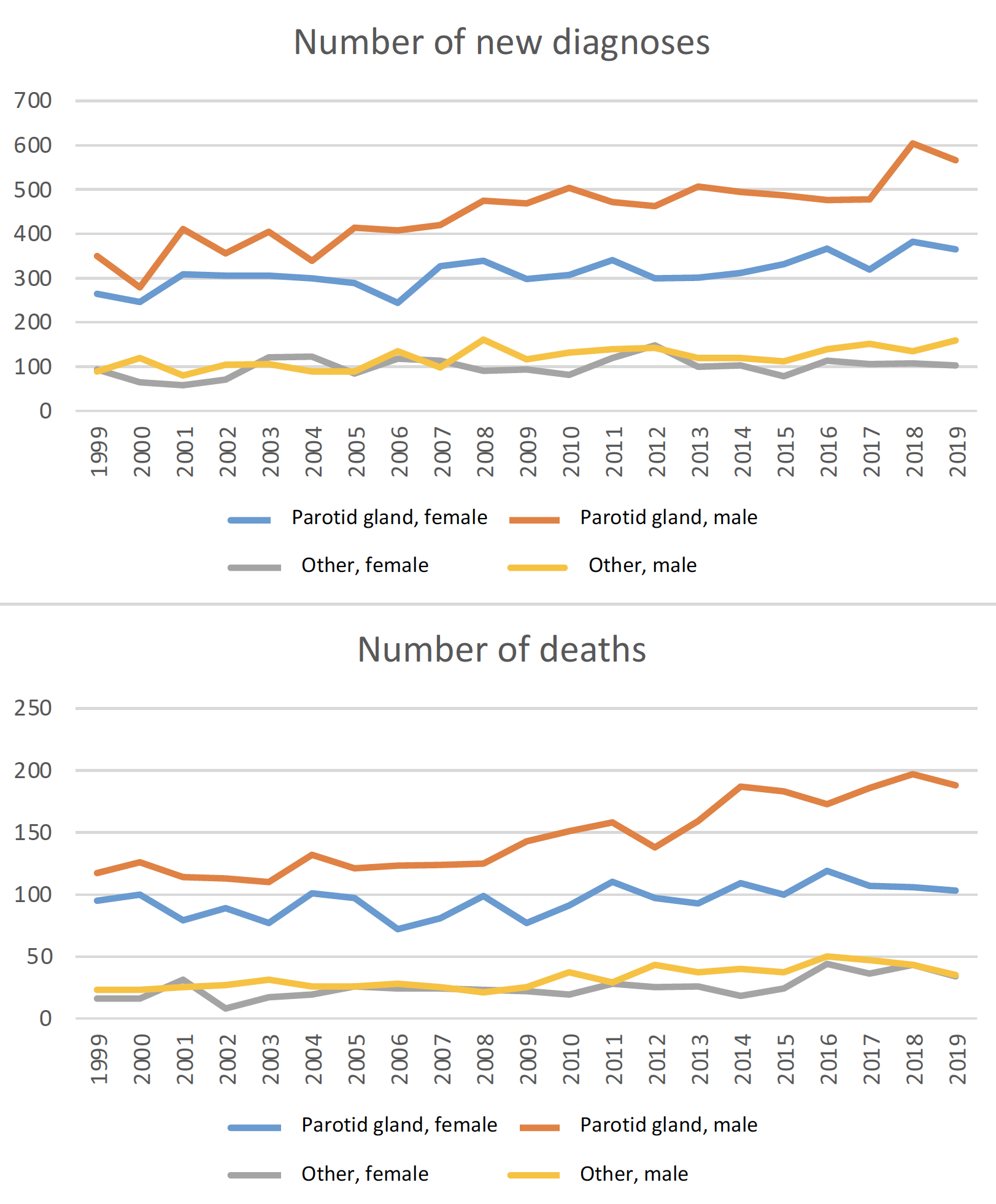
According to most national population-based studies, no significant change in incidence has been observed in recent years, with the exception of the United States, where a rising incidence has been reported without any identifiable causes [6]. The interactive web-based platform Global Cancer Observatory, which incorporates GLOBOCAN data among other sources, forecasts an increase in salivary gland carcinomas in Germany from 1 case per 100,000 people per year in 2022 to 1.22 cases per 100,000 people per year in 2045 [10]. In the studies and statistics cited, a distinction is made at most between carcinomas of the parotid gland (ICD: C07) and all other carcinomas (ICD: C08). A more detailed analysis of nationwide state cancer registry data for 2009–2022 revealed a slight increase in incidence over the past years, driven by a rise in salivary duct carcinomas among men. The observed decrease in adenocarcinomas not otherwise specified (NOS)—this terminology is now obsolete; it is now referred to as “salivary gland carcinoma, NOS”—is likely due to their reclassification as salivary duct carcinomas [6, 38]. In this study, all squamous cell carcinomas were excluded due to the difficulty in distinguishing between primary and secondary carcinomas. In Thuringia (including squamous cell carcinomas), an increase in salivary gland carcinomas was observed for many histological types between 1996 and 2011 [5]. However, it should be noted that the incidence of cutaneous squamous cell carcinoma in Germany has roughly doubled since the 2000s [11]. It can therefore be assumed that secondary squamous cell carcinomas in the parotid gland also increased during this period, i.e., metastases to the parotid gland from tumors of other sites were not distinguished from primary tumors of the parotid gland. This inaccuracy must also be taken into account when examining the current data from the Robert Koch Institute (RKI), as all (primary and secondary) salivary gland carcinomas are included here (Figure 1). In Germany, between 1999 and 2023, there was a significant increase in parotid gland malignancies among men and a slight increase among women. It is likely that this increase among men is not due to primary salivary gland carcinomas, but rather to secondary tumors, primarily resulting from metastases of squamous cell carcinomas of the skin. For all other sites, the RKI data show no changes for either gender. In 2023, 347 women and 520 men in Germany were diagnosed with parotid gland carcinomas. For the other sites, 101 women and 144 men were diagnosed. Deaths in Germany are also shown in Figure 1. The increasing incidence of salivary gland carcinomas is reflected in the number of deaths. In 2023, 99 women and 180 men died from parotid carcinoma. Thirty-nine women and 55 men died from salivary gland carcinomas in other locations. Since salivary gland carcinomas of the minor salivary glands, in particular, were not always registered as salivary gland carcinomas but instead as head and neck carcinomas of the corresponding location until 2025, an underestimation of case numbers is suspected here.
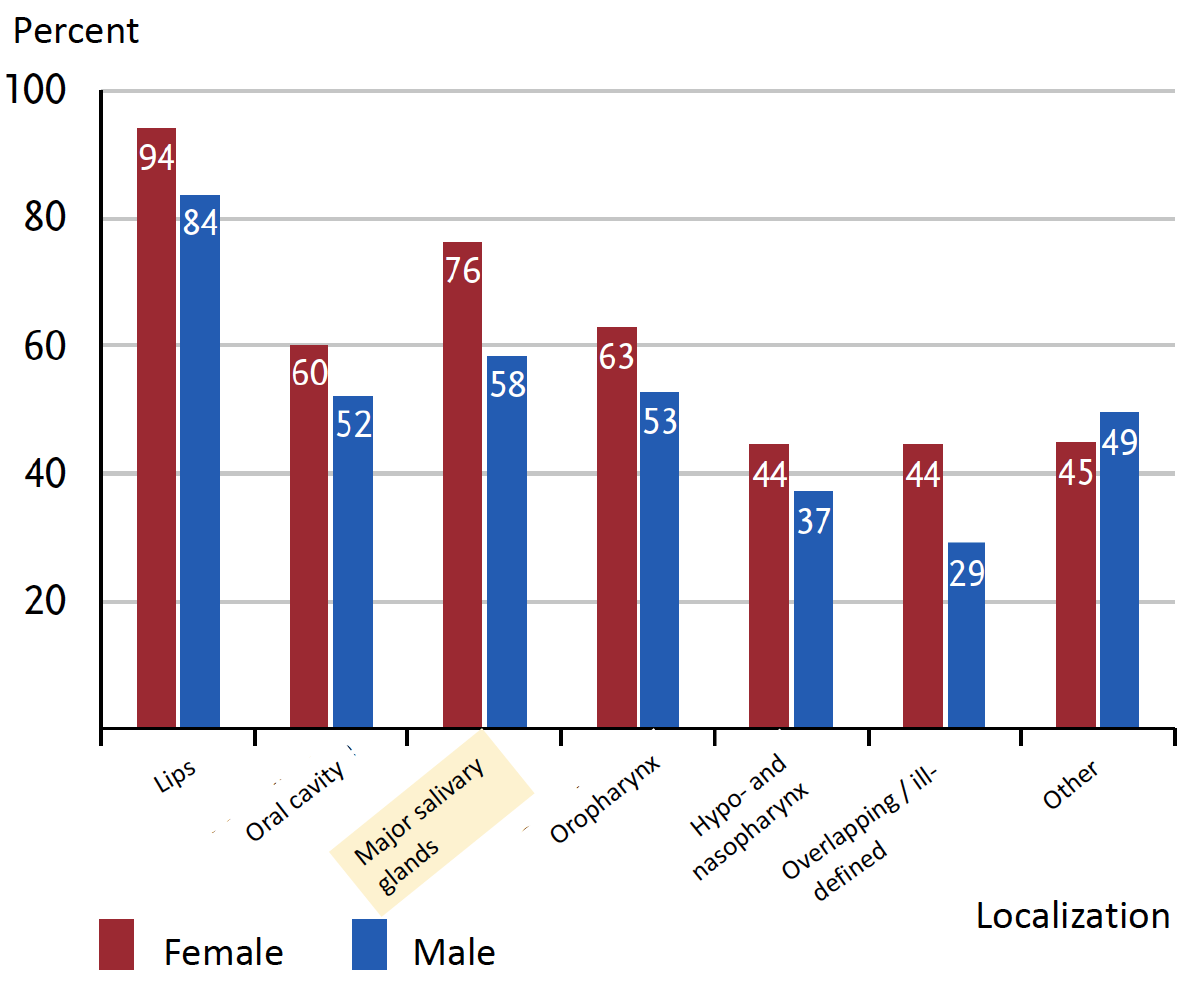
In its report “Cancer in Germany for 2021–2023”, the RKI, as in previous reports, provides only summary data on the survival rates of patients with salivary gland carcinomas (Figure 2). According to this, the 5-year survival rate for 2021–2023 was 75% for women and 60% for men, and has thus not improved compared to the last report from 2018 [12]. In North Rhine-Westphalia, the average relative 5-year survival rate for all patients between 2009 and 2022 was 70% and has thus remained unchanged since 2018 (69% at that time) [6]. In Thuringia, the 5-year and 10-year survival rates between 1999 and 2011 were 60.1% and 48.2%, respectively [5]. More recent regional population-based data from Germany are not available. The most important prognostic factors are the TNM classification, the histological type, and, to a limited extent, tumor grading. Carcinomas of the minor salivary glands are rarely considered in isolation in population-based studies. Five-year survival rates of 76–86% are reported for carcinomas of the minor salivary glands [13]. The risk factors for poorer survival do not differ from those for carcinomas of the major salivary glands.
2.3Pathogenesis
The pathogenesis is unclear. Two concepts are currently under discussion: the histogenetic concept assumes that the histologically very different tumor types (see chapter 5.2.2 Histology) develop from the various cell types of the salivary gland tissue. Thus, the various tumors are thought to form from the basal cells or acinar cells of the glandular acini or ductal segments through pathological replication [14]. According to the morphogenetic concept, the tumors arise from stem cells within the gland, and differentiated pathological gene expression under the influence of the environment, along with epigenetic changes, leads to the emergence of the various tumor types [14, 15].
2.4Risk Factors
Ionizing radiation is the only definitively established risk factor [16]. This may include prior radiation therapy to the head and neck region. Exposure to radioactive substances is likely another risk factor. There also appears to be an association with occupations in the rubber manufacturing industry, the hair and cosmetics industry, and grain/vegetable farming [16, 17, 18]. Lymphoepithelial carcinoma occurs more frequently in patients with AIDS, and the tumors may contain components of the Epstein-Barr virus (EBV) [19, 20]. The etiological role of HIV or EBV infection remains unclear. However, the factors mentioned are responsible for only a very small proportion of the tumors. In most cases, no cause can be identified. Age is an associated factor: the incidence increases significantly after the age of 50–60.
3Prevention and Early Detection
3.1Prevention
There are no general recommendations for prevention.
3.2Early Detection
Currently, there are no specific screening tools for the early detection of salivary gland carcinomas. Patients who have undergone radiation therapy in the head and neck region for another tumor should have their salivary glands examined if they notice any changes.
4Clinical Characteristics
The predominantly nonspecific symptoms depend on the location of the salivary gland tumor. As with other malignant tumors of the head and neck region, symptoms such as weight loss and localized pain may occur. The most common symptom is localized swelling. In terms of clinical characteristics, malignant tumors often do not differ from the much more common benign tumors. In the majority of cases, malignant tumors do not exhibit clear signs of malignancy [21]. Signs of malignancy include tumor infiltration into the surrounding tissue, skin infiltration (both of which are associated with poor tumor mobility), rapid growth, or facial nerve palsy in tumors of the parotid or submandibular glands. In the parotid gland, most salivary gland carcinomas are located in the superficial lobe and, as they continue to grow, invade the deep lobe. In benign tumors of the minor salivary glands on the hard palate, ulceration (which occurs due to a lack of space for expansion) can falsely mimic a malignant tumor. A salivary gland tumor (particularly in the parotid gland) may also be detected as an incidentaloma, e.g., during a positron emission tomography-computed tomography (PET-CT) scan performed for other reasons. Incidentalomas are typically benign salivary gland tumors or metastases from other tumors [22].
5Diagnosis
5.1Diagnosis
In addition to a detailed medical history, the standard diagnostic approach includes a combination of inspection, palpation, and endoscopic examination. Furthermore, as with all head and neck tumors, performance status, nutritional status, psychosocial history, dental status, and an assessment of speech and swallowing function should be evaluated. For patients over 65 years of age, a geriatric assessment is additionally recommended [23]. The further course of action depends on the location of the salivary gland tumor. Table 1 provides an overview. In patients with facial nerve palsy, the extent of the palsy is classified (graded), and an electrophysiological examination is performed to objectively assess the severity of the damage [24].
If histopathological examination of a parotid gland tumor reveals squamous cell carcinoma, a search for the primary tumor must be conducted. A primary squamous cell carcinoma of the parotid gland is extremely rare and is a diagnosis of exclusion [25]. Since cutaneous squamous cell carcinomas represent the most common primary tumor site, a careful examination of the body surface and a medical history regarding previous skin tumors are performed. If risk factors for head and neck squamous cell carcinoma are present (see Onkopedia guideline on head and neck squamous cell carcinomas), panendoscopy should be considered. If cutaneous squamous cell carcinoma or head and neck squamous cell carcinoma has been ruled out, further evaluation with FDG-PET-CT (see below) is recommended.
5.1.1Imaging
Ultrasound (US) examination of the soft tissues of the neck is the gold standard for the initial evaluation of tumors of the major salivary glands. In contrast, tumors of the minor salivary glands can be assessed directly by inspection or endoscopy and are poorly or not at all accessible to US. Salivary gland tumors, particularly in the superficial lobe of the parotid gland, submandibular gland, or sublingual gland, are adequately visualized by US [26].
For deeper tumors in the parotid gland, tumors extending into the parapharyngeal space, or tumors that cannot be fully visualized by ultrasound, magnetic resonance imaging (MRI) with contrast medium (CM) is the diagnostic method of choice. If MRI with CM is not available, computed tomography (CT) is selected. Both ultrasound and MRI/CT can be used to perform neck staging. If malignancy is already suspected, an MRI with contrast is strongly recommended. MRI allows for the detection of perineural spread, bone invasion, and meningeal infiltration. The specificity of ultrasound, CT±CM, MRI±CM, and even PET-CT is insufficient to precisely diagnose a malignant tumor. Only histological confirmation (see chapter 5.2.2 Histology) allows for a definitive diagnosis. To rule out distant metastases in the lungs and abdomen, a chest CT and an abdominal CT are recommended for advanced tumors (stage T3 N0 or N1 and higher).
In the case of a lymphatically metastasized salivary gland tumor, as well as in high-grade subtypes, an FDG-PET-CT scan may be helpful for optimizing treatment planning. The most common site of distant metastases is the lung. Bone metastases are the second most common site for distant metastasis [27]. Although the sensitivity of FDG-PET is comparable to that of plain CT imaging, a small single-center study demonstrated higher specificity for ruling out distant metastases [28]. However, this should first be confirmed by further, more extensive studies before recommendations are derived from these findings.
The recommendations for diagnosis and staging are summarized in Table 1.
5.1.2Fine-Needle Aspiration Cytology, Core Needle Biopsy, and Excisional Biopsy
Fine-needle aspiration cytology (FNAC) is the standard cytological procedure that can help detect a malignant salivary gland tumor of the parotid or submandibular gland preoperatively. However, it is controversial whether FNAC can reliably distinguish between a benign tumor and a well-differentiated salivary gland carcinoma. FNAC can also be combined with ultrasound examination, which facilitates the aspiration of informative regions within the tumor. There is no definitely accepted classification system for cytological evaluation, neither internationally nor in Germany. The Milan system is frequently recommended for evaluation [29, 30]. FNAC requires the availability of a cytopathologist experienced in the diagnosis of salivary gland carcinomas. From a health economic perspective, preoperative fine-needle aspiration is a cost-effective procedure that can also spare the patient unnecessary surgery [131, 132]. An alternative to FNAC is the core needle biopsy (CNB). With CNB as well, performing the procedure under ultrasound guidance increases the diagnostic value of the results [31]. Since a tissue core is removed, histological examination is possible. On the other hand, the risk of bleeding increases after CNB, and theoretically, there is also a risk of tumor cell dissemination and injury to the facial nerve [32]. Like FNAC, CNB is well-suited for determining the malignancy of the tumor [33, 145]. To date, there are no prospective studies directly comparing FNAC and CNB. For tumors of the minor salivary glands, excisional biopsy is recommended whenever possible, as a puncture or incisional biopsy can often lead to severe misinterpretations (including benign versus malignant) [34, 39].
An overview of preoperative diagnostics is summarized in figure 3.
5.1.3Intraoperative Frozen Section
Intraoperative frozen section analysis performed as part of definitive tumor surgery plays a role in detecting a malignant tumor only when FNAC and CNB have yielded an inconclusive result and/or a very specific clinical situation is present, due to the lower reliability of these methods in salivary gland carcinomas. However, as is otherwise the case with extensive tumors, intraoperative frozen section analysis can increase the likelihood of a complete tumor resection (R0 resection).
5.2Classification
5.2.1Stages
The current TNM classification for tumors of the major salivary glands is shown in Table 2, and the UICC staging classification is shown in Table 3. Since 2026, tumors of the minor salivary glands have no longer been classified according to the respective region (see Onkopedia guideline on head and neck squamous cell carcinomas) in accordance with the 9th edition of the TNM classification for head and neck tumors, but are now classified in the same manner as tumors of the major salivary glands.
The parotid gland contains approximately 10–20 intraparotid lymph nodes. Metastatic involvement of these lymph nodes in parotid gland carcinomas has prognostic significance regardless of whether there is metastatic involvement of the cervical lymph nodes [35]. Intraparotid lymph node metastases are counted as cervical lymph node metastases. It is unofficially recommended to include these in the N category. In the 9th edition of the TNM classification, the T categories have not changed, but the descriptions of the T3 and T4 categories have. The N category has been simplified. The staging system has also changed. Stage III has been subdivided into IIIA and IIIB. Only M1 tumors now fall into stage IV.
T Category | |
|---|---|
TX | Primary tumor cannot be assessed |
T0 | No evidence of primary tumor |
T1 | Tumor 2 cm or less in its greatest dimension, without extraparenchymal extension |
T2 | Tumor measuring more than 2 cm but no more than 4 cm in its greatest dimension, without macroscopic extraparenchymal extension |
T3 | Tumor greater than 4 cm in maximum dimension and/or with macroscopic extraparenchymal spread |
T4a | Tumor infiltrates adjacent structures: skin, mandible, external auditory canal, facial nerve |
T4b | Tumor infiltrates beyond adjacent structures: skull base, pterygoid process, or encases the carotid artery |
N Category* | |
NX | Regional lymph nodes cannot be assessed |
N0 | No regional lymph node metastases |
N1 | 1–3 lymph node metastases, without extranodal spread (ENE-negative) |
N2 | >3 lymph node metastases or at least 1 lymph node metastasis with extranodal spread |
M category | |
M0 | No distant metastases |
M1 | Distant metastasis(es) |
5.2.2Histology
Salivary gland carcinomas are classified according to the current 5th edition of the WHO Classification 2022 [37] (table 4). Some of the WHO classifications are considered provisional, and others are regarded as controversial among pathologists [38]. Genetic aberrations (often translocations) are (unlike in many other organs) very often entity-specific and can therefore be used as a valuable additional diagnostic criterion in cases of difficult histological diagnosis (table 5) [39]. Unlike with other head and neck carcinomas (oral cavity, pharyngeal, and laryngeal tumors), the necessity of grading (G) in salivary gland carcinomas is a subject of controversy [38]. Only a few of the malignant epithelial tumors exhibit a variable gradation from low to high malignancy. In most cases, the tumors occur exclusively as low-grade (e.g., polymorphic adenocarcinoma) or only as high-grade (e.g., ductal carcinoma). Furthermore, the WHO 2022 classification does not specify whether pathologists should use a two-tiered (low-versus-high-grade) or a three-tiered system (G1, G2, G3) [38].
The histomorphological diagnosis of tumors of the minor salivary glands is, on average, significantly more difficult than that of tumors of the major salivary glands and thus more frequently leads to clinically relevant misdiagnoses. Fourteen reasons for this have been identified; the following are the most important: Initially, incision biopsies (that are too small and too superficial) are frequently performed; the carcinomas almost invariably show high tumor differentiation (with no or minimal cellular atypia). Additionally, the specific location on the hard palate often leads to ulcerations, necrosis, and inflammation due to lack of space, which greatly complicates the diagnosis. An important recommendation is therefore to always perform a complete resection (excision biopsy) rather than an incisional biopsy for tumors of the minor salivary glands, whenever possible [39].
If histological examination of a tumor of the parotid gland reveals squamous cell carcinoma, it is highly likely to be a metastasis of a squamous cell carcinoma of another origin. Cutaneous squamous cell carcinomas of the head and neck region most frequently metastasize to the parotid gland.
Mucoepidermoid carcinoma | Myoepithelial carcinoma |
Adenoid cystic carcinoma | Epithelial-myoepithelial carcinoma |
Acinar cell carcinoma | Mucinous adenocarcinoma |
Secretory carcinoma | Sclerosing microcystic adenocarcinoma |
Microsecretory adenocarcinoma | Carcinoma ex pleomorphic adenoma |
Polymorphic adenocarcinoma | Carcinosarcoma |
Hyalinizing clear cell carcinoma | Sebaceous adenocarcinoma |
Basal cell adenocarcinoma | Lymphoepithelial carcinoma |
Intraductal carcinoma | Squamous cell carcinoma |
Salivary duct carcinoma | Salivary gland carcinoma, NOS, and emerging entities |
Sialoblastoma |
5.2.3Immunohistochemistry
Given the diversity of salivary gland entities, some of which exhibit highly overlapping histomorphological differentiation and where distinguishing benign adenomas from well-differentiated carcinomas is often difficult, the immunohistological profile (e.g., cytokeratin subtypes, myoepithelial markers, etc.) can be helpful, but is frequently highly limited. More specific immunohistochemical surrogate markers, such as DOG-1, NR4A3, and panTRK, can be diagnostically helpful [40]. For example, positive expression of NR4A3 can support the diagnosis of acinar cell carcinoma, particularly in cases with unusual morphology. And typically, NTRK3-translocated secretory carcinomas show immunohistochemical nuclear expression of panTRK. Therapeutically relevant is the overexpression of androgen receptor (AR) and HER2/neu, particularly in salivary duct carcinoma and in the common subtype of carcinoma ex pleomorphic adenoma, as these alterations can be specifically targeted therapeutically [41]. RAS(Q61R) immunohistochemistry can serve as a surrogate marker indicating a corresponding HRAS mutation, as is relevant for epithelial-myoepithelial carcinoma.
5.2.4Molecular Pathology
The molecular genotype can be particularly useful in classifying unusual morphological variants (Table 5). Gene fusions, in particular, generally exhibit high specificity. The detection of recurrent NTRK or RET gene fusions is not only diagnostically significant but can also be used to guide potential targeted therapy [40].
Histological tumor type | Genetic aberrations |
|---|---|
Mucoepidermoid carcinoma | CRTC1::MAML2; CRTC3::MAML2 |
Hyalinizing clear cell carcinoma | EWSR1::ATF1 |
Adenoid cystic carcinoma | MYB::NFIB; MYBL1::NFIB |
Secretory carcinoma | ETV6::NTRK3; ETV6::RET |
Carcinoma arising from a pleomorphic adenoma | PLAG1 rearrangement; HMGA2 rearrangement; ERBB2 amplification; MDM2 amplification; TP53 mutation; AR amplification |
Salivary duct carcinoma | ALK rearr; ERBB2 ampl; PTEN del; HRAS mut; BRAF mut; AR ampl; PIK3CA mut; TP53 mut |
Polymorphic adenocarcinoma | PRKD1-E710D |
Cribriform adenocarcinoma | PRKD1/2/3 rearrangement |
Acinar cell carcinoma | NR4A3rearr |
Microsecretory adenocarcinoma | MEF2C::SS18 |
Intraductal carcinoma | NCOA4::RET; TRIM27::RET; HRAS mutation |
Mucinous adenocarcinoma | AKT1-E17K, TP53mut |
Epithelial-myoepithelial carcinoma | HRAS mutation |
6Treatment
The curative treatment of choice is surgery. Other factors determine whether postoperative radiation therapy is necessary after surgery. Chemotherapy alone does not play a role in standard curative therapy. For inoperable tumors, radiation therapy is used as primary treatment. Chemotherapy or other systemic tumor therapy is used for inoperable recurrent tumors or tumors with distant metastases, i.e., when local therapy (repeat surgery or radiation therapy) is not an option. Figure 4 provides an overview of the course of curative therapy.
6.1Surgery for the Primary Tumor
Surgical removal of a salivary gland carcinoma with tumor-free resection margins is the curative treatment of choice. Tumor resection is performed en-bloc with a safety margin of at least 2 cm [42]. In the case of tumors of the submandibular gland, the resection includes at least the entire gland. For parotid malignancies, the standard conservative treatment is total parotidectomy (level I to IV parotidectomy according to the European Salivary Gland Society (ESGS) classification) [26, 43]. Based on small, monocentric case series to date, a lateral parotidectomy (level I/II parotidectomy according to the ESGS/MSGS classification) may be sufficient for small, low-grade tumors (T1/T2) provided the resection margins are adhered to [44]. The decision between a total parotidectomy for the diagnosis of intraparotid lymph nodes and as an aid in deciding whether to initiate adjuvant radiation therapy should be discussed with the patient. However, the grade is often not determined until after surgery, once the final histology is available. If the tumor extends beyond the organ margins, extended surgery is necessary, which may also involve reconstructive surgery using flap procedures.
Some salivary gland tumors, particularly those of the parotid gland, are only identified as salivary gland carcinomas following histopathological examination of the resected specimen. These were therefore previously operated on under the suspicion of a benign tumor. If, in such cases, only a parotidectomy of individual levels was performed, a revision surgery to complete the total parotidectomy (levels I to IV according to ESGS) is recommended, unless the tumor was a T1/T2 tumor according to the criteria mentioned above. It should be noted that if the facial nerve was already visualized during the primary surgery, revision surgery must be performed as soon as possible, as the facial nerve is otherwise significantly more difficult to identify in scar tissue and the risk of postoperative facial nerve palsy increases significantly.
If facial nerve function is normal preoperatively and the facial nerve does not appear to be infiltrated by the tumor during surgery, the facial nerve is preserved. Therefore, surgery using loupes or a surgical microscope, along with facial nerve monitoring, is recommended. Resection of the nerve—i.e., a more radical approach—offers no oncological benefit in terms of survival but significantly impairs the patient’s quality of life [45]. If the facial nerve is infiltrated, a radical parotidectomy is performed with resection of the tumor-infiltrated portions of the nerve. In many cases, this allows for a one-stage nerve reconstruction using nerve grafts [46]. Nerve reconstruction immediately following tumor resection yields better functional results than a two-stage procedure. The need for postoperative radiation therapy is not a reason to forego single-stage reconstruction. If nerve reconstruction is not possible, not advisable due to a life expectancy of < 1 year, or not desired by the patient, other measures (dynamic muscle transfer, static suspension) can be performed in a single or two-stage procedure. Since protection of the eye is functionally very important, implantation of an upper eyelid weight to restore eyelid closure is recommended following facial nerve resection, with or without nerve reconstruction [47].
FNAC = fine-needle aspiration cytology; CNB = core needle biopsy; ACC = adenoid cystic carcinoma.
6.2Surgery of Soft Tissues of the Neck: Neck Dissection
Salivary gland carcinomas show cervical lymph node metastases in 10–40% of cases [48]. Curative neck dissection should be performed in all patients with clinical or radiological evidence of cervical metastases [49]. There is no standard for the extent of curative neck dissection. Depending on the primary tumor location, this should include levels II to IV, I to IV, or I to V. The inclusion of level I (in parotid carcinomas) and level V is controversial, as is the question of whether these cannot also be adequately treated electively with adjuvant radiotherapy.
As a prophylactic measure, elective neck dissection should be performed in patients with stage III/IV major salivary gland carcinomas and in cases of high-grade tumors (e.g., salivary gland carcinoma NOS, squamous cell carcinoma, undifferentiated carcinomas, high-grade mucoepidermoid carcinoma, and carcinoma arising from pleomorphic adenoma) [50]. This also applies to adenoid cystic carcinoma, although this tumor type tends to metastasize hematogenously. Neck dissection provides further important prognostic information, such as the presence of extracapsular seeding, which is associated with a poorer prognosis. Elective neck dissection should include neck levels II and III for tumors of the parotid gland and neck levels I–III for tumors of the other major and minor salivary glands. In general, however, elective neck dissection for tumors of the minor salivary glands is controversial [51].
6.3Postoperative Radiotherapy
Postoperative radiotherapy is indicated in the presence of at least one of the following risk factors [52]: advanced T stage (T3/T4), high-grade tumor, presence of lymph node metastases, N+, perineural sheath infiltration (Pn1), lymphatic or vascular invasion [L1, V1]), and positive or narrow resection margins [53, 54, 133], although in cases of low/intermediate-grade acinar and mucoepidermoid carcinomas at stage T1/2 without additional risk factors, postoperative radiation may be omitted if the resection margin is narrow [56, 57, 58]. Thus, for early-stage tumors (T1/T2) without cervical metastasis or any of the other risk factors mentioned, surgery alone is sufficient [54]. Adenoid cystic carcinoma occupies a special position: here, adjuvant radiotherapy is indicated even for T1/T2 tumors, with complete resection (R0), and particularly in cases of perineural invasion [55].
When defining the target volume, a distinction is made between the high-risk clinical target volume (CTV) and the elective CTV [134]. The target volume should be defined based on preoperative imaging, histopathological findings, the surgical report, and a radiation planning CT scan with intravenous contrast. In cases of postoperative residual tumor, MRI imaging should be performed for radiation planning. The high-risk CTV includes the former primary tumor region, the extent of the affected salivary gland, the resection cavity, and affected lymph node levels.
The elective CTV includes areas with possible microscopic spread, including elective lymphatic drainage areas or, in the case of perineural sheath infiltration, the course of the corresponding nerve pathways down to the skull base. In cases of parotid carcinoma involving the deep lobe, the infratemporal fossa and the parapharyngeal space are also included [59, 60, 61].
Elective lymphatic drainage irradiation is performed for T3/T4 tumors, high-grade tumors, and the presence of lymph node involvement. In cases of lymph node involvement, at least the next lymph node level should be irradiated. As a rule, the elective lymphatic drainage areas are irradiated ipsilaterally. In cases of parotid gland malignancies and multiple lymph node metastases with extracapsular growth, bilateral irradiation of the lymphatic drainage areas may be performed [62]. For malignancies of the submandibular gland and the minor salivary glands, bilateral irradiation of the lymphatic drainage areas should be performed in the presence of midline infiltration or at least 2 of the following risk factors: pT3/4, presence of lymph node metastases, extracapsular growth, or lymphatic vessel or vascular invasion. In the case of p or cN0 disease, radiation of the elective lymphatic drainage areas may be omitted for acinar cell carcinoma and low/intermediate-grade adenoid cystic carcinoma [63, 64].
The respective planning target volumes (PTVs) are derived from the CTVs, taking into account individual positioning uncertainty (typically a 3–7 mm expansion of the CTV).
In the high-risk CTV, a dose of at least 60 Gy should be administered in standard fractions, and in the case of a narrow/positive resection margin and/or perineural sheath infiltration, a dose of at least 64–66 Gy [65, 66, 67, 68]. In cases of R2 resection, a dose of 70 Gy should be administered. In the elective CTV, a dose of 50 Gy is administered using conventional fractionation.
Highly conformal radiation techniques (VMAT, IMRT) are now standard. For adenoid cystic carcinoma and residual tumor present postoperatively, heavy-ion therapy may be appropriate [65].
To date, additional chemotherapy as postoperative chemoradiotherapy has not shown any advantages over postoperative radiotherapy in retrospective analyses [69, 70, 71]. However, there is evidence that combined cisplatin-containing chemoradiotherapy could improve local tumor control, particularly in adenoid cystic carcinomas and in patients at high risk for distant metastases (advanced tumor stage) [72, 73, 135, 136]. The results of the prospective randomized trials (RTOG 1008, NCT01220583, and GORTEC 2016-02, NCT02998385) are pending. These studies investigate radiotherapy alone in the adjuvant setting or, in the GORTEC study, also in the definitive setting, versus combined cisplatin-based chemoradiotherapy. In the adjuvant setting, simultaneous cisplatin-based chemoradiotherapy may therefore be administered in individual cases.
6.4Adjuvant Systemic Therapy
Currently, there are no prospective studies on adjuvant systemic therapy. Retrospective data indicate that, in cases of DAKO3+ Her2/neu expression or Her2/neu amplification, adjuvant therapy with trastuzumab following Surgery and radiation therapy is associated with a survival benefit [74]. Furthermore, according to a retrospective analysis, androgen deprivation therapy with bicalutamide alone or in combination with an LH-RH agonist (goserelin, triptorelin) administered adjuvantly for 1–5 years following postoperative radiotherapy in patients with androgen receptor-positive stage IVa salivary duct carcinoma may offer an advantage over radiotherapy alone [75]. However, evidence from prospective clinical trials is currently lacking.
6.5Definitive Radiotherapy or Chemoradiotherapy
Definitive radiotherapy is indicated for inoperable carcinomas, e.g., cases involving the skull base, or when there is a patient-specific contraindication for surgery.
When defining the target volume, a distinction is made between high-risk CTV and elective CTV. The target volume should be defined based on pre-treatment examination and imaging, histopathological findings, a treatment planning CT scan with intravenous contrast, and an MRI. The high-risk CTV should include the macroscopic primary tumor, the entire salivary gland, and, if present, lymph node metastases. The elective CTV includes areas with possible microscopic spread, including elective lymphatic drainage areas or the course of the corresponding nerve pathways down to the skull base [59, 60].
Elective lymphatic drainage irradiation is performed for T3/4 tumors, high-grade tumors, adenocarcinomas, and mucoepidermoid carcinomas, as well as for all carcinomas with lymph node involvement. In the case of a cN0 situation, irradiation of the elective lymphatic drainage areas can be omitted for acinar cell carcinoma and low/intermediate-grade adenoid cystic carcinoma [63, 64].
In cases of lymph node involvement, at least the next lymph node level should be irradiated. As a rule, the elective lymphatic drainage areas are irradiated ipsilaterally. For malignancies of the submandibular gland and the minor salivary glands, bilateral irradiation of the lymphatic drainage areas should be performed in the presence of midline infiltration or in the presence of the risk factors cT3/4 and lymph node metastases [64].
The respective planning target volumes (PTVs) are derived from the CTVs, taking into account individual positioning uncertainty (typically a 3–7 mm expansion of the CTV). In the high-risk CTV, a dose of at least 72 Gy should be administered in standard fractions [76, 77]. In the elective CTV, a dose of 50 Gy is administered in standard fractions. Highly conformal radiation techniques (VMAT, IMRT) are now standard.
Since many salivary gland carcinomas grow slowly, there is relative radiation resistance, particularly in adenoid cystic carcinoma. Therefore, radiation modalities with high linear energy transfer properties are of interest for salivary gland carcinomas, such as carbon ions, and more recently also in combination with proton therapy [78]. Regarding particle therapy for salivary gland carcinomas, data are available only for selected cases in predominantly retrospective cohorts [79]. Particle therapy should therefore be evaluated as a potential alternative to photon radiation therapy, provided that better dose delivery near critical risk organs can be achieved.
Definitive chemoradiotherapy may be considered. There are no clear criteria for this compared to definitive radiotherapy [73, 80]. There is also no standard for the selection of the chemotherapeutic agent. Cisplatin-based therapy is most commonly used, based on data regarding common head and neck tumors [81, 78, 79].
6.6Treatment with Non-Curative Intent: Systemic Therapy
There is no standard of care for the medical management of salivary gland carcinomas that are not amenable to curative treatment. The rarity and heterogeneity of salivary gland carcinomas make it difficult to conduct large-scale studies on systemic therapy. Consequently, there are no large-scale phase III trial data available for the management of locally recurrent or metastatic disease. Recommendations for systemic therapy are based primarily on results from phase II trials or on results from molecularly stratified basket trials. Numerous additional phase II trials on new agents are currently ongoing (overview in: [15, 82, 83]). For the majority of the therapies listed here, there is no approval for use in salivary gland carcinomas.
The course of the disease in the metastatic setting is variable, and a significant proportion of patients remain asymptomatic for a long time. Accordingly, a watch-and-wait strategy is justified in selected cases (low tumor burden, stable disease, no symptoms). In particular, adenoid cystic carcinomas (especially those with an isolated pulmonary metastasis pattern), myoepithelial carcinomas, and acinar cell carcinomas may exhibit a very low growth rate over an extended period [84, 85, 86].
Systemic therapy based on treatment protocols for squamous cell carcinomas of the head and neck is not recommended, as patients with salivary gland carcinomas were excluded from the underlying studies [87]. In particular, the use of checkpoint inhibitors—unlike in the common head and neck squamous cell carcinomas—plays no role in salivary gland carcinomas due to a lack of efficacy [88, 89, 137].
In patients with a high tumor burden and active disease progression, systemic therapy should be offered if the patient’s general condition permits. In indirect comparisons, combination chemotherapies demonstrate higher response rates than monochemotherapy. Platinum-based chemotherapy regimens (cisplatin, carboplatin) are primarily used in combination with cyclophosphamide and doxorubicin (CAP regimen), platinum-taxane combinations (only limited efficacy is expected in adenoid cystic carcinoma), or with vinorelbine. Response rates range from 20–60% [90, 91]. The combination of carboplatin and paclitaxel is also used in metastatic salivary duct carcinoma [92], with the exception of adenoid cystic carcinomas, where it has only a very limited effect [93]. In cases of reduced general condition, single-agent chemotherapy regimens with vinorelbine, cisplatin, or epirubicin represent possible treatment options [90, 94, 95].
In secretory salivary gland carcinoma, an ETV6-NTRK3 gene fusion is detectable in more than 95% of cases. This gene fusion results in excessive tyrosine kinase activity, which makes targeted therapy possible. The two tyrosine kinase inhibitors, entrectinib and larotrectinib, are approved for the treatment of NTRK-positive tumors and demonstrate good efficacy in secretory salivary gland carcinoma [96, 97]. Entrectinib achieved a response rate of 57% in a cohort of patients with NTRK gene fusion-positive tumors. In the subgroup of 7 patients with secretory carcinoma, a response rate of 86% was reported [97]. Immunohistochemical TRK expression correlates with NTRK1 and NTRK2 fusions, although specificity appears to be lower in salivary gland carcinomas compared to other solid tumors. RNA-based confirmation of the gene fusion is necessary before starting treatment with an NTRK inhibitor [98].
For HER2-positive tumors, anti-HER2 therapy should be considered. Up to 30% of mucoepidermoid carcinomas and 40% of salivary duct carcinomas exhibit HER2 overexpression. Phase II studies show very high response rates to HER2 blockade in this setting, e.g., with docetaxel plus trastuzumab (response rate up to 70%) or ado-trastuzumab emtansine following trastuzumab failure or trastuzumab deruxtecan [99, 100, 101, 138, 139]. The combination of trastuzumab and pertuzumab represents a potential option for patients with a contraindication to taxane therapy. According to a subgroup analysis of a basket study, the response rate with trastuzumab and pertuzumab was 60% [102]. Another treatment option is the antibody-drug conjugate (ADC) trastuzumab deruxtecan (T-DXd). In a Japanese phase II study, T-DXd was investigated in a largely pretreated HER2-positive patient cohort (IHC 3+ or IHC 2+ and ISH+). A response rate of 68.4% and a median PFS of 15.7 months were observed [139]. This study also included patients with low HER2 expression (HER2+ and ISH- or HER2 1+). In the meantime, T-DXd has received tumor-agnostic approval in the U.S. for HER2-positive (IHC 3+; immunohistochemically triple-positive) tumors without satisfactory treatment alternatives. An indication expansion by the European Medicines Agency (EMA) is expected (as of May 22, 2026).
RET gene fusions represent a rare driver in non-small cell lung cancer, thyroid cancer, or tumors of the gastrointestinal tract. In salivary gland carcinomas and secretory carcinomas, the corresponding fusions have been described in a small but relevant proportion of cases. The selective RET kinase inhibitor selpercatinib was investigated in a tumor-agnostic phase I/II study. Among the four patients with salivary gland carcinomas included in the study, the response rate was 50% [104].
In a large-scale molecular profiling study of salivary gland carcinomas, BRAF alterations were detected in 2.7% of the total cohort [105]. To date, case reports in references have described clinical activity of corresponding inhibitors (dabrafenib and trametinib) in BRAF-altered salivary gland carcinomas [106].
Antiangiogenic agents represent a therapeutic option for adenoid cystic carcinomas. The multityrosine kinase inhibitor lenvatinib was investigated in a phase II study involving 33 patients with adenoid cystic carcinoma and disease progression following prior therapy. The response rate with lenvatinib was 15%, and 75% of the cohort showed disease stabilization [107]. Similarly, the tyrosine kinase inhibitors sorafenib and axitinib were tested in phase II studies for adenoid cystic carcinoma. A response rate of 16% was reported with sorafenib and 9% with axitinib [108, 109]. It should be noted that disease progression prior to the start of therapy was not an inclusion criterion in the studies mentioned. In another recent randomized phase II study, axitinib demonstrated a significantly better progression-free survival rate at 6 months (73.0%) compared to a watch-and-wait approach (23.0%) in patients with recurrent or metastatic adenoid cystic carcinoma [110]. The combination of axitinib with the checkpoint inhibitor avelumab was also investigated in patients with recurrent or metastatic adenoid cystic carcinoma and resulted in a response rate of 18% in a non-randomized study, with a progression-free survival of 7.3 months and an overall survival of 16 months [111]. Amivantamab, a bispecific EGFR-MET antibody, demonstrated a best ORR of 5.6% with partial remission in a Phase II study of recurrent or metastatic adenoid cystic carcinoma, meaning the primary endpoint was not met. However, 66.7% achieved disease stabilization [140].
In contrast to other salivary gland carcinomas, salivary duct carcinomas very frequently exhibit androgen receptor expression (80%). As first-line therapy or as second-line therapy in the event of progression following chemotherapy or a low disease burden, androgen deprivation represents a potential treatment option in cases of high nuclear androgen receptor positivity (>70%) [112].
Studies demonstrate that patients with androgen receptor-positive salivary duct carcinoma or salivary gland carcinoma NOS benefit from androgen deprivation therapy with leuprorelin or bicalutamide [113, 114]. In a phase II study, the combination of leuprorelin and bicalutamide resulted in a response rate of 40% in salivary gland carcinoma [115]. In a castration-resistant setting, a phase II study demonstrated clinical efficacy with the use of bicalutamide plus LHRH agonists [116]. In a phase II study by the EORTC, a randomized comparison was conducted between ADT (bicalutamide + triptorelin) and combination chemotherapy (cisplatin/doxorubicin or carboplatin/paclitaxel). In this study, no PFS benefit in favor of ADT therapy was observed (median PFS 4.0 vs. 6.5 months). The response rates in the ADT and chemotherapy arms were 23.1% and 35.7%, respectively. In a cohort of patients previously exposed to chemotherapy, similar response rates for ADT were observed as in the first-line setting (19.6%) [141]. As an alternative to therapy with bicalutamide/leuprorelin, data are available on the use of darolutamide plus goserelin from the DISCOVARY study [146]. In combination, darolutamide plus goserelin demonstrated an objective response rate (ORR) of 45.2%. The median progression-free survival (PFS) was 13.1 months.
For second-line therapy, the use of abiraterone (mandatorily combined with prednisone) should be weighed against enzalutamide or chemotherapy. In a phase II study involving 24 patients, abiraterone/prednisone resulted in disease control in 62% of patients and a median PFS of 3.6 months [116]. Enzalutamide resulted in disease control in 67% of study participants, translating to a median PFS of 5.6 months and an overall survival of 17 months [117]. In cases of double-positive (HER2-positive/androgen receptor-positive) salivary gland carcinoma, HER2 blockade and androgen deprivation therapy may be administered sequentially [118]. The optimal treatment sequence for these double-positive salivary gland carcinomas has not yet been defined.
In particular, prior to systemic therapy, it is recommended that the patient be presented to a molecular tumor board. Molecular testing can enable patients to access targeted therapy [142]. In some centers, whole-genome sequencing (WGS) is performed in selected cases [143]. The potential targets for personalized treatment decisions are presented in Table 6.
*Most of these drugs are not approved for use in salivary gland carcinomas. In such cases, consent from the patient’s health insurance provider should be obtained prior to administration (see approval status);
**Caution: highly toxic; particularly wound healing disorders in previously irradiated areas [120];
***To date, there are no publications on salivary gland carcinoma; proven efficacy in desmoid tumors [119]; TMB = Tumor Mutational Burden, MSI = Microsatellite Instability;
****Some studies use older terminology for the classification of salivary gland tumors
*****Based on: [82, 83], supplemented by [100, 104, 119, 120]
Figure 5 and Figure 6 illustrate how molecular testing supports the decision-making process for systemic therapy. In principle, the decision regarding systemic therapy must be based on whether the tumor is an adenoid cystic carcinoma (ACC) or another, non-adenoid cystic carcinoma (non-ACC).
FISH – Fluorescence In Situ Hybridization; NGS – Next-Generation Sequencing; TMB – Tumor Mutational Burden; Chemotherapy – preferably cisplatin/carboplatin plus cyclophosphamide plus doxorubicin (CAP); secondarily (low efficacy) cisplatin/carboplatin plus docetaxel/paclitaxel or plus vinorelbine; in cases of severe comorbidity, monotherapy with vinorelbine or cisplatin or epirubicin
FISH – Fluorescence In Situ Hybridization; RT-PCR – Reverse Transcriptase Polymerase Chain Reaction; NGS – Next Generation Sequencing; IHC – Immunohistochemistry; NOS – Not Otherwise Specified; NTRK – Neurotrophic Tyrosine Receptor Kinase; RET – Rearranged during Transfection; HER2 – Human Epidermal Growth Factor Receptor 2; TMB – Tumor Mutational Burden; AR – Androgen Receptor; MSI-high: high microsatellite instability; dMMR – deficient mismatch repair; BRAF – proto-oncogene; Chemotherapy – preferably cisplatin/carboplatin plus cyclophosphamide plus doxorubicin (CAP); secondarily (low efficacy) cisplatin/carboplatin plus docetaxel/paclitaxel or plus vinorelbine; in cases of severe comorbidity, monotherapy with vinorelbine or cisplatin or epirubicin
6.7Treatment of Local Relapse and Distant Metastases as a Relapse of Salivary Gland Carcinoma
Relapses of salivary gland carcinoma are often highly aggressive and carry a high risk of distant metastases [122]. Salvage surgery is only possible in selected cases. Following resection of a locoregional relapse, the indication for postoperative radiotherapy in patients who have not previously received radiation is the same as in the primary setting (see chapter 6.3). For previously untreated, locally inoperable, or incompletely resected locoregional relapses, radiation therapy should be performed, and heavy-ion radiation should be considered for adenoid cystic carcinomas. For previously irradiated locally inoperable or incompletely resected relapses, re-irradiation with heavy-ion or highly conformal stereotactic techniques should be considered [123, 124]. In patients with recurrent or metastatic salivary gland carcinoma, the combination of dual PD-1 (nivolumab) and CTLA-4 (ipilimumab) immune checkpoint inhibition in combination with hypofractionated radiotherapy was recently evaluated in a phase I/II study [144]. Partial remission was observed in 21% of patients, with a median overall survival of 25 months.
With regard to distant metastases, adenoid cystic carcinoma is a special case: hematogenous metastases occur in 25–50% of patients over the long term [125]. Due to the slow growth, patients with adenoid cystic carcinoma can still have a long life expectancy. For this tumor type, resection of lung metastases is therefore also an option for local pulmonary control of the disease [126]. Alternatives to metastasis resection include other local ablative procedures such as radiofrequency ablation or stereotactic radiotherapy [127].
For the use of systemic tumor therapy in recurrent tumors, see chapter 6.6.
6.8Special Situation: Salivary Gland Carcinomas in Children
Approximately 5% of all salivary gland tumors occur in children [128]. 40–60% of tumors in children are malignant, which is significantly more common than in adults. Mucoepidermoid carcinoma (45–50%) and acinar cell carcinoma (25–35%) are the most common malignant histological types in children [9]. The treatment principle for children does not differ from that for adults [129]: The curative treatment of choice is Surgery, followed by postoperative radiotherapy if necessary (for indications for postoperative radiotherapy, see chapter 6.3). In children, postoperative radiotherapy is generally used with greater caution in cases of pN0 neck. As a rule, postoperative radiotherapy of the neck soft tissues is not performed in pN0 cases.
6.9Systemic Tumor Therapy
6.9.1Agents for Systemic Tumor Therapy (alphabetical)
6.9.1.1Abiraterone
Abiraterone acetate is an antiandrogen (androgen synthesis inhibitor) used for antihormonal therapy of prostate cancer. By inhibiting the CYP17 enzyme, it also inhibits extragonadal androgen biosynthesis in the tumor and metastases. It is administered daily in combination with 10 mg of prednisone. Side effects primarily include fatigue, hot flashes, edema, hypokalemia and hypomagnesemia, as well as constipation.
Abiraterone is a CYP3A4 substrate, meaning that CYP3A4 inducers accelerate its oxidative metabolism. Concomitant treatment with strong CYP3A4 inducers may reduce the bioavailability of abiraterone and potentially impair its efficacy. Concomitant use of CYP3A4 inhibitors does not affect plasma levels of abiraterone. An increased incidence of fractures and deaths has been observed with concomitant treatment with abiraterone and [223Ra]radium chloride. Concomitant treatment with [223Ra]radium chloride is contraindicated. Androgen deprivation therapy with abiraterone may prolong the QTc interval. Therefore, the risk of ventricular tachycardia is increased during concomitant treatment with drugs that may also prolong the QTc interval. Torsade de pointes with symptomatic dizziness or syncope may occur. In rare cases, these may progress to ventricular fibrillation and cardiac arrest. Concomitant use with drugs that prolong the QTc interval should be undertaken with great caution.
Abiraterone is a CYP2D6 inhibitor and inhibits the oxidative metabolism of CYP2D6 substrates. Abiraterone may impair the analgesic and antitussive effects of codeine and increase the bioavailability of dextromethorphan by approximately 200%. Concomitant treatment with abiraterone may enhance the effects of CYP2D6 substrates (ajmaline, amphetamines, dextromethorphan, flecainide, haloperidol, hydromorphone, metoprolol, propafenone, propranolol, risperidone, tramadol, venlafaxine). Concomitant administration of abiraterone with food increases abiraterone exposure up to 17-fold.
6.9.1.2Amivantamab
Amivantamab is a bispecific antibody against MET and EGFR. In a phase II study in patients with recurrent and/or metastatic adenoid cystic salivary gland carcinoma [140], it was administered at a dose of 1050 mg (for body weight < 80 kg) or 1400 mg (for ≥ 80 kg) weekly for 1 month, followed by administration on days 1 and 15 every 4 weeks until disease progression. In 18 evaluable patients, the overall response rate was 5.6% (1 PR), and a clinical benefit was observed in 72.2% overall. Acneiform skin reactions (86%), infusion-related reactions (76%), and fatigue (71%) were the most frequently documented adverse effects. The prescribing information recommends concomitant medication (glucocorticoids, antihistamines, antipyretics) when treating patients with non-small cell lung cancer (approved indication) who are receiving higher doses. Clinically relevant interactions are not expected due to the pharmacological properties of the antibody.
6.9.1.3Avelumab
Avelumab is a human monoclonal IgG1 antibody. It binds to programmed cell death ligand 1 (PD-L1) and prevents its binding to its receptor PD-1. Indications include cutaneous Merkel cell carcinoma, renal cell carcinoma, and urothelial carcinoma. The most common side effects during palliative combination therapy with axitinib for adenoid cystic carcinoma of the salivary glands [111] were fatigue, diarrhea, hypertension, nausea, weight loss, and constipation, as well as skin rashes, hypothyroidism, and elevated liver enzymes, which are presumed to be autoimmune-related side effects. Concomitant administration of immunosuppressive medications is expected to impair the efficacy of avelumab.
6.9.1.4Axitinib
Axitinib is a tyrosine kinase inhibitor that selectively inhibits VEGF receptors 1–3. It is approved for palliative therapy in renal cell carcinoma. Side effects primarily include hypertension, mucositis, weight loss, proteinuria, diarrhea, and fatigue. Axitinib is a tyrosine kinase inhibitor that is metabolized primarily in the liver via CYP3A4 and to a lesser extent via CYP1A2 and CYP2C19. Concomitant treatment with strong CYP3A4/5 inducers may reduce the plasma concentrations of axitinib and thereby impair its clinical efficacy. Concomitant treatment with strong CYP3A4 enzyme inhibitors may increase the plasma concentrations of axitinib and thereby also increase adverse effects. No clinically relevant study results are available regarding a possible pharmacodynamic potentiation of the side effects of axitinib by other drugs or a possible influence of axitinib on the effects of other drugs. Taking axitinib with a moderately high-fat meal resulted in a 10% reduction in bioavailability compared to administration on an empty stomach. A high-calorie meal increased bioavailability by 19%. These effects are not considered clinically significant. Concomitant use of strong CYP3A4 inhibitors or inducers with axitinib should be avoided. Throughout treatment with axitinib, consumption of grapefruit, grapefruit-like fruits (e.g., pomelo, bitter orange, clementine), and their preparations should be avoided. If concomitant treatment with axitinib and strong CYP3A4 inhibitors is unavoidable, a reduction of the axitinib dose to approximately half is recommended. If macrolide antibiotics are indicated, drugs that do not inhibit CYP3A4 or inhibit it only slightly (e.g., azithromycin) should be preferred. If a strong CYP3A4/5 inducer must be used concomitantly, it is recommended to increase the axitinib dose gradually. After discontinuation of the inducer, the reduction in the axitinib dose must be done slowly, as the inducing effects persist beyond the discontinuation of the inducer due to the half-life of the enzymes.
6.9.1.5Bicalutamide
Bicalutamide is a nonsteroidal antiandrogen (androgen receptor antagonist) used for antihormonal therapy of prostate cancer. No adverse effects have been reported from its use as adjuvant monotherapy for androgen receptor-positive salivary gland carcinomas [75]. Common side effects according to the prescribing information include skin rashes, weight loss, weight gain, anemia, loss of appetite, diabetic metabolic disorder, loss of libido, depression, abdominal complaints such as diarrhea or constipation, elevated liver enzymes, alopecia, dry skin, sweating, itching, muscle and bone pain, chest tightness, and gynecomastia. Bicalutamide is primarily metabolized in the liver via oxidation and glucuronidation; however, the enzymes involved are unknown. Involvement of CYP3A4 appears possible. Theoretically, therefore, concomitant use of drugs that inhibit various CYP enzymes may increase plasma concentrations of bicalutamide, while inducers of CYP enzymes may decrease plasma concentrations of bicalutamide. Bicalutamide is a weak inhibitor of CYP3A4 and resulted in an increase in the bioavailability of the CYP3A4 substrate midazolam by up to 80%. This increase may be significant for CYP3A4 substrates with a narrow therapeutic range (e.g., cyclosporine). In some cases, the risk of bleeding was increased or bleeding events occurred during concomitant treatment with vitamin K antagonists and bicalutamide. It is assumed that bicalutamide displaces vitamin K antagonists from plasma protein binding. The risk of “Torsades de pointes” associated with the use of QTc-prolonging drugs may be increased by concomitant administration of bicalutamide, as androgen deprivation therapy with bicalutamide can prolong the QTc interval. Patients with risk factors for QTc prolongation should be monitored by electrocardiogram. When administering cyclosporine, careful monitoring of plasma concentrations is recommended during treatment with bicalutamide. Similarly, patients being treated concomitantly with vitamin K antagonists should be closely monitored.
Patients with risk factors for QTc prolongation should be monitored by electrocardiogram. When administering cyclosporine, careful monitoring of plasma concentrations is recommended during treatment with bicalutamide. Patients being treated concomitantly with vitamin K antagonists should also be closely monitored.
6.9.1.6Cabozantinib
Cabozantinib is a multikinase inhibitor. In addition to VEGFR1, VEGFR2, and VEGFR3 kinases, it also inhibits AXL and MET. Cabozantinib is approved for the treatment of renal cell carcinoma, hepatocellular carcinoma, neuroendocrine tumors, and differentiated thyroid carcinoma. A phase II study in patients with salivary gland carcinomas was terminated prematurely due to excessive toxicity in the area of previously irradiated wounds [120]. The most common adverse effects leading to dose reduction in larger clinical trials with cabozantinib were diarrhea (16%), palmar-plantar erythrodysesthesia (11%), and fatigue (10%).
Cabozantinib exhibits very high plasma protein binding. As a result, it can displace other drugs that are strongly bound to plasma proteins from their plasma protein binding sites. In the case of drugs with a narrow therapeutic index, this can lead to an increase in both desired and undesired effects if their metabolic and excretion pathways are simultaneously impaired. When cabozantinib is taken with a very high-fat meal, its oral bioavailability is increased by 57% compared to when taken on an empty stomach. Cabozantinib is primarily metabolized by CYP3A4. Concomitant treatment with cabozantinib and strong CYP3A4 inducers may reduce the systemic availability of cabozantinib and thus its clinical efficacy. Concomitant treatment with cabozantinib and strong CYP3A4 inhibitors may increase the incidence of adverse effects. Concomitant treatment with cabozantinib and drugs that are strong CYP3A4 inducers or CYP3A4 inhibitors should be avoided. Throughout the entire duration of treatment with cabozantinib, patients should avoid consuming grapefruit, grapefruit-like fruits (e.g., pomelo, bitter orange), and preparations containing these fruits. Myelosuppression caused by cabozantinib, which occurs very frequently, may be exacerbated by the concomitant use of other myelosuppressive drugs. Since electrolyte disturbances have been observed very frequently during treatment with cabozantinib, concomitant treatment with cabozantinib and drugs that prolong the QTc interval may increase the risk of polymorphic ventricular arrhythmias, known as “Torsade de pointes.” During treatment with cabozantinib, attention should be paid to a possible decrease in the levels of individual or all blood cell lines. Appropriate measures should be taken if necessary. Concomitant treatment with cabozantinib and drugs that prolong the QTc interval should be avoided. If this is not possible, attention should be paid to maintaining electrolyte balance, and the QTc interval should be monitored regularly. Taking cabozantinib may lead to bleeding, which can be severe in some cases. This risk is increased by the concomitant administration of cabozantinib with anticoagulants. During concomitant treatment with cabozantinib and anticoagulants, coagulation-related laboratory parameters should be monitored regularly. Cases of gastrointestinal perforation have been reported in clinical trials. This risk may be increased by the concomitant use of cabozantinib with substances known to carry a risk of gastrointestinal perforation. Concomitant treatment with cabozantinib and drugs associated with a risk of gastrointestinal perforation should be avoided.
6.9.1.7Carboplatin
Carboplatin is a platinum derivative that has been used in combination with paclitaxel for palliative therapy in patients with salivary gland carcinomas [93]. Common side effects reported include neutropenia, nausea, vomiting, alopecia, diarrhea, or constipation. Neurotoxicity may also occur occasionally.
6.9.1.8Cetuximab
Cetuximab is a monoclonal antibody against the EGF receptor. It is approved for the treatment of colorectal carcinomas as well as head and neck squamous cell carcinomas. Side effects (grade 3–4) that occurred in more than 5% of patients in the approval studies included acneiform dermatitis and infusion reactions. Prophylactic treatment of acneiform dermatitis should be administered with doxycycline or minocycline.
6.9.1.9Cisplatin
Cisplatin is a platinum derivative used as palliative monotherapy [94], in conjunction with curative-intent radiotherapy, or as palliative combination therapy with docetaxel and cyclophosphamide (CAP protocol) for salivary gland carcinoma. It is approved for the treatment of testicular cancer, ovarian cancer, bladder cancer, squamous cell carcinoma of the head and neck, small-cell and non-small-cell lung cancer, bronchial carcinoma, and cervical cancer. Significant side effects reported include nausea and vomiting, nephrotoxicity, polyneuropathy, ototoxicity, hematotoxicity, electrolyte imbalances, cardiotoxicity, and diarrhea. Vaccination with live vaccines (e.g., yellow fever) is contraindicated. The prescribing information notes relevant pharmacological interactions with other active substances such as ototoxic or nephrotoxic substances, anticoagulants, anticonvulsants, or phenytoin, as well as potentiation of effects when combined with paclitaxel, docetaxel, bleomycin, vinorelbine, or cyclosporine.
6.9.1.10Cyclophosphamide
Cyclophosphamide is a widely used cytotoxic chemotherapeutic agent from the alkylating agent class that is frequently employed in high-dose combination therapies and is associated with a very broad spectrum of potential side effects (see prescribing information). When used palliatively at moderate doses in combination with doxorubicin and cisplatin for the treatment of salivary gland carcinoma (CAP protocol) [91], myelotoxicity (Grade II–III neutropenia) and grade II mucositis were reported. The prescribing information notes clinically relevant drug interactions, for example with aprepitant, ciprofloxacin, azole antifungals, macrolide antibiotics, sulfonamides, prasugrel, thiotepa, ondansetron, or allopurinol. Potential cardiotoxicity should be considered when combined with anthracyclines.
6.9.1.11Dabrafenib
Dabrafenib is a BRAF-targeted tyrosine kinase inhibitor. It is approved for the treatment of melanoma, differentiated thyroid carcinoma, and non-small cell lung cancer. A response has been reported in BRAF-mutated salivary gland carcinoma when used in combination with the MEK inhibitor trametinib [106]. In monotherapy, cutaneous side effects, including newly developed squamous cell carcinomas, fatigue, and febrile reactions, have been reported.
Dabrafenib should be taken at least one hour before a meal or as far as possible after a previous meal, both in monotherapy and in combination therapy with trametinib. If dabrafenib is taken with food, its oral bioavailability decreases by 31% compared to administration on an empty stomach. Dabrafenib exhibits very high plasma protein binding. As a result, it may displace other drugs that are strongly bound to plasma proteins from plasma protein binding. In drugs with a narrow therapeutic index, this can lead to an increase in both desired and undesired effects if their metabolic and excretion pathways are limited. Dabrafenib is metabolized by CYP2C8 and CYP3A4. The resulting active metabolites, hydroxy-dabrafenib and desmethyl-dabrafenib, are also substrates of CYP3A4. Concomitant treatment with crizotinib and strong inducers of CYP3A4 or CYP2C8 may reduce the systemic availability of dabrafenib and its active metabolites and thus their clinical efficacy. Concomitant treatment with strong inhibitors of CYP3A4 or CYP2C8 may increase the incidence of adverse effects. Concomitant administration of dabrafenib with drugs that are inducers or strong inhibitors of the enzymes CYP3A4 or CYP2C8 should be avoided. Concomitant administration of dabrafenib with drugs that are CYP3A4 substrates and have a narrow therapeutic index may therefore lead to a reduction or loss of the clinical efficacy of these drugs. If concomitant treatment with dabrafenib and drugs that are CYP3A4 substrates with a narrow therapeutic index is necessary, patients must be closely monitored for the occurrence of adverse effects.
6.9.1.12Darolutamide
Darolutamide is an oral androgen receptor inhibitor that has been used in salivary gland carcinoma at a dose of 600 mg p.o. twice daily, i.e., 1,200 mg/day. Frequently reported side effects include, above all, fatigue or a feeling of weakness, exhaustion, tiredness, malaise, pain in the arms or legs, skin rash, as well as laboratory abnormalities such as increased liver enzymes, particularly AST/ALT, and increased bilirubin.
6.9.1.13Docetaxel
Docetaxel belongs to the taxane class. In HER2-positive salivary gland carcinoma, it is used in combination with trastuzumab [99]; it is also considered for palliative therapy in combination with carboplatin or as monotherapy. It is approved for the treatment of breast cancer, gastric adenocarcinoma, non-small cell lung cancer, prostate cancer, and head and neck cancer. Severe grade 3 or 4 side effects include infections, nail changes, stomatitis, and diarrhea; grade 2 side effects include alopecia. Particularly burdensome is polyneuropathy, which may be irreversible in some cases. Common side effects such as nausea/vomiting and allergic reactions can be prevented with adequate supportive care; see Onkopedia Antiemesis.
6.9.1.14Doxorubicin
Doxorubicin (synonym: adriamycin) is a cytotoxic chemotherapeutic agent belonging to the anthracycline class of drugs. For salivary gland carcinomas, it is used in combination with cyclophosphamide and cisplatin (CAP regimen) [90, 91]. It is approved for a wide range of malignant neoplasms (breast cancer, lung cancer, ovarian cancer, endometrial cancer, bladder cancer, sarcomas, Wilms’ tumor, thyroid cancer, neuroblastoma, Hodgkin’s and non-Hodgkin’s lymphomas, acute leukemias, multiple myeloma). In addition to cardiotoxicity (maximum cumulative total dose in adults 550 mg/m²), hematotoxicity is of particular concern. Due to its tissue-damaging effects, doxorubicin should be administered via a secure venous access.
6.9.1.15Entrectinib
Entrectinib is a potent inhibitor of tropomyosin receptor kinases (TRK) A, B, and C and is approved for the treatment of TRK-fusion-positive tumors as well as ROS1-mutated non-small cell lung cancer. Three cross-study analyses [97] reported the following adverse effects: taste disturbances, constipation, diarrhea, fatigue, confusion, elevated serum creatinine, paresthesias, nausea, vomiting, arthralgia, myalgia, and weight gain, as well as isolated cases of severe neurotoxicity.
6.9.1.16Enzalutamide
Enzalutamide is a pure androgen receptor antagonist with approximately 10-fold higher androgen receptor affinity than bicalutamide, which is approved for antihormonal therapy of prostate cancer. The main side effects reported include fatigue, hypertension, hot flashes, weight loss, drowsiness, diarrhea, and edema.
Enzalutamide is primarily metabolized by CYP2C8, resulting in an active metabolite. Concomitant administration of CYP2C8 inhibitors leads to an increase in the systemic availability of enzalutamide, which may exacerbate adverse effects. Concomitant administration of CYP2C8 inducers does not result in any clinically relevant change in the systemic availability of enzalutamide. Increased formation of active metabolites is also possible (e.g., clopidogrel). The full induction potential of enzalutamide often becomes apparent only after one month, when the steady state of the clinical drug concentration of enzalutamide is reached; however, induction effects may occur even earlier. If concomitant administration of enzalutamide and drugs that are strong CYP2C8 inhibitors is necessary, the dose of enzalutamide should be reduced to 80 mg once daily (prescribing information as of May 2024).
Enzalutamide is considered a strong inducer of CYP3A4 and a moderate inducer of CYP2C9 and CYP2C19. Concomitant use of enzalutamide with drugs that are substrates of CYP3A4, CYP2C19, or CYP2C9 may lead to significant reductions in systemic availability and to a marked decrease or loss of the clinical efficacy of the drugs. When taking medications that are substrates of CYP3A4, CYP2C9, or CYP2C19 concomitantly, patients should be monitored during the first month of treatment with enzalutamide for a loss of pharmacological effect or an increase in effect due to increased formation of active metabolites. A dose adjustment may need to be considered. Due to the long half-life of enzalutamide, it should be noted that the effect on CYP enzymes may persist for one month or longer after the end of treatment.
Androgen deprivation therapy may lead to a prolongation of the QTc interval. Concomitant treatment with enzalutamide and other QTc-prolonging drugs may increase the risk of polymorphic ventricular arrhythmias, known as “Torsade de pointes.” The risk of seizures during treatment with enzalutamide is increased in patients taking medications that lower the seizure threshold. Concomitant treatment of enzalutamide with drugs that prolong the QTc interval should be avoided. If this is not possible, electrolyte balance should be maintained and the QTc interval monitored regularly.
6.9.1.17Epirubicin
Epirubicin is a cytotoxic chemotherapeutic agent belonging to the anthracycline class, which is approved for the treatment of breast cancer, ovarian cancer, gastric cancer, and small cell lung cancer. The most important side effects are myelosuppression and cumulative cardiotoxicity (maximum total dose 900 mg/m² epirubicin hydrochloride according to the prescribing information). In a study on the palliative treatment of salivary gland carcinoma [95], the following adverse effects were reported: alopecia, nausea, vomiting, mucositis, and a tissue reaction at the peripheral venous access site.
6.9.1.18Goserelin
Goserelin is a GnRH analog used for antiandrogen therapy in prostate cancer. It is administered subcutaneously under the abdominal skin every 3 months. No adverse effects were reported from palliative monotherapy in androgen receptor-positive salivary gland carcinomas [75]. The most common side effects, according to the prescribing information, are impaired glucose tolerance, loss of libido, heart failure, hot flashes, sweating, skin rashes, bone pain, erectile dysfunction, and local reactions at the injection site.
6.9.1.19Larotrectinib
Larotrectinib is a selective TRK inhibitor approved for the treatment of TRK-fusion-positive tumors. A study on its use in salivary gland carcinomas [96] reported the following side effects: elevated liver enzymes, confusion, constipation, fatigue, muscle and joint pain, nausea, edema, headaches, weight gain, hyperglycemia, and peripheral neuropathy. The prescribing information notes that if concomitant administration with a strong CYP3A4 inhibitor is necessary, the dose should be reduced by 50%. After discontinuing the inhibitor for 3 to 5 elimination half-lives, treatment should be resumed at the dose taken prior to treatment with the CYP3A4 inhibitor.
6.9.1.20Lenvatinib
Lenvatinib is a multi-tyrosine kinase inhibitor that inhibits VEGFR1-3, FGFR1-4, PDGF, KIT, and RET. In a study on palliative use in adenoid cystic salivary gland carcinomas [107], the most commonly reported side effects were hypertension and oral pain; 18 of 32 patients discontinued treatment due to drug-related side effects. According to the prescribing information, other potential side effects include proteinuria, hepatotoxicity, aneurysms, aortic dissections, renal failure, diarrhea, CNS toxicity, fistulas/perforations, bleeding, arterial thromboembolism, impaired wound healing, osteonecrosis of the jaw, thyroid dysfunction, and cardiac dysfunction such as QTc prolongation may occur.
Myelosuppression caused by lenvatinib may be exacerbated by the concomitant use of other myelosuppressive drugs. Since prolongations of ventricular repolarization have been observed during treatment with lenvatinib, the concomitant administration of lenvatinib with drugs that prolong the QTc interval may increase the risk of polymorphic ventricular arrhythmias, known as “torsade de pointes.” Concomitant treatment with lenvatinib and QTc-prolonging drugs should be avoided. If this is not possible, electrolyte balance should be maintained and the QTc interval monitored regularly. Bleeding also occurs very frequently with the use of lenvatinib. Concomitant treatment with lenvatinib and anticoagulants may further increase the risk of bleeding. When lenvatinib is administered concomitantly with anticoagulants, coagulation-related laboratory parameters should be monitored regularly. Renal dysfunction, particularly acute renal failure, frequently occurs during treatment with lenvatinib. Concomitant administration of lenvatinib and drugs that interfere with the renin-angiotensin-aldosterone system (RAAS) may result in an increased risk of acute renal failure. Renal function should be monitored regularly when lenvatinib is administered concomitantly with drugs that affect the RAAS. The administration of corticosteroids or NSAIDs during therapy with lenvatinib should be avoided.
Gastrointestinal perforations have been observed during treatment with lenvatinib. The risk of this may increase with the concomitant administration of lenvatinib and drugs that interfere with prostaglandin metabolism (e.g., NSAIDs, corticosteroids).
Lenvatinib is primarily metabolized via oxidation by aldehyde oxidase. N-demethylation via CYP3A4 and glutathione conjugation represent minor metabolic pathways. Therefore, neither CYP3A4 inhibitors nor CYP3A4 inducers have a significant effect on the systemic availability of lenvatinib.
6.9.1.21Leuprorelin
Leuprorelin is a GnRH analog used for antiandrogenic therapy of prostate cancer. It is administered subcutaneously every 6 months. No adverse effects have been reported from monotherapy in androgen receptor-positive salivary gland carcinomas [75]. The most common side effects, according to the prescribing information, are skin rashes, nasopharyngitis, hot flashes, nausea, diarrhea, enteritis, itching, night sweats, bone/joint/muscle pain, urinary retention, dysuria, anemia, prolonged clotting time, chest tightness, gynecomastia, erectile dysfunction, loss of libido, and local reactions at the injection site.
Leuprorelin may lead to QTc interval prolongation. In patients with a history of QTc prolongation or risk factors for QTc prolongation, and in patients who are concurrently taking medications that may prolong the QTc interval, physicians should weigh the benefit-risk ratio, including the potential for torsades de pointes tachycardia, before initiating treatment with leuprorelin. Regular monitoring of ECG and electrolytes should be considered.
6.9.1.22Nivolumab
Nivolumab is a monoclonal anti-PD-1 antibody and belongs to the class of immune checkpoint inhibitors. It is approved as monotherapy or combination therapy for the treatment of melanoma, lung cancer, pleural mesothelioma, renal cell carcinoma, Hodgkin’s disease, head and neck squamous cell carcinoma, urothelial carcinoma, colorectal carcinoma, esophageal carcinoma, and gastric carcinoma. In a study on palliative nivolumab monotherapy for salivary gland carcinoma [88], the most commonly reported adverse events were anemia, hypoalbuminemia, hyperkalemia, elevated liver enzymes, heart failure, elevated serum amylase, hyponatremia, elevated creatine phosphokinase, and renal dysfunction. Other possible side effects include rash, diarrhea, and loss of appetite, as well as sometimes severe fever and interstitial pneumonia (immune-mediated pneumonitis), and immune-mediated liver or kidney inflammation and endocrinopathies. Concomitant administration of immunosuppressive medications is expected to impair the efficacy of nivolumab.
6.9.1.23Paclitaxel
Like docetaxel, paclitaxel belongs to the class of cytotoxic chemotherapeutic agents known as taxanes. It is approved for the treatment of breast cancer, ovarian cancer, non-small cell lung cancer, or AIDS-associated Kaposi’s sarcoma. Since it has not demonstrated efficacy as a monotherapy for salivary gland carcinomas, it is generally used in combination with carboplatin or cetuximab [92, 93]. Severe side effects may include infections, stomatitis, and diarrhea, as well as allergic reactions to the solvent Cremophor contained in the formulation. Premedication with glucocorticoids, H2-receptor antagonists, and antihistamines is mandatory. Among the debilitating side effects is alopecia; additionally, polyneuropathy—which may be irreversible in some cases—is particularly severe.
The metabolism of paclitaxel is partly catalyzed by the cytochrome P450 isoenzymes CYP2C8 and CYP3A4. Therefore, special caution is warranted when paclitaxel is used in combination with other drugs that inhibit either CYP2C8 or CYP3A4 (e.g., azole antifungals, erythromycin, fluoxetine, gemfibrozil, clopidogrel, cimetidine, ritonavir, saquinavir, indinavir, and nelfinavir), as paclitaxel toxicity may be increased due to higher paclitaxel exposure. The use of paclitaxel in combination with other drugs that induce either CYP2C8 or CYP3A4 (e.g., rifampicin, carbamazepine, phenytoin, efavirenz, nevirapine) is not recommended, as efficacy may be impaired due to reduced paclitaxel exposure.
6.9.1.24Pembrolizumab
Pembrolizumab is an immune checkpoint inhibitor. It is a fully human monoclonal antibody of the immunoglobulin G4 (IgG4) class that binds to the PD-1 receptor on T cells and prevents interaction with the PD-1 receptor ligand that would normally bind there. It is approved for the treatment of melanoma, lung cancer, pleural mesothelioma, renal cell carcinoma, Hodgkin’s disease, head and neck squamous cell carcinoma, urothelial carcinoma, colorectal cancer, esophageal cancer, and gastric cancer. It is also approved as monotherapy for colorectal carcinoma, endometrial carcinoma, gastric carcinoma, small intestine carcinoma, and biliary carcinoma with high microsatellite instability (MSI-H) or mismatch repair deficiency (dMMR). In patients with salivary gland carcinoma, it has been used in studies as monotherapy or in combination with radiation therapy. No relevant pharmacological interactions have been reported. Concomitant administration of immunosuppressive medications is expected to impair the efficacy of pembrolizumab. As with other immune checkpoint inhibitors, there is a risk of immune-mediated, sometimes severe adverse effects such as pneumonitis, endocrinopathy, nephritis, hepatitis, colitis, or skin reactions.
6.9.1.25Pertuzumab
Pertuzumab is a humanized antibody targeting HER2, approved for use in combination with trastuzumab and docetaxel in HER2-positive breast cancer. As part of a “basket” study, it was used in combination with trastuzumab in patients with salivary gland carcinomas [102]. According to the prescribing information, the order of administration is arbitrary. In addition to an infusion reaction, left ventricular dysfunction may occur as a side effect when pertuzumab is administered in combination with trastuzumab. Regular monitoring of left ventricular heart function via echocardiography should be performed during ongoing therapy. Another serious side effect may be diarrhea, which can be severe in some cases. No relevant pharmacological interactions have been reported.
6.9.1.26Selpercatinib
Selpercatinib is a highly selective RET kinase inhibitor. It is approved across tumor types for the treatment of RET-fusion-positive tumors as well as for RET-mutated thyroid carcinomas. The main adverse effects in the cross-entity phase I/phase II study [104] were hypertension and elevated liver enzymes, along with fatigue, proteinuria, and abdominal discomfort. Severe treatment-related adverse effects were reported in 40% of patients. The prescribing information also lists pneumonia, hypersensitivity reactions, headaches, QTc prolongation, bleeding, interstitial pneumonitis, gastrointestinal symptoms such as nausea, vomiting, diarrhea, or constipation, edema, and myelosuppression as common adverse effects. In patients with known QTc prolongation, specific cardiac evaluations are recommended prior to the use of selpercatinib (see prescribing information). Due to its metabolism via CYP3A4 and P-glycoprotein, as well as its effect on CYP2C8, selpercatinib has numerous interactions with other medications and active ingredients (St. John’s wort), and its absorption following oral administration is influenced by proton pump inhibitors (PPIs). Please refer to the detailed information in the prescribing information regarding this.
6.9.1.27Sorafenib
Sorafenib is a multi-kinase inhibitor that inhibits the RAF and VEGF signaling pathways, as well as PDGFR-alpha and -beta, KIT, and RET. It is approved for the treatment of renal cell carcinoma, hepatocellular carcinoma, and differentiated thyroid carcinoma. In palliative monotherapy for patients with salivary gland carcinomas [108], grade ≥ 3 adverse effects were reported in nearly 30% of cases, primarily skin rashes, hand-foot syndrome, mucositis, pulmonary infections, fatigue, arterial thrombosis, and gastrointestinal complaints. Sorafenib has been extensively studied for its potential for pharmacological interactions (see prescribing information). Of particular clinical relevance is the interaction with CYP3A4 inducers such as St. John’s wort, phenytoin, dexamethasone, or carbamazepine, which can lead to a reduction in sorafenib bioavailability.
6.9.1.28Trametinib
Trametinib is an orally administered MEK inhibitor that is approved in combination with the BRAF inhibitor dabrafenib for the treatment of BRAF V600-mutated melanomas, as well as NSCLC and differentiated thyroid carcinoma. This combination has also been used sporadically in patients with BRAF V600-mutated salivary gland carcinomas [106]. Trametinib monotherapy is not effective for the aforementioned tumor types. The prescribing information notes potential side effects such as QTc prolongation, reduced left ventricular ejection fraction, hypertension, fever, or visual disturbances, and mentions interstitial pneumonitis as a specific potential complication.
Trametinib is deacetylated by hydrolytic enzymes such as carboxylesterase. Due to this metabolism, an interaction via other metabolizing enzymes (e.g., CYP enzymes) is considered rather unlikely. Bleeding may occur with the use of trametinib. Concomitant treatment with trametinib and anticoagulants may further increase the risk of bleeding. When trametinib is used concomitantly with anticoagulants, coagulation-related laboratory parameters should be monitored regularly. If trametinib is taken with a high-fat, high-calorie meal, the maximum plasma concentration decreases by 70% compared to administration on an empty stomach, and oral bioavailability is reduced by 10%. Trametinib should be taken on an empty stomach, which means at least one hour before a meal or as long as possible after a previous meal.
6.9.1.29Trastuzumab
Trastuzumab is a humanized monoclonal antibody that binds to the epidermal growth factor receptor HER2 on the cell surface, thereby inhibiting cell growth. It is approved for the treatment of HER2-positive breast cancer or gastric cancer. In a study on palliative therapy in combination with docetaxel for the treatment of HER2-positive salivary gland carcinomas [99], the most common side effects described were myelosuppression, febrile neutropenia, hypoalbuminemia, edema, elevated liver enzymes, weight loss, fatigue, constipation, and electrolyte imbalances. The prescribing information also lists skin rashes, respiratory tract infections, hypersensitivity reactions, muscle and joint pain, impaired renal function, conjunctivitis, hot flashes, and respiratory complaints as common side effects. Particular attention should be paid to cardiac dysfunction such as left heart failure and arrhythmias.
Clinically significant pharmacological interactions with other medications and active ingredients were not observed in studies.
6.9.1.30Trastuzumab Emtansine
Trastuzumab emtansine (T-DM1) is an anti-HER2 antibody-drug conjugate linked to an antimicrotubular agent. It is approved for the treatment of HER2-positive breast cancer. In the treatment of HER2-positive malignancies [100] in the NCI-MATCH study, a relevant clinical response was observed in HER2-positive salivary gland carcinomas. The most common side effects reported were anemia, thrombocytopenia, fatigue, nausea/vomiting, elevated liver enzymes, and weight loss. The prescribing information also lists urinary tract infections, headaches, polyneuropathy, sleep disturbances, gastrointestinal complaints, muscle and joint pain, and a tendency to bleed. Interstitial pneumonitis is described as a rare, sometimes severe side effect.
Trastuzumab emtansine is metabolized primarily via CYP3A4 and, to a lesser extent, via CYP3A5. Drugs that inhibit CYP3A4, e.g., azole antifungals, clarithromycin, telithromycin, and numerous antiviral agents—particularly those used for HIV treatment—should not be administered concomitantly with trastuzumab emtansine whenever possible.
6.9.1.31Trastuzumab Deruxtecan (T-DXd)
Trastuzumab deruxtecan is an anti-HER2 antibody-drug conjugate; the conjugated drug is a topoisomerase inhibitor. In the multi-entity phase II study evaluating its use in HER2-positive tumors [103], a response rate of 42% was reported among 19 enrolled patients with salivary gland carcinoma. Approval currently covers the treatment of HER2-positive breast cancer, lung cancer, and gastric cancer (as of January 2024). In the USA, there is a cross-entity (“tumor-agnostic”) approval for the treatment of HER2-positive tumor diseases.
When using a dosage of 5.4 mg/kg every 3 weeks, grade 3–4 adverse effects were observed in 40% of patients, primarily nausea/vomiting, anemia, diarrhea, fatigue, loss of appetite, weight loss, and alopecia. A particular side effect is interstitial pneumonitis, which can be life-threatening and has been documented in 10–30% of treated patients in studies involving patients with various underlying malignant conditions. In these studies, however, T-DXd was also administered in some cases at a higher dosage (6.4 mg/kg every 3 weeks).
Clinically relevant pharmacological interactions with other active substances have not been identified in studies to date. The prescribing information also contains no references to such interactions.
6.9.1.32Triptorelin
Triptorelin is a GnRH analog used for antiandrogen therapy in prostate cancer. Outside of malignant diseases, it is approved in adults for hormone therapy in endometriosis or uterine myomatosis. It is administered subcutaneously or by deep intramuscular injection every 4 weeks. Adverse effects were not reported in detail in a study on combination therapy with bicalutamide for androgen receptor-positive salivary gland carcinomas [113]. The most common side effects, according to the prescribing information, are hypersensitivity, loss of libido, depression, sleep disturbances, hot flashes, nausea, sweating, bone/joint/muscle pain, erectile dysfunction, gynecomastia, or local reactions at the injection site.
Due to a potential QTc prolongation, concomitant administration with active substances such as quinidine, disopyramide, amiodarone, sotalol, methadone, moxifloxacin, or neuroleptics should be carefully evaluated according to the prescribing information.
6.9.1.33Vinorelbine
Vinorelbine is a cytotoxic chemotherapeutic agent belonging to the class of vinca alkaloids, which blocks mitosis by inhibiting the formation of microtubules and the spindle apparatus. It is approved for the treatment of lung and breast cancer. In a phase II study on palliative use in salivary gland carcinomas [90], the adverse effects reported included myelosuppression, nausea/vomiting, peripheral neurotoxicity, and alopecia. According to the prescribing information, the most common side effects to note include bone marrow depression with neutropenia, anemia, and thrombocytopenia; gastrointestinal toxicity with nausea, vomiting, diarrhea, mucositis, and constipation; as well as fatigue and fever. It is important to emphasize that vaccination with live vaccines is contraindicated during treatment with vinorelbine. In addition, there are complex and, in some cases, life-threatening interactions with other active substances such as triazole antifungals, macrolide antibiotics, St. John’s wort, HIV-targeted protease inhibitors, rifampicin, carbamazepine, phenytoin, and others; therefore, before starting treatment with vinorelbine, the prescribing information must be reviewed with particular care in this regard.
7Rehabilitation
Rehabilitation follows the same principles as for common head and neck tumors (see the Onkopedia guideline on head and neck carcinomas): Salivary gland carcinomas or their treatment with surgery, radiation therapy, or systemic drug therapy often lead to significant stress, a loss of quality of life, and functional and somatic sequelae. As a result of these side effects and the oncological diagnosis itself, there is significant psychological stress and a corresponding need for concurrent psycho-oncological treatment and psychosocial support. Therefore, targeted rehabilitation measures are necessary. These should be initiated as soon as possible after completion of primary therapy. Rehabilitation should include standard therapeutic services such as sports therapy, physical therapy, and occupational therapy. The costs of dental rehabilitation with dental implants following treatment for salivary gland cancer are usually covered by statutory health insurance (German §28 SGB V). Rehabilitation facilities should be able to continue systemic tumor therapies if necessary. Patients who have not yet reached the statutory retirement age should be informed about services to facilitate participation in working life as part of medically and vocationally oriented rehabilitation (MBOR). Further socio-medical issues, as well as any necessary patient care, should be addressed during rehabilitation. Furthermore, all patients should be offered psycho-oncological care. Patients should also be recommended to join self-help groups for head and neck tumors.
8Follow-up and Checkups
Structured follow-up care is recommended for patients following curative treatment of salivary gland carcinoma. Clinical follow-up examinations are conducted every 3 months during the first and second years after initial treatment. Thereafter, follow-up examinations are conducted every 6 months from the third to the fifth year. An ultrasound examination of the tumor region and the soft tissues of the neck is performed every 6 months for the following 5 years after initial treatment. For advanced tumors, ultrasound examinations every 3 months are recommended during the first two years. An MRI of the neck with contrast (or a CT scan if MRI is not possible) is performed every 12 months during the first two years and for 5 years in high-risk cases. In high-risk cases, a chest CT scan should also be performed every 12 months for 5 years, and for adenoid cystic carcinoma, a low-dose CT scan should also be performed in the 6th to 10th year.
PET-CT is reserved for specific clinical questions and patients following curative chemoradiotherapy to identify positive lymph nodes for neck dissection. In addition, cross-sectional imaging should be performed in the event of clinical symptoms or abnormal clinical examination findings.
Follow-up should generally continue for a period of ten years and, in the case of adenoid cystic carcinoma, for life.
9References
Oesterling F, Kajuter H, Nachtsheim L, Loning T, Stang A. Letter: Parotid gland metastases of cutaneous squamous cell carcinoma - a corroboration at population level. Head Neck Pathol 2022;16:836-837. DOI:10.1007/s12105-022-01443-8
Ihrler S, Guntinas-Lichius O, Haas C, Mollenhauer M. WHO Classification 2017: Updates on salivary gland tumors. Der Pathologe. 2018;39(11):1-17. DOI:10.1007/s00292-017-0407-5
Mueller SK, Haderlein M, Lettmaier S et al. Targeted therapy, chemotherapy, immunotherapy, and novel treatment options for different subtypes of salivary gland cancer. J Clin Med 2022;11:720 . DOI:10.3390/jcm11030720
Cancer Incidence in Five Continents (CI5) CI5 2.0 Data visualization. https://www.the-iacr.net/en/ci5-2.0 (2026). Accessed on April 21, 2026.
Guntinas-Lichius O, Wendt TG, Buentzel J et al. Incidence, treatment, and outcome of parotid carcinoma, 1996–2011: a population-based study in Thuringia, Germany. J Cancer Res Clin Oncol 2015;141:1679–1688. DOI:10.1007/s00432-015-1961-y
Jansen L, Mayer M, Stang A et al. Incidence and survival of primary major salivary gland carcinoma in Germany over the last decade: A nationwide population-based study. Eur J Cancer. 2026 Feb 5;234:116196. DOI:10.1016/j.ejca.2025.116196.
. Steuer CE, Hanna GJ, Viswanathan K et al. The evolving landscape of salivary gland tumors. CA Cancer J Clin 2023;73:597-619. DOI:10.3322/caac.21807
Ord RA, Carlson ER. Pediatric salivary gland malignancies. Oral Maxillofac Surg Clin North Am 2016;28:83-89. DOI:10.1016/j.coms.2015.07.007
Coleman M, Liang J, Rastatter JC et al. Exploring the epidemiology and survival trends in pediatric major salivary gland malignancies: insights from the National Cancer Database. Curr Oncol 2023;30:6134-6147. DOI:10.3390/curroncol30070456
International Agency for Research on Cancer. Global Cancer Observatory. Cancer Tomorrow: Salivary glands, Germany, 2024. https://gco.iarc.fr/tomorrow/en/dataviz/isotype?cancers=2&single_unit=50&populations=276. Accessed May 22, 2026
Keim U, Katalinic A, Holleczek B, Wakkee M, Garbe C, Leiter U. Incidence, mortality, and trends of cutaneous squamous cell carcinoma in Germany, the Netherlands, and Scotland. Eur J Cancer 2023;183:60-68. DOI:10.1016/j.ejca.2023.01.017
Cancer in Germany for 2021–2023. 15th edition. Berlin: Robert Koch Institute and the Society of Cancer Registries in Germany; 2025. https://www.krebsdaten.de/Krebs/DE/Content/Publikationen/Krebs_in_Deutschland/krebs_in_deutschland_node.html . Accessed May 22, 2026
Moretz-Sohn PF, Dias FL, de Carvalho Marques CM. Minor salivary gland cancer of the head and neck: a review of epidemiologic aspects, prognostic factors, and outcomes. Curr Oncol Rep 2023;25:173-179. DOI:10.1007/s11912-022-01356-3
Iyer J, Hariharan A, Cao UMN et al. An overview on the histogenesis and morphogenesis of salivary gland neoplasms and evolving diagnostic approaches. Cancers 2021;13:3910. DOI:10.3390/cancers13153910
Mat Lazim N, Yousaf A, Abusalah MAH et al. The epigenesis of salivary gland carcinoma: from field cancerization to carcinogenesis. Cancers 2023;15:2111. DOI:10.3390/cancers15072111
Horn-Ross PL, Ljung BM, Morrow M. Environmental factors and the risk of salivary gland cancer. Epidemiology 1997;8:414-419. DOI:10.1097/00001648-199707000-00011
Swanson GM, Burns PB. Cancers of the salivary gland: workplace risks among women and men. Ann Epidemiol 1997;7:369-374. DOI:10.1016/s1047-2797(97)00041-0
Radoï L, Barul C, Menvielle G et al. Risk factors for salivary gland cancers in France: Results from a case-control study, the ICARE study. Oral Oncol 2018;80:56-63. DOI:10.1016/j.oraloncology.2018.03.019
Shebl FM, Bhatia K, Engels EA. Salivary gland and nasopharyngeal cancers in individuals with acquired immunodeficiency syndrome in the United States. Int J Cancer 2010;126:2503-2508. DOI:10.1002/ijc.24930
Thompson LDR, Whaley RD. Lymphoepithelial carcinoma of salivary glands. Surg Pathol Clin 2021;14:75-96. DOI:10.1016/j.path.2020.09.009
Beck-Broichsitter B, Heiland M, Guntinas-Lichius O. Salivary gland tumors: Limitations of international guidelines and current status of the AWMF S3 guideline. Laryngorhinolaryngology 2024;103:135-149. DOI:10.1055/a-2150-2670
Thompson C, Nolli T, Bannister M. Parotid incidentalomas: a systematic review. J Laryngol Otol 2021;135:765-769. DOI:10.1017/S0022215121002036
Extermann M, Aapro M, Bernabei R et al. Use of comprehensive geriatric assessment in older cancer patients: recommendations from the task force on CGA of the International Society of Geriatric Oncology (SIOG). Crit Rev Oncology Hematol 2005;55:241-252. DOI:10.1016/j.critrevonc.2005.06.003
Guntinas-Lichius O, Volk GF, Olsen KD et al. Facial nerve electrodiagnostics for patients with facial palsy: a clinical practice guideline. Eur Arch Otorhinolaryngol 2020;277:1855-1874. DOI:10.1007/s00405-020-05949-1
Edafe O, Hughes B, Tsirevelou P, Goswamy J, Kumar R. Understanding primary parotid squamous cell carcinoma - a systematic review. Surgeon 2020;18:44-48. DOI:10.1016/j.surge.2019.03.006
Thielker J, Grosheva M, Ihrler S, Wittig A, Guntinas-Lichius O. Contemporary management of benign and malignant parotid tumors. Front Surg 2018;5:39. DOI:10.3389/fsurg.2018.00039
Ali S, Bryant R, Palmer FL et al. Distant metastases in patients with carcinoma of the major salivary glands. Ann Surg Oncol 2015;22:4014-4019. DOI:10.1245/s10434-015-4454-y
Sharma P, Jain TK, Singh H et al. Utility of (18)F-FDG PET-CT in staging and restaging of patients with malignant salivary gland tumors: a single-institution experience. Nucl Med Commun 2013;34:211-219. DOI:10.1097/MNM.0b013e32835bc4c4
Rossi ED, Faquin WC, Baloch Z et al. The Milan system for reporting salivary gland cytopathology: Analysis and suggestions from an initial survey. Cancer 2017;125:757-766. DOI:10.1002/cncy.21898
Farahani SJ, Baloch Z. Retrospective assessment of the effectiveness of the Milan system for reporting salivary gland cytology: A systematic review and meta-analysis of published references. Diagn Cytopathol 2019;47:67-87. DOI:10.1002/dc.24097
Kim HJ, Kim JS. Ultrasound-guided core needle biopsy in salivary glands: a meta-analysis. Laryngoscope 2018;128:118-125. DOI:10.1002/lary.26764
Douville NJ, Bradford CR. Comparison of ultrasound-guided core biopsy versus fine-needle aspiration biopsy in the evaluation of salivary gland lesions. Head Neck 2013;35:1657-1661. DOI:10.1002/hed.23193
Cho J, Kim J, Lee JS, Chee CG, Kim Y, Choi SI. Comparison of core needle biopsy and fine-needle aspiration in the diagnosis of malignant salivary gland neoplasms: systematic review and meta-analysis. Head Neck 2020;42:3041-350. DOI:10.1002/hed.26377
Ihrler S, Agaimy A, Guntinas-Lichius O et al. Why is the histomorphological diagnosis of tumors of minor salivary glands much more difficult? Histopathology 2021;79:779-790. DOI:10.1111/his.14421
Guntinas-Lichius O, Thielker J, Robbins KT et al. Prognostic role of intraparotid lymph node metastasis in primary parotid cancer: systematic review. Head Neck 2021;43:997-1008. DOI:10.1002/hed.26541
Wittekind C. TNM Classification of Malignant Tumors. 9th ed. Weinheim: Wiley-VCH; 2026. ISBN: 978-3-527-35603-4
WHO Classification of Tumours Editorial Board. Head and neck tumours. Lyon (France): International Agency for Research on Cancer; 2022. (WHO classification of tumours series, 5th ed.; vol. 9). https://publications.iarc.fr/
Ihrler S, Jurmeister P, Haas C, Greber L, Agaimy A. New developments in salivary gland tumors. WHO Classification 2022. Pathologie (Heidelb) 2023;44:214-223. DOI:10.1007/s00292-023-01194-5
Ihrler S, Agaimy A, Guntinas-Lichius O, Haas C, Greber L. Why is the histomorphological diagnosis of minor salivary gland tumors so much more difficult? Pathologie (Heidelb) 2023;44:224-232. DOI:10.1007/s00292-023-01196-3
Rupp NJ, Freiberger SN. Salivary gland carcinomas—a current overview. Advances in Molecular Typing: Part I. Pathology (Heidelb) 2022;43:467-474. DOI:10.1007/s00292-022-01123-y
Rupp NJ, Freiberger SN. Salivary gland carcinomas – a current overview. Advances in molecular typing Part II. Pathology (Heidelb) 2023;44:70-77. DOI:10.1007/s00292-022-01171-4
Scherl C, Kramer B, Rotter N. Surgical management of salivary gland carcinomas. Laryngorhinolaryngology 2021;100:569-581. DOI:10.1055/a-1398-3652
Quer M, Guntinas-Lichius O, Marchal F et al. Classification of parotidectomies: a proposal of the European Salivary Gland Society. Eur Arch Otorhinolaryngol 2016;273:3307-3312. DOI:10.1007/s00405-016-3916-6
Mantsopoulos K, Iro H. Surgery for primary parotid gland carcinomas – Controversies and established practices. HNO 2023;71:215-222. DOI:10.1007/s00106-022-01182-w
Guntinas-Lichius O, Klussmann JP, Schroeder U, Quante G, Jungehuelsing M, Stennert E. Primary parotid malignoma surgery in patients with normal preoperative facial nerve function: outcome and long-term postoperative facial nerve function. Laryngoscope 2004;114:949-956. DOI:10.1097/00005537-200405000-00032
Thielker J, Kouka M, Guntinas-Lichius O. Preservation, reconstruction, and rehabilitation of the facial nerve. HNO 2023;71:232-242. DOI:10.1007/s00106-022-01148-y
Guntinas-Lichius O, Silver CE, Thielker J et al. Management of the facial nerve in parotid cancer: preservation or resection and reconstruction. Eur Arch Otorhinolaryngol 2018;275:2615-2626. DOI:10.1007/s00405-018-5154-6
Klussmann JP, Ponert T, Mueller RP, Dienes HP, Guntinas-Lichius O. Patterns of lymph node spread and its influence on outcome in resectable parotid cancer. Eur J Surg Oncol 2008;34:932-937. DOI:10.1016/j.ejso.2008.02.004
Kejner AE, Harris BN. Extent and indications for elective and therapeutic neck dissection for salivary carcinoma. Otolaryngol Clin North Am 2021;54:641-651. DOI:10.1016/j.otc.2021.02.006
Yan F, Lao WP, Nguyen SA, Sharma AK, Day TA. Elective neck dissection in salivary gland malignancies: Systematic review and meta-analysis. Head Neck 2022;44:505-517. DOI:10.1002/hed.26923
Gu H, Zhou Y, Xuan G, Wang Y, Chen M. Elective neck dissection improves regional control in cN0 minor salivary gland carcinoma in the oral cavity. J Oral Maxillofac Surg 2023;81:504-510. DOI:10.1016/j.joms.2022.12.012
Mahmood U, Koshy M, Goloubeva O, Suntharalingam M. Adjuvant radiation therapy for high-grade and/or locally advanced major salivary gland tumors. Arch Otolaryngol Head Neck Surg. 2011;137:1025-30. 2011;137:1025-1030. DOI:10.1001/archoto.2011.158
Terhaard CH. Postoperative and primary radiotherapy for salivary gland carcinomas: indications, techniques, and results. Int J Radiat Oncol Biol Phys 2007;69(2 Suppl):S52-55. DOI:10.1016/j.ijrobp.2007.04.079
Al-Qurayshi Z, Sullivan CB, Allison DB, Buchakjian MR. Presentation and outcomes of patients with clinically T1-2, N0 parotid mucoepidermoid carcinoma: The roles of elective neck dissection and adjuvant radiotherapy. Head Neck 2022;44:2151-2161. DOI:10.1002/hed.27128
Scarpa A, Viola P, Ralli M et al. Postoperative radiotherapy in adenoid cystic carcinoma of the salivary glands versus surgery alone: what is the evidence regarding survival and local control? A systematic review and meta-analysis. Eur Arch Otorhinolaryngol 2024;281:563-571. DOI:10.1007/s00405-023-08252-x
North L, Stadler M, Massey B et al. Intermediate-grade carcinoma of the parotid and the impact of adjuvant radiation. Am J Otolaryngol 2019;40:102282. DOI:10.1016/j.amjoto.2019.102282
Zenga J, Yu Z, Parikh A et al. Mucoepidermoid carcinoma of the parotid: very close margins and adjuvant radiotherapy. ORL J Otorhinolaryngol Relat Spec 2019;81:55-62. DOI:10.1159/000497438
Zenga J, Parikh AS, Emerick KS, Lin DT, Faquin WC, Deschler DG. Close margins and adjuvant radiotherapy in acinic cell carcinoma of the parotid gland. JAMA Otolaryngol Head Neck Surg 2018;144:1011-1016. DOI:10.1001/jamaoto.2018.0788
Chen AM, Garcia J, Granchi P, Bucci MK, Lee NY. Base of skull recurrences after treatment of salivary gland cancer with perineural invasion reduced by postoperative radiotherapy. Clin Otolaryngol 2009;34:539-545. DOI:10.1111/j.1749-4486.2009.02036.x
Armstrong K, Ward J, Hughes NM et al. Guidelines for clinical target volume definition for perineural spread of major salivary gland cancers. Clin Oncol 2018;30:773-779. DOI:10.1016/j.clon.2018.08.018
von der Grün J, Rödel C, Semrau S et al. Patterns of care analysis for salivary gland cancer: a survey within the German Society of Radiation Oncology (DEGRO) and recommendations for daily practice. Strahlenther Onkol 2022;198:123-134. DOI:10.1007/s00066-021-01833-x
Lau VH, Aouad R, Farwell DG, Donald PJ, Chen AM. Patterns of nodal involvement for clinically N0 salivary gland carcinoma: refining the role of elective neck irradiation. Head & Neck. 2014;36(10):1435-9. DOI:10.1002/hed.23467
Chen AM, Garcia J, Lee NY, Bucci MK, Eisele DW. Patterns of lymph node recurrence after surgery and postoperative radiation therapy for carcinomas of the major and minor salivary glands: what is the role of elective neck irradiation? Int J Radiat Oncol Biol Phys 2007;67:988-994. DOI:10.1016/j.ijrobp.2006.10.044
Hsieh CE, Lee LY, Chou YC et al. Nodal failure patterns and utility of elective nodal irradiation in submandibular gland carcinoma treated with postoperative radiotherapy - a multicenter experience. Radiat Oncol 2018;13:184. DOI:10.1186/s13014-018-1130-y
Joshi NP, Broughman JR. Postoperative management of salivary gland tumors. Curr Treat Options Oncol 2021;22:23. doi: 10.1007/s11864-021-00820-9. DOI:10.1007/s11864-021-00820-9
Terhaard CH, Lubsen H, Rasch CR et al. The role of radiotherapy in the treatment of malignant salivary gland tumors. Int J Radiat Oncol Biol Phys 2005;61:103-111. DOI:10.1016/j.ijrobp.2004.03.018
Garden AS, Weber RS, Morrison WH, Ang KK, Peters LJ. The influence of positive margins and nerve invasion in adenoid cystic carcinoma of the head and neck treated with surgery and radiation. Int J Radiat Oncol Biol Phys 1995;32:619-26. DOI:10.1016/0360-3016(95)00122-f
Haderlein M, Scherl C, Semrau S et al. Salivary gland carcinoma (SGC) with perineural spread and/or positive resection margin—high locoregional control rates after photon (chemo) radiotherapy—experience from a monocentric analysis. Radiat Oncol 2019;14:68. DOI:10.1186/s13014-019-1260-x
Amini A, Waxweiler TV, Brower JV et al. Association of adjuvant chemoradiotherapy vs. radiotherapy alone with survival in patients with resected major salivary gland carcinoma: data from the National Cancer Database. JAMA Otolaryngol Head Neck Surg 2016;142:1100-1110. DOI:10.1001/jamaoto.2016.2168
Kang NW, Kuo YH, Wu HC, Ho CH, Chen YC, Yang CC. No survival benefit from adding chemotherapy to adjuvant radiation in advanced major salivary gland cancer. Sci Rep 2022;12:20862. DOI:10.1038/s41598-022-25468-9
Gordon AJ, Chow MS, Patel A et al. Adoption of adjuvant chemotherapy in high-risk salivary gland malignancies. Head Neck 2023;45:167-177. DOI:10.1002/hed.27222
Hsieh CE, Lin CY, Lee LY et al. Adding concurrent chemotherapy to postoperative radiotherapy improves locoregional control but not overall survival in patients with salivary gland adenoid cystic carcinoma—a propensity score-matched study. Radiat Oncol 2016;11:47. DOI:10.1186/s13014-016-0617-7
Schoenfeld JD, Sher DJ, Norris CM Jr et al. Salivary gland tumors treated with adjuvant intensity-modulated radiotherapy with or without concurrent chemotherapy. Int J Radiat Oncol Biol Phys 2012;82:308-314. DOI:10.1016/j.ijrobp.2010.09.042
Hanna GJ, Bae JE, Lorch JH et al. The benefits of adjuvant trastuzumab for HER-2-positive salivary gland cancers. Oncologist 2020;25:598-608. DOI:10.1634/theoncologist.2019-0841
van Boxtel W, Locati LD, van Engen-van Grunsven ACH et al. Adjuvant androgen deprivation therapy for poor-risk, androgen receptor-positive salivary duct carcinoma. Eur J Cancer 2019;110:62-70. DOI:10.1016/j.ejca.2018.12.035
Mendenhall WM, Morris CG, Amdur RJ, Werning JW, Hinerman RW, Villaret DB. Radiotherapy alone or combined with surgery for adenoid cystic carcinoma of the head and neck. Head Neck 2004;26:154-162.
Mendenhall WM, Morris CG, Amdur RJ, Werning JW, Villaret DB. Radiotherapy alone or combined with surgery for salivary gland carcinoma. Cancer 2005;103:2544-2550. DOI:10.1002/hed.10380
Aljabab S, Lui A, Wong T, Liao J, Laramore G, Parvathaneni U. A combined neutron and proton regimen for advanced salivary tumors: early clinical experience. Cureus 2021;13:e14844. DOI:10.7759/cureus.14844
Jensen AD. Particle therapy: protons and heavy ions. Adv Otorhinolaryngol 2020;84:87-105. DOI:10.1159/000457929
Cerda T, Sun XS, Vignot S et al. A rationale for chemoradiation (vs. radiotherapy) in salivary gland cancers? On behalf of the REFCOR (French rare head and neck cancer network). Crit Rev Oncol Hematol 2014;91:142-158. DOI:10.1016/j.critrevonc.2014.02.002
Geiger JL, Ismaila N, Beadle B et al. Management of salivary gland malignancy: ASCO guideline. J Clin Oncol 2021;39:1909-1941. DOI:10.1200/JCO.21.00449
Di Villeneuve L, Souza IL, Tolentino FDS, Ferrarotto R, Schvartsman G. Salivary gland carcinoma: novel targets to overcome treatment resistance in advanced disease. Front Oncol 2020;10:580141. DOI:10.3389/fonc.2020.580141
Nachtsheim L, Prinz J, Arolt C et al. New therapeutic approaches for salivary gland malignancies. Laryngorhinolaryngology 2022;101:876-881. doi: 10.1055/a-1792-2246. DOI:10.1055/a-1792-2246
van der Wal JE, Becking AG, Snow GB, van der Waal I. Distant metastases of adenoid cystic carcinoma of the salivary glands and the value of diagnostic examinations during follow-up. Head Neck 2002;24:779-783. DOI:10.1002/hed.10126
Fang Q, Wu J, Du W, Zhang X. Predictors of distant metastasis in parotid acinic cell carcinoma. BMC Cancer 2019;19:475. DOI:10.1186/s12885-019-5711-4
Su YX, Roberts DB, Hanna EY et al. Risk factors and prognosis for myoepithelial carcinoma of the major salivary glands. Ann Surg Oncol 2015;22:3701-3707. DOI:10.1245/s10434-015-4389-3
Even C, Baste N, Classe M. New approaches in salivary gland carcinoma. Curr Opin Oncol 2019;31:169-174. DOI:10.1097/CCO.0000000000000527
Niwa K, Kawakita D, Nagao T et al. Multicenter, retrospective study of the efficacy and safety of nivolumab for recurrent and metastatic salivary gland carcinoma. Sci Rep 2020;10:16988. DOI:10.1038/s41598-020-73965-6
Vos JL, Burman B, Jain S et al. Nivolumab plus ipilimumab in advanced salivary gland cancer: a phase 2 trial. Nat Med 2023;29:3077-3089. DOI:10.1038/s41591-023-02518-x
Airoldi M, Pedani F, Succo G et al. Phase II randomized trial comparing vinorelbine versus vinorelbine plus cisplatin in patients with recurrent salivary gland malignancies. Cancer 2001;91:541-547. DOI:10.1002/1097-0142(20010201)91:3<541::aid-cncr1032>3.0.co;2-y
Chintakuntlawar AV, Okuno SH, Price KA. Systemic therapy for recurrent or metastatic salivary gland malignancies. Cancers Head Neck. 2016;1:11. DOI:10.1186/s41199-016-0011-z
Nakano K, Sato Y, Sasaki T et al. Combination chemotherapy of carboplatin and paclitaxel for patients with advanced/metastatic salivary gland carcinoma: differences in responses by different pathological diagnoses. Acta Otolaryngol 2016;136:948-951. DOI:10.3109/00016489.2016.1170876
Laurie SA, Ho AL, Fury MG, Sherman E, Pfister DG. Systemic therapy in the management of metastatic or locally recurrent adenoid cystic carcinoma of the salivary glands: a systematic review. Lancet Oncol 2011;12:815-824. DOI:10.1016/s1470-2045(10)70245-x
Licitra L, Marchini S, Spinazzè S et al. Cisplatin in advanced salivary gland carcinoma. A phase II study of 25 patients. Cancer 1991;68:1874-1877. DOI:10.1002/1097-0142(19911101)68:9<1874::aid-cncr2820680904>3.0.co;2-s
Vermorken JB, Verweij J, de Mulder PH et al. Epirubicin in patients with advanced or recurrent adenoid cystic carcinoma of the head and neck: a phase II study of the EORTC Head and Neck Cancer Cooperative Group. Ann Oncol 1993;4:785-788. DOI:10.1093/oxfordjournals.annonc.a058665
Hong DS, DuBois SG, Kummar S et al. Larotrectinib in patients with TRK fusion-positive solid tumors: a pooled analysis of three phase 1/2 clinical trials. Lancet Oncol 2020;21:531-540. DOI:10.1016/S1470-2045(19)30856-3
Doebele RC, Drilon A, Paz-Ares L et al. Entrectinib in patients with advanced or metastatic NTRK fusion-positive solid tumors: integrated analysis of three phase 1-2 trials. Lancet Oncol 2020;21:271-282. DOI:10.1016/S1470-2045(19)30691-6
Solomon JP, Linkov I, Rosado A et al. NTRK fusion detection across multiple assays and 33,997 cases: diagnostic implications and pitfalls. Mod Pathol 2020;33:38-46. DOI:10.1038/s41379-019-0324-7
Takahashi H, Tada Y, Saotome T et al. Phase II trial of trastuzumab and docetaxel in patients with human epidermal growth factor receptor 2-positive salivary duct carcinoma. J Clin Oncol 2019;37:125-134. DOI:10.1200/jco.18.00545
Jhaveri KL, Wang XV, Makker V et al. Ado-trastuzumab emtansine (T-DM1) in patients with HER2-amplified tumors excluding breast and gastric/gastroesophageal junction (GEJ) adenocarcinomas: results from the NCI-MATCH trial (EAY131) subprotocol Q. Ann Oncol 2019;30:1821-1830. DOI:10.1093/annonc/mdz291
Li BT, Shen R, Buonocore D et al. Ado-trastuzumab emtansine for patients with HER2-mutant lung cancers: results from a phase II basket trial. J Clin Oncol 2018;36:2532-2537. DOI:10.1200/jco.2018.77.9777
Ikeda S, Kudo R, Yamashita Y et al. Primary results from JUPITER, a phase 2 basket trial of combination therapy with trastuzumab and pertuzumab in patients with HER2-amplified solid tumors. J Clin Oncol 2022;40(16 suppl):3131; DOI:10.1200/JCO.2022.40.16_suppl.3131
Meric-Bernstam F, Makker V, Oaknin A et al. Efficacy and safety of trastuzumab deruxtecan in patients with HER2-expressing solid tumors: primary results from the DESTINY-PanTumor02 phase II trial. J Clin Oncol 2024;42:47-58. DOI:10.1200/jco.23.02005
Subbiah V, Wolf J, Konda B et al. Tumor-agnostic efficacy and safety of selpercatinib in patients with RET fusion-positive solid tumors other than lung or thyroid tumors (LIBRETTO-001): a phase 1/2, open-label, basket trial. Lancet Oncol 2022;23:1261-1273. DOI:10.1016/s1470-2045(22)00541-1
Ross JS, Gay LM, Wang K et al. Comprehensive genomic profiles of metastatic and relapsed salivary gland carcinomas are associated with tumor type and reveal new routes to targeted therapies. Ann Oncol 2017;28:2539-2546. DOI:10.1093/annonc/mdx399
Lin VTG, Nabell LM, Spencer SA, Carroll WR, Harada S, Yang ES. First-line treatment of widely metastatic BRAF-mutated salivary duct carcinoma with combined BRAF and MEK inhibition. J Natl Compr Canc Netw 2018;16:1166-1170. DOI:10.6004/jnccn.2018.7056
Tchekmedyian V, Sherman EJ, Dunn L et al. Phase II study of lenvatinib in patients with progressive, recurrent, or metastatic adenoid cystic carcinoma. J Clin Oncol 2019;37:1529-37. DOI:10.1200/jco.18.01859
Locati LD, Perrone F, Cortelazzi B et al. A phase II study of sorafenib in recurrent and/or metastatic salivary gland carcinomas: translational analyses and clinical impact. Eur J Cancer 2016;69:158-65. DOI:10.1016/j.ejca.2016.09.022
Ho AL, Dunn L, Sherman EJ et al. A phase II study of axitinib (AG-013736) in patients with incurable adenoid cystic carcinoma. Ann Oncol 2016;27:1902-1908. DOI:10.1093/annonc/mdw287
Kang EJ, Ahn MJ, Ock CY et al. Randomized phase II study of axitinib versus observation in patients with recurrent or metastatic adenoid cystic carcinoma. Clin Cancer Res 2021;27:5272-5279. DOI:10.1158/1078-0432.Ccr-21-1061
Ferrarotto R, Sousa LG, Feng L et al. Phase II clinical trial of axitinib and avelumab in patients with recurrent/metastatic adenoid cystic carcinoma. J Clin Oncol 2023;41:2843-2851. DOI:10.1200/jco.22.02221
Mayer M, Wolber P, Prinz J et al. The extent of androgen receptor and HER2 expression allows for targeted therapy in most cases of salivary duct carcinoma: analysis of clinical and histopathological data in a tertiary care center. Eur Arch Otorhinolaryngol 2024 Jul;281:3779-3789. DOI:10.1007/s00405-024-08627-8
Locati LD, Perrone F, Cortelazzi B et al. Clinical activity of androgen deprivation therapy in patients with metastatic/relapsed androgen receptor-positive salivary gland cancers. Head Neck 2016;38:724-731. DOI:10.1002/hed.23940
van Boxtel W, Verhaegh GW, van Engen-van Grunsven IA et al. Prediction of clinical benefit from androgen deprivation therapy in salivary duct carcinoma patients. Int J Cancer 2020;146:3196-3206. DOI:10.1002/ijc.32795
Fushimi C, Tada Y, Takahashi H et al. A prospective phase II study of combined androgen blockade in patients with androgen receptor-positive metastatic or locally advanced unresectable salivary gland carcinoma. Ann Oncol 2018;29:979-984. DOI:10.1093/annonc/mdx771
Locati LD, Cavalieri S, Bergamini C et al. Abiraterone acetate in patients with castration-resistant, androgen receptor-expressing salivary gland cancer: a phase II trial. J Clin Oncol 2021;39:4061-4068. DOI:10.1200/jco.21.00468
Ho AL, Foster NR, Zoroufy AJ et al. Phase II study of enzalutamide for patients with androgen receptor-positive salivary gland cancers (Alliance A091404). J Clin Oncol 2022;40:4240-4249. DOI:10.1200/jco.22.00229
Kawakita D, Nagao T, Takahashi H et al. Survival benefit of HER2-targeted or androgen deprivation therapy in salivary duct carcinoma. Ther Adv Med Oncol 2022;14:17588359221119538. DOI:10.1177/17588359221119538
Gounder M, Ratan R, Alcindor T et al. Nirogacestat, a γ-secretase inhibitor for desmoid tumors. N Engl J Med 2023;388:898-912. DOI:10.1056/NEJMoa2210140
van Boxtel W, Uijen MJM, Krens SD et al. Excessive toxicity of cabozantinib in a phase II study in patients with recurrent and/or metastatic salivary gland cancer. Eur J Cancer 2022;161:128-137. DOI:10.1016/j.ejca.2021.10.033
Kapoor A, Noronha V, Chougule A et al. Molecular tumor board: Case 4 Salivary Gland Cancer: Novel therapeutic options as a result of comprehensive molecular profiling. Cancer Res Stat Treat 2020;3:554-563. DOI:10.4103/crst.Crst_258_20
Gillespie MB, Albergotti WG, Eisele DW. Recurrent salivary gland cancer. Curr Treat Options Oncol 2012;13:58-70. DOI:10.1007/s11864-011-0174-0
Karam SD, Snider JW, Wang H et al. Reirradiation of recurrent salivary gland malignancies with fractionated stereotactic body radiation therapy. J Radiat Oncol 2012;1:147-153. DOI:10.1007/s13566-012-0010-6
Vischioni B, Dhanireddy B, Severo C et al. Reirradiation of salivary gland tumors with carbon ion radiotherapy at CNAO. Radiother Oncol 2020;145:172-177. DOI:10.1016/j.radonc.2020.01.004
Lorini L, Ardighieri L, Bozzola A et al. Prognosis and management of recurrent and/or metastatic head and neck adenoid cystic carcinoma. Oral Oncol 2021;115:105213. DOI:10.1016/j.oraloncology.2021.105213
Girelli L, Locati L, Galeone C et al. Lung metastasectomy in adenoid cystic cancer: Is it worth it? Oral Oncol 2017;65:114-118. DOI:10.1016/j.oraloncology.2016.10.018
Franzese C, Ingargiola R, Tomatis S et al. Metastatic salivary gland carcinoma: a role for stereotactic body radiation therapy? A study of the AIRO-Head and Neck working group. Oral Dis 2022;28:345-351. DOI:10.1111/odi.13755
Surun A, Schneider DT, Ferrari A et al. Salivary gland carcinoma in children and adolescents: The EXPeRT/PARTNER diagnosis and treatment recommendations. Pediatr Blood Cancer 2021;68 Suppl 4:e29058. DOI:10.1002/pbc.29058
Schneider DT, Brecht I: Salivary Gland Tumors - Fact Sheet. https://www.gpoh.de/kinderkrebsinfo/content/index_ger.html (2023). Accessed May 22, 2026.
RTOG-1008. A randomized phase II/phase III study of adjuvant concurrent radiation and chemotherapy versus radiation alone in resected high-risk malignant salivary gland tumors. https://www.nrgoncology.org/Clinical-Trials/Protocol/rtog-1008?filter=rtog-1008 . Accessed on May 22, 2026
Jansen L, Nachtsheim L, Kourou S et al. Cost-effectiveness analysis of the Milan System for reporting salivary gland cytopathology in fine-needle aspiration cytology of salivary gland lesions. Cancer Med 2025;152:e71579. DOI:10.1002/cam4.71579
Mayer M, Kourou S, Alfarra M et al. Fine-needle aspiration cytology reduces the frequency of surgeries for malignant salivary gland tumors. Cancer Cytopathol 2026;134:e70070. DOI:10.1002/cncy.70070
Gau M, Su J, Huang SH et al. Refining adjuvant radiation therapy decisions using a nomogram in major salivary gland carcinoma. Radiother Oncol 2026 Apr 17;220:111528. DOI:10.1016/j.radonc.2026.111528 Epub ahead of print.
Biau J, Nutting C, Langendijk JA et al. International guidelines for the delineation of the postoperative clinical target volumes (CTV) for parotid and submandibular gland cancers. Radiother Oncol 2026;214:111317. DOI:10.1016/j.radonc.2025.111317
Tan M, Chen Y, Du T et al. Comparison of postoperative radiotherapy and definitive radiotherapy for non-metastatic adenoid cystic carcinoma of the head and neck: a propensity score-matched analysis based on the SEER database. Transl Cancer Res 2024;13:6045-6056. DOI:10.21037/tcr-24-1221
Cavalieri S, Lombardi Stocchetti B, Crippa N et al. Radiochemotherapy for salivary gland adenoid cystic carcinoma: survival assessment through a retrospective study utilizing real-world data extracted from a data warehouse. ESMO Real World Data Digit Oncol 2025;9:100161. DOI:10.1016/j.esmorw.2025.100161
Nagatani Y, Kiyota N, Yamazaki T et al. A phase II trial of nivolumab for patients with platinum-refractory recurrent or metastatic salivary gland cancer. Jpn J Clin Oncol. 2026;56:274-281. DOI:10.1093/jjco/hyaf192
Kano S, Kiyota N, Kinoshita I et al. Multicenter phase II trial of trastuzumab and docetaxel for HER2-positive salivary gland cancer. Jpn J Clin Oncol 2025;55:1131-1140. DOI:10.1093/jjco/hyaf106
Kinoshita I, Kano S, Honma Y et al. Phase II study of trastuzumab deruxtecan in patients with HER2-positive recurrent or metastatic salivary gland cancer: results from the MYTHOS trial. Ann Oncol 2024;35(Suppl 2):S613-S614. DOI:10.1016/j.annonc.2024.08.909
Hanna GJ, Zamulko OY, Grover P et al. Amivantamab for recurrent or metastatic adenoid cystic carcinoma: a phase 2 nonrandomized clinical trial. JAMA Otolaryngol Head Neck Surg 2026;152:376-383. DOI:10.1001/jamaoto.2025.5404
Licitra LFL, Locati LD, Digue L et al. A randomized phase II study to evaluate the efficacy and safety of androgen deprivation therapy (ADT) versus chemotherapy (CT) in patients with recurrent and/or metastatic, androgen receptor (AR)-expressing salivary gland cancers. Ann Oncol 2024;35(Suppl 2):S1227-1228. DOI:10.1016/j.annonc.2024.08.2275
Weijers JAM, van Ruitenbeek NJ, van Engen-van Grunsven ACH et al. Real-world effectiveness of molecular-matched therapies in salivary gland cancer. ESMO Open 2026;11:106961. DOI:10.1016/j.esmoop.2026.106961
Church M, Burghel G, Betts G et al. Clinical utility of whole-genome sequencing to aid histologic diagnosis and to direct personalized medicine in salivary gland cancer. JCO Precis Oncol 2025;9:e2500490. DOI:10.1200/PO-25-00490
Rodriguez CP, Wu QV, Ng K et al. Dual PD-1 and CTLA-4 immune checkpoint blockade and hypofractionated radiation in patients with advanced salivary gland cancers. Head Neck 2025;47:2552-2557. DOI:10.1002/hed.28169
Mayer M, Alfarra MM, Möllenhoff K et al. The impact of lesion-specific and sampling-related factors on the success of salivary gland fine-needle aspiration cytology. Head Neck Pathol 2025;19:1. DOI:10.1007/s12105-024-01741-3
Okano S, Tahara M, Tsukahara K et al. Darolutamide plus goserelin for androgen receptor-positive salivary gland cancers: Results of a phase 2 study (DISCOVARY). J Clin Oncol 2025;43(16 suppl):6007. DOI:10.1200/JCO.2025.43.16_suppl.6007
10Active Studies
The Radiation Therapy Oncology Group 1008 (RTOG-1008) is investigating the role of adjuvant chemoradiotherapy with cisplatin versus radiotherapy in surgically treated high-risk salivary gland carcinomas in a randomized phase II/III study with a 4-year follow-up (ClinicalTrials.gov Identifier NT01220583). Recruitment was completed in March 2021. The study protocol can be found here: [130]. No data have been published to date.
The GORTEC 2016-02 Phase III SANTAL study compares postoperative radiotherapy with cisplatin-based chemoradiotherapy in patients with surgically treated salivary gland carcinomas and paranasal sinus carcinomas. The study began in 2017 and is scheduled to be completed in 2030 (ClinicalTrials.gov Identifier NCT02998385).
The EORTC HNCG/UKCRN 1206 study, “Randomized Phase II Study to Evaluate the Efficacy and Safety of Chemotherapy (CT) vs. Androgen Deprivation Therapy (ADT) in patients with recurrent and/or metastatic androgen receptor (AR)-expressing SGC” is investigating the effect of antiandrogen therapy in androgen receptor-positive salivary gland carcinomas or adenocarcinomas NOS (ClinicalTrials.gov identifier NCT01969578). The study is scheduled to close in mid-2024. No data have been published to date.
Led by the Dana-Farber Cancer Institute and sponsored by Genentech, Inc., a multicenter Phase II study was launched in 2020 to evaluate adjuvant combination therapy with ado-trastuzumab emtansine (T-DM1) in patients with HER2-positive salivary gland carcinomas during and after postoperative radiation therapy: “Phase II Study of Adjuvant Ado-trastuzumab Emtansine (T-DM1) in HER2-positive Salivary Gland Carcinomas”; by the end of 2024, 16 of the 47 planned patients had been recruited. The study was originally scheduled to be completed by 2026; it is now projected to be completed by 2029 (ClinicalTrials.gov Identifier NCT04620187).
The Phase II multicenter study “Testing the Use of Ado-Trastuzumab Emtansine Compared to the Usual Treatment (Chemotherapy With Docetaxel Plus Trastuzumab) or Trastuzumab Deruxtecan for Recurrent, Metastatic, or Unresectable HER2-Expressing Salivary Gland Cancers” began in 2023 and is scheduled to be completed in 2028 (ClinicalTrials.gov Identifier NCT05408845).
11Systemic Therapy - Protocols
12Study Results
13Certification status
14Links
16Disclosure of Potential Conflicts of Interest
according to the rules of the responsible Medical Societies.
Download
Reference:
Quellenangabe:
Onkopedia-Leitlinien werden kontinuierlich an den Stand des Wissens angepasst. Die jeweils gültige Version, AGB und Nutzungsbedingungen finden Sie unter www.onkopedia.com.
Für die kommerzielle Nutzung wenden Sie sich bitte an onkopedia@dgho.de.
Onkopedia guidelines are continuously adapted to the state of knowledge. The currently valid version, terms of use and general terms and conditions can be found at onkopedia-guidelines.info.
For commercial use, please contact onkopedia@dgho.de.